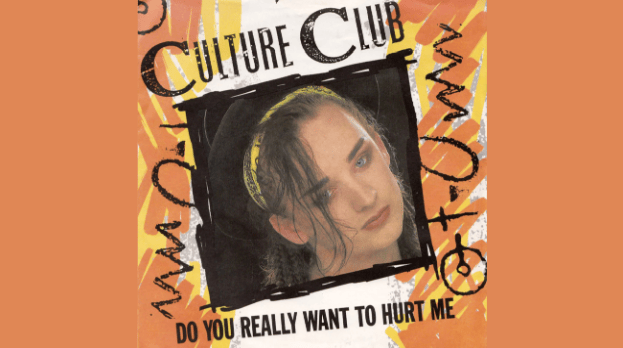
“Do you really want to hurt me? / Do you really want to make me cry?”
- Reached #2: March 26th, 1983
- Number of Weeks at #2: Three Weeks
- #1 Song At the Time: “Billie Jean” – Michael Jackson
“When do the eighties become The Eighties(tm)?” That’s the big question I’ve been trying to answer in the first half of this project. At what point have we completely left all trace of the seventies behind and enter into a completely brand new world? I know the cultural moments that get thrown around and get used as an argument for when the eighties “really start” (MTV’s launch on August 1st, 1981, Michael Jackson releases Thriller, etc.), but when do the number two songs start reflecting “The Eighties,” the parts of the decade that everyone romanticizes? To figure it out, I made this decision: The eighties can only truly begin when this project encounters someone who could not have gotten big and successful during the seventies. Bonus points if it’s someone who wasn’t even really active in music during the seventies. It has taken twenty-five entries, but I believe I have finally figured out when that moment happens for the number two hits: Culture Club.
Culture Club arrived in the early eighties and got huge during the only time it could have feasibly happened for them. If they had been any earlier, it wouldn’t have happened. I think people would have found them too offputting, weird, and trying too hard to recreate the glam rock of the early-to-mid seventies. Plus, very early MTV wouldn’t have known what to do with them. If they showed up any later than 1982-83, the game would’ve changed and they would have seemed old hat. It wouldn’t have happened for them. I imagine Boy George would’ve gotten called a Cyndi Lauper cosplayer. No, their moments of success happened at the perfect moment, the only moment it could have. Culture Club, led by their one-of-a-kind frontman, Boy George, battled through the rampant homophobia of his time, paraded a new kind of fashion and style that Americans hadn’t quite seen before, and weaponized MTV with pure charm during a time when the network needed unique characters that could captivate television audiences. During the early years of MTV’s dominance, there was a second British Invasion happening, and Culture Club were power players during that moment. The British artists were engaged in a new kind of fashion and style that made Americans look like a bunch of squares. “Do You Really Want To Hurt Me” was Culture Club’s breakthrough moment in the United States and established their brief flirtations with Hot 100 dominance. But forty years later, that breakthrough moment rings hollow. “Do You Really Want To Hurt Me,” along with most of Culture Club’s work, is a masterclass in style over substance. Culture Club was a group meant to be seen, not heard.
The story of Culture Club begins with the New Romantics (not the Taylor Swift song), an English subculture and fashion movement that took hold in the late seventies and early eighties. It grew out of the nightclub scene in London and Birmingham. Characterized by flamboyant and eccentric fashion mimicking the romanticism period of the eighteenth century, androgynous makeup looks, and anything that made the wearer look unusual and striking. If your fashion choices and makeup looks made you look anything like a gay pirate, you were probably doing the whole New Romantics thing correctly. They basically looked at the fashion of the glam rock era and picked up where the likes of David Bowie, Marc Bolan, and Roxy Music left off.
It needs to be noted that the late seventies and early eighties were not a great time to be coming of age in Britain. At the end of the seventies, the country had just endured what is known as “The Winter of Discontent,” a period that saw over two thousand private and public union strikes that caused a lot of public inconvenience set against the backdrop of the coldest winter the United Kingdom had faced in sixteen years. It’s a whole mess of a situation that eventually led to the victory of conservative Prime Minister and real life Wicked Witch of the West, Margaret Thatcher, who only made life a living hell for everybody. She goes far beyond this conversation. All you really need to know about her is that she’s to Britain what Ronald Reagan was to us. If you want to know how a good chunk of Brits feel about her, consider this: People rallied and made “Ding-Dong! The Witch Is Dead” a number two hit when she died in 2013. It became a number one hit on the Scottish Singles Chart. Couple the rise of Thatcher with intense racism and homophobia running rampant and it makes for a tough environment to grow up in. To my eyes, the New Romantics look like they were trying to escape all of that and find bright visions and ecstasy in a horribly gloomy time.
Though the New Romantics movement was primarily fashion-based, it bled into the English synthpop and new wave music of the early eighties. It became associated with a bunch of the new wave acts appearing on Top of the Pops or music videos. I always point to early Duran Duran as an easy example of what the whole movement looked like. Along with Culture Club and Duran Duran, groups like early Spandau Ballet, Berlin Blondes, Steve Strange/Visage, and Adam and the Ants (though Adam himself would disagree with you) were all lumped into the New Romantics movement. All of these groups could be seen at London clubs like the Blitz, which is where Boy George often found himself hanging out at.
Boy George–real name George O’Dowd–had been the second of five children born into a working class Irish Catholic family in Kent, then raised in Eltham, both in South East England. George grew up with an abusive father and also had the challenge of growing up gay in a really terrible time and bleak environment. You can imagine why he might have wanted to find escape from it all. He found that escape by being a regular at London’s Blitz.
One night at the Blitz in 1981, George caught the attention of Malcolm McLaren, the famous impresario and manager of groups such as New York Dolls, the Sex Pistols, and Adam and the Ants. McLaren liked him and George, performing under the lame Lieutenant Lash (which sounds like the name of a rejected Village People member), occasionally performed with Bow Wow Wow, the group McLaren was managing at the time. Bow Wow Wow is known in the United States exclusively for their cover of the 1965 Strangeloves song “I Want Candy” (which only peaked at #62, but it’s a song a lot of people would easily recognize). McLaren envisioned George as a possible second vocalist, but he apparently clashed with Bow Wow Wow lead singer Annabella Lwin (the first in a long series of pop music beefs for him) and set out on his own. He was gonna form his own band, which would end up going a lot farther than Bow Wow Wow ever did.
For this new band, he recruited bassist Mikey Craig and guitarist Jon Suede. They initially called themselves In Praise of Lemmings (not a terrible name, but it sounds like it should be the name of a hardcore band). That name didn’t last long. They changed it to Sex Gang Children, which is an absolutely awful name to go with. The band found a drummer in Jon Moss, who had played in bands like the Damned and Adam and the Ants. Jon Suede got replaced with guitarist Roy Hay and the band changed their name one more time after they found out there was another band named Sex Gang Children. This time, they changed the name to Culture Club, which finally stuck. They got the name from the band realizing that they had a decent amount of diversity between them. Boy George was a gay Irishman, Mikey Craig was a Black man, Jon Moss was Jewish, and Roy Hay was a blonde Englishman. Once formed, they got to work quickly.
They recorded a set of demos for EMI Records, but they got turned down. They eventually found a deal with Virgin Records and released their first two singles,“White Boy” and “I’m Afraid Of Me,” neither of which charted. I don’t care for them much. I just feel like I’m listening to an inferior version of the first Wham! album, which is Fantastic (that’s why the album is called that). Neither of those songs were going to make them big time stars. It was the third single, “Do You Really Want To Hurt Me” that did it.
You could make the argument that the song would have become a hit without any visual aids, though it would have had a tough road to do that. It was met with immediate dislike in the UK, but it maybe would’ve caught on with a bit of time. The truth of the matter is this: the song became a hit because everybody had seen the band on the popular British music show Top of the Pops and became both fascinated and curious about Boy George’s androgynous style and sexuality. His appearance on that show and in the tabloids launched the song to the top of the UK Singles Chart. Without that visual element, the song would have ended up nowhere, which is something I can’t say for anyone else we’ve covered so far. Make no mistake, it wasn’t like Boy George woke up one day and decided he was going to start wearing makeup, doing his hair up real funky, and dressing like that just to sell records. It wasn’t a costume or persona to him. He was living his authentic truth and I will not be dragging him for that. He clearly knew that music and music promotion was heading in a more visual direction and knew how to make it work for him and the band. Once they struck gold with “Do You Really Want To Hurt Me,” Culture Club had arrived. It was now time to try and plant their flag on American soil.
“Do You Really Want To Hurt Me” was the first Culture Club single that was released in America. Like the appearances on Top of the Pops, the song became a hit mainly through the music video that aired on MTV. Since the Brits had already been dabbling in the medium of music videos before MTV launched, a lot of British new wave acts already had videos ready to go and MTV was desperate for anything it could get a hold of. With that in mind, I imagine Boy George didn’t look nearly as weird to an audience that was already exposed to the likes of Adam and the Ants, Eurythmics, Duran Duran, and the Human League. They had time to acclimate and get used to the sight of a guy like him.
I listened to Culture Club’s debut album, Kissing To Be Clever, in preparation for this. It did not impress me much. I found it utterly dull at worst, passable at best. If anything, it reminded me that I should be listening to Wham! and Duran Duran, two groups I like a lot more. In fact, I find a lot of the band’s competition to be wildly more entertaining and interesting than them. I believe your enjoyment of Culture Club hinges entirely on how captivating you find Boy George. I don’t find him very interesting, so a lot of the album was a miss for me. “Do You Really Want To Hurt Me” is the album’s closer and by that point, I was bored and exhausted with them. I do not like “Do You Really Want To Hurt Me.”
I will give them this: They were certainly unique in terms of sound. Mikey Craig brought a reggae influenced, tropical, Caribbean kind of sound to the band and you hear that in full force on this song. They use synths like a lot of other groups, but in a smoother and non-confrontational way. I think they’re at their weakest when trying to make club music (that was the wheelhouse of early Wham!) but a lot better when they attempt a sound like this. Boy George also tries to sound like former You Got the Silver subject Smokey Robinson every chance he gets, which sets him apart vocally from the rest. Musically, Culture Club found unique ways to stand out, but without Boy George’s eccentric fashion sense and his ability to charm on camera, the shine of the music dulls very quickly. If Boy George isn’t on camera, isn’t seen, the spell doesn’t work. “Do You Really Want To Me” is a prime example of this.
I should make it clear that I am not the biggest reggae fan in the world. It’s a genre where a lot of it ends up sounding the same to me, despite knowing that isn’t the case at all. I fully understand why people love it, it’s just not my thing. I’m more of a ska fan. However, despite not being a huge reggae fan, I can tell you that white British people absolutely have no right making any kind of reggae music (especially UB-40). Even if the white British people in question have someone like Mikey Craig, it will still sound watered down, which is what this song sounds like to me.
That chorus gets annoying and utterly repetitive fast. It’s the most repetitive song I’ve heard in this project. I’ll admit it’s a great hook because the melody of 🎶Do you really want to hurt me / Do you really want to make me cry🎶 gets stuck in my head, but not in a fun way. I also couldn’t rattle off any words that come after that, even though I’ve listened to the song a bunch of times. It’s a smooth groove and I really like Mikey Craig’s bass playing (he throws in a lot of interesting little bits that keep me from losing my mind), but the whole thing eventually just fades into the background and doesn’t leave me with much to absorb. Smash Hits called it “weak, watered-down fourth division reggae,” when it came out and that’s exactly what it is.
All four members of Culture Club wrote the music, but it was Boy George who supplied the lyrics. Again, if you can’t see him performing the words and just have to listen to them, you find out very quickly that George is a chap who doesn’t have much to say that’s truly meaningful. The song is about the public rejection and victimization Boy George faced for his sexuality and gender expression. That’s where the intro and the opening lines “Give me time to realise my crime / Let me love and steal” comes from. It is also about Jon Moss, whom he was having a closeted relationship with during the band’s heyday. They were together for about six years. I would have more to say about the words, but they mostly just come off like poetic nothings to me. They’re gesturing towards something, but they’re ultimately empty and nothing about George’s words really compels me. If there’s any meaning the video had interest in latching onto and expanding upon, it’s Boy George’s identity being victimized and being viewed as something alien and strange. If this is a song about some kind of aching and pain, I don’t hear it. It’s too dull and drab to elicit any strong emotion.
We should talk about the video, since Culture Club is the first band I’ve encountered in this project where the video tells the entire story. This is the first time in You Got the Silver history that I have to issue a content warning: If you watch the music video for the song, which begins with Boy George on trial (presumably for engaging in activities of a homosexual nature), Boy George’s jury are all dressed as minstrels wearing blackface. I do not understand why they are all in blackface. In I Want My MTV: The Uncensored Story of the Music Video Revolution, director Julien Temple explained the choice:
‘Do You Really Want To Hurt Me? was about being gay and being victimized for your sexuality, which George was kind of emblematic of. It seemed appropriate to me that in the video he would be judged by jurors in blackface, to send up bigotry and point out the hypocrisy of the many gay judges and politicians in the UK who’d enacted anti-gay legislation.
I have read that explanation several times and I am still scratching my head in confusion. I know that all the jurors are Black actors wearing blackface, but I don’t think the idea sends up or points out anything bigoted or hypocritical. I think it just makes the band look fucking racist and stupid. I don’t know who in the everliving fuck told them or Temple that was a good idea. Americans had more shocked and negative reactions to blackface than the British did, so when the video was brought over to the boys at MTV, they had to edit all those shots out and replace them. I would have linked that version, but for some reason, that edit doesn’t seem to exist anymore. So if you plan to watch the music video, there’s a warning for you.
The rest of the video features Boy George being viewed as an outsider and being kicked out of several different historical eras. He is kicked out of the Gargoyle Club in Soho (London, not New York) in 1936 and the Dolphin Square Health Club, Pimlico in 1957, respectively. He sways and grooves, but nobody is buying what he’s selling.
Maybe it’s because I’m more than forty years removed from Culture Club’s big moment, but I truly don’t get what was so great about them. I understand the cultural context of nobody looking or acting like Boy George, I understand the ways they distanced themselves from their competitors musically, but as a whole, I don’t get why this is considered a classic eighties song I should love. The song is repetitive and boring as fuck, and anything about the video that was supposed to be subversive or shocking (besides the fucking blackface) is incredibly tame and normalized at this point. Yes, gay and transgender people are still very much being victimized and oppressed (they’re actively being killed at worst), but Boy George’s whole style and gender presentation isn’t a strange or weird thing to see anymore. I’ve seen a music video of Troye Sivan in full drag where he looks like a dream woman. I’ve seen Sam Smith and Kim Petras work together. I’ve seen every Chappell Roan music video. Nothing is strange to see at this point. I could go to a club in Philadelphia and see people who are doing way more provocative looks and style than anything Boy George was doing back then. So in that sense, I suppose there’s been a good deal of progress made in terms of music videos making expressions of gender and sexuality less taboo.
Culture Club got blocked from the top spot because Michael Jackson had officially established himself as the king. “Billie Jean” hit the top spot for seven weeks and put the world in a chokehold. It’s the definition of the word “game changer.” When the music video first aired, it transformed MTV from just a rock station to something that had the power and responsibility of spreading pop music across the land. Jackson forced his way in and told the studio rockers and new wavers that MTV championed to kick rocks and go fuck themselves. He changed and rewrote the entire rule book. He broke down the doors and got Black artists more prominently featured on MTV. He was undeniable. He couldn’t be stopped. This all sounds like intense glazing, but I promise it’s not. He really did all that. Watching that video, even now, there’s a sense that this guy was changing everything. The imagery of Jackson’s footsteps making the sidewalk light up, the swagged out suit, the backdrop of a city at dusk, the way he moves and spins, it’s all still incredible. The moment that really solidified him as the once and future king was when Jackson performed solo at the Motown 25 celebration event. He lip syncs to “Billie Jean,” which is still the number one song in the country (he didn’t do live vocals because the show’s producers felt the live band couldn’t do the backing track well enough). He’s on fire and dancing his ass off for the entire song, but the game changing moment happens when he stops, prepares, and then hits the moonwalk for the first time. You can hear people lose their minds in real time. This is all to say that Culture Club never stood a fucking chance against this guy. Nobody did.
Kissing To Be Clever ended up going platinum over here and in the UK, presumably on the strength of “Do You Really Want To Hurt Me.” I would tell you what happened to them next, but the Culture Club moment wasn’t over yet. They ended up scoring a second silver medal with the single that came immediately after “Do You Really Want To Hurt Me.” We will see them again in this project very soon.
Bonus Silver
Rita Coolidge recorded a version the same year Culture Club’s original got popular. Check it out here.
In 1991, Violent Femmes recorded a strange-yet-weirdly-good version of it for their fifth album, Why Do Birds Sing? Give it a listen here.
In 1998, Pras, the Ringo of the legendary rap trio the Fugees, sampled the song for the song “What’cha Wanna Do.” Pras never met an obvious sample he didn’t like. Ride with it here.
Adam Lambert, who looks like if I yassified Boy George, recorded a version of the song for his 2023 album, High Drama. I really dig the arrangement of this one. Lambert turns the song into a slightly dark, techno-pop, futuristic kind of sound that’s honestly a lot better than the original. I like this one. Give it some love here.


Leave a Reply