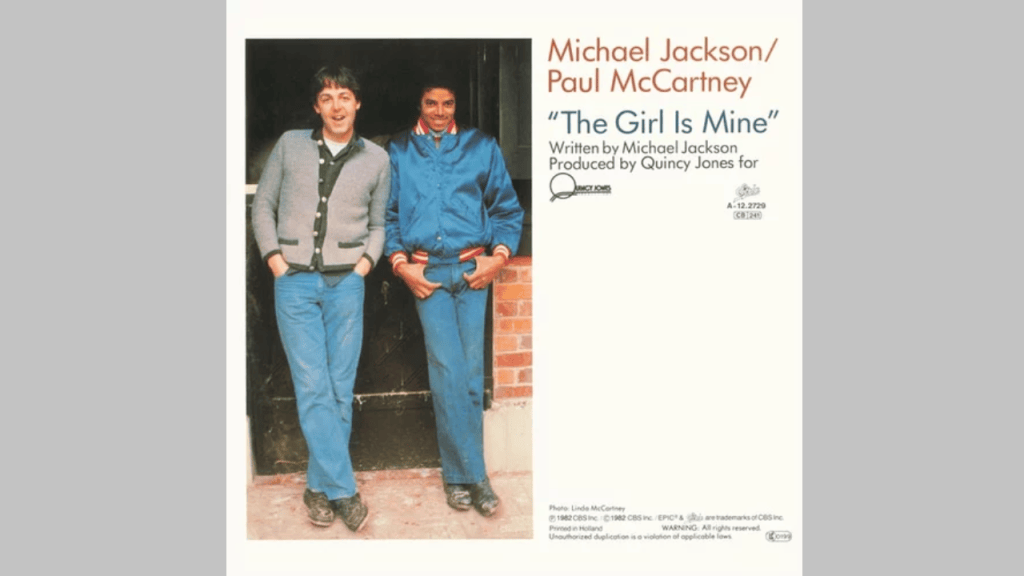
(“But we both cannot have her / So it’s one or the other / And one day, you’ll discover / That she’s my girl forever and ever”)
- Reached #2: January 8th, 1983
- Number of Weeks at #2: Three Weeks
- #1 Song At the Time: “Maneater” – Daryl Hall & John Oates (One Week) and “Down Under” – Men At Work (Two Weeks)
You knew he was gonna eventually show up. It was only a matter of time. Even in a project where we are only looking at silver medalists/first losers exclusively, the once and future King will not be ignored. He demands attention.
It is impossible to speak about Thriller, Michael Jackson’s sixth solo album released on November 29th, 1982, and not make it sound like you’re engaging in the extreme glazing known to man. There are few albums like Thriller and none of them have managed to do what it did. Thriller has nine songs on it. Seven of them were singles. Two of them were number ones, all of them were Top 10 hits on the Billboard Hot 100. By February 26th, 1983, it had hit the top of the Billboard 200 Album Chart. It went on to become the best-selling album in the United States for 1983 and 1984, making it the first album to be the best-selling album for two consecutive years. It also spent a record thirty-seven weeks at number one on the Album Chart, from February 26th, 1983 to April 14th, 1984. It has reportedly sold about seventy million copies total, making it the best-selling album of all time. To put it in perspective, Taylor Swift’s The Life of a Showgirl (all of its many variant forms included) sold roughly 6,050,000 copies. She would have to sell twelve times that amount to surpass what Thriller did. Even at her level of mega-stardom, she will never do that. Nobody can. Thriller has held that “best-selling album of all time” record for about forty years and unless all streaming platforms suddenly crumble and fall, causing us to become a culture that actually goes out and buys music again, it will continue to keep that record indefinitely. I reserve the term “game changer” for only a special handful of things in pop music history that truly deserve it. The Beatles deserve that term. Nirvana’s “Smells Like Teen Spirit” deserves that term. Thriller practically re-defined that term. To quote Stereogum’s Tom Breihan, “There is before Thriller, and there is after.”
Thriller did not achieve all of this overnight, but it must have felt like it did at the time. It came along and simply kicked down every door and roadblock in its way on the quest to supremacy. It rewrote the rules. It made the world bend to its whims. It forced MTV’s hand to start letting Black people on the channel and play ball with the pop music of the moment rather than cater exclusively to white rock bands. It transformed Michael Jackson from a pop star into something resembling a god. It was a pop culture phenomenon the likes of which we see maybe once in a generation, if we’re lucky. Paul McCartney, the former Beatle turned solo artist, was part of a giant moment like that once long ago, back when Jackson was nothing more than a small child. When McCartney and Jackson’s paths eventually crossed and the two struck up a friendship and brief partnership, McCartney got to play a small part in another giant moment.
If you had to guess which song was chosen to be the first of Thriller’s seven singles, what would you guess? You’d be forgiven for thinking he came out the gate swinging with the title track or “Billie Jean” or “Beat It,” but none of those songs were what started Thriller’s road to glory. Nope! It was “The Girl Is Mine,” the Michael Jackson and Paul McCartney team-up that most fans and publications tend to agree is the worst song on Thriller. I’m probably gonna have plenty of hot takes in this entry and here’s the first two: “The Girl Is Mine” is my favorite song on Thriller. I think it’s absolutely stunning and I am more than happy to offer up a defense as to why I love it so much. Michael and Paul each only got one silver medal as lead artist during the decade, but what a fucking song to get that medal for.
I’ve been so fucking excited to get to this one. I’m warning you now, this is gonna be a really long one. Both of these men are well known (Michael got a very successful biopic made about him this year, Paul is getting one as part of a four-film series about the Beatles) but we’re still gonna give them the treatment we give everybody here. The origins and histories of Paul McCartney and Michael Jackson in the years before “The Girl Is Mine” are incredibly storied, so this will not be the most detailed version of their stories. Since Jackson is the main artist on the song, we’ll start with him.
On August 29th, 1958, a young boy named Michael Joseph Jackson was born in the small town of Gary, Indiana, about two hundred miles from Seymour, Indiana, where former and future You Got The Silver subject John Mellencamp was born. Indiana seems to like naming towns with people names for some reason. Michael was the eighth of ten children and grew up on 2300 Jackson Street (a place you can visit. The Jacksons also have a whole song about it). Michael had five brothers: Jackie, Tito, Jermaine, Marlon, and Randy. He also had three sisters: Rebbie, La Toya, and Janet (who will eventually appear in this project). All of them are musicians of varying quality if we’re not talking about Michael or Janet.
The Jacksons all received a love of music from their parents, Katherine and Joe. Katherine could play clarinet, cello, and piano, Joe was a former boxer turned crane operator who could play guitar. The story goes that in 1963, Joe saw Tito starting to learn how to play guitar and started seeing musical talent in his children. Joe Jackson then put three of his kids together–Tito, Jackie, and Jermaine–and started entering them into local talent shows as the Jackson Brothers, with him as their manager. In 1965, Marlon and Michael, who was only about six years old at this time, were added to the group. With their additions, the Jackson Brothers became the Jackson 5 and started touring them around in talent shows where, according to famous rapper Freddie Gibbs, Michael cleaned shop and beat out competition like Gibbs’ father (who eventually became a member of the Chi-Lites in the late 2010s). They also started touring the R&B circuit, serving as the opening act for artists like Gladys Knight, Etta James, and Bobby & the Vancouvers. They slowly gained more attention and notoriety.
This is the part where I will tell you that Joe Jackson is probably the most evil talent manager/showbiz father in all of pop music. I think the only dude that could compete with him is Murry Wilson, the father/manager of the Beach Boys. Like Wilson, Jackson was a bastard that demanded absolute perfection out of his children, using any method possible to get what he wanted and make them the most successful act in the world. To say he was abusive to his children is a huge understatement. If there was a way to abuse one of his kids (especially Michael), then he probably did it. Physical, emotional, mental. If you can name it, Jackson did it. Joe Jackson’s level of abuse makes the stories in I’m Glad My Mom Died look quaint. The stories of the gruelling rehearsals that lasted for hours, the name-calling, and the whippings young Michael endured during his Jackson 5 days is horrifying stuff. I wouldn’t wish it on anybody. I’m not gonna defend any of it, but I am going to tell you that I think I understand why he did it. I think Joe Jackson saw his kids and their early musical talent as his one golden ticket to escape a life of poverty, loneliness, and working class struggles that he had endured for his entire life, and decided that every tactic to escape that life was the ends justifying the means. That’s my two-cents on it and I’m probably way off. The Jackson family dynasty is a whole fucking mess of shit, from the bottom to the top. Every strange thing about Michael Jackson–the soft-spoken voice, the eccentricities, the cosmetic surgeries, anything else–can probably be traced back to something his father did to set that in motion. When your father is a man like Joe Jackson, how do you not end up with something being weird or wrong with you?
Back to the music. In 1967, Joe Jackson attempted to secure them a record deal that would take them to the big time. Gladys Knight sent their demo tape to Berry Gordy and Motown Records, which Gordy rejected. Gordy didn’t want any more kid acts after Stevie Wonder, the child prodigy at Motown who wasn’t seeing a ton of success, but showed promise. Give him some time and he’ll eventually go on a generational run. After Motown shot them down, Joe got them a deal with a label in Gary, Indiana by the name of Steeltown Records. It was through there that their very first single, “Big Boy” was first released in January 1968. It would eventually move 10,000 copies. It’s received new attention in recent days through being included in the biopic on Michael. He was nine years old when he recorded it and it truly is staggering how incredible he was at such a young age.
After a performance with Bobby Taylor & the Vancouvers, Taylor took another demo tape to Motown for Berry Gordy to see. Gordy’s mind was changed the second time and the Jackson 5 were officially signed to Motown on an exclusive seven-year deal on March 11th, 1969. Motown’s PR machine got to work and started advertising the group. In an attempt to get peoples’ attention, they invented a story that Diana Ross of the Supremes discovered the boys and took them under her wing. That’s why their first album is called Diana Ross Presents: The Jackson 5.
When the Jackson 5 got signed, Berry Gordy established a group of writers, producers, and arrangers who worked exclusively for the boys known as The Corporation, which consisted of Gordy, Alphonso Mizell, Freddie Perren and Deke Richards. The Jackson 5 could not have asked for a better quartet of guys, because it was through their songwriting that the Jacksons were able to make history. The first four singles the Jackson 5 released on Motown–”I Want You Back,” “ABC,” “The Love You Save,” “I’ll Be There”–were all number one hits on the Hot 100 in 1970, which is an insane feat for a group just starting to get national attention. The Corporation wrote all those except “I’ll Be There” and all four of those songs are undeniable classic heaters. They’re getting linked because if you somehow don’t know these songs, you’re gonna wanna fix that sooner rather than later. Even if the Jacksons hadn’t gone to do anything else, these songs would’ve been enough to create a lasting legacy. When “I Want You Back” hit number one, Michael Jackson was the first person to ever score a number one hit who was younger than the Hot 100 (the first Hot 100 chart was published August 4th, 1958, Michael was born a few weeks later). The kid was barely eleven and already scoring knockouts. He would keep finding his way back to the top many times over the years.
It was immediately apparent that Michael was the biggest star of the five. You’d have to be blind not to see that he had something special that none of his other brothers had. So, it should come as no surprise to you that it didn’t take long for little Michael to start making solo records. Until Off the Wall happened in 1979, Michael didn’t have much creative control over the making of his own albums. Most of the choices were made by Motown, Berry Gordy, and the Corporation. That said, Michael’s first solo album, 1972’s Got To Be There, has a good deal of solid hits and highlights, including a recording of former You Got The Silver subject Bill Withers’ “Ain’t No Sunshine.” He scored a silver medal in the seventies with a recording of “Rockin’ Robin” and hit #4 with the title track. He achieved more at twelve than you or I will ever achieve in our entire lives.
One of the most incredible things about going back and revisiting child Michael is hearing how mature of a performer he sounded from such a young age. I think that, more than anything, has always stuck with people. He just never sounded like a kid who was barely old enough to be in middle school when delivering these songs. He delivered songs like “Ain’t No Sunshine” like he was Bill Withers’ age and had lived those experiences, when that couldn’t have been further from the truth. Not a lot of kid singers have that.
Anyway, let’s talk about Michael’s first solo number one hit. You know which one it is. It’s the one where he sings the tearjerking ballad about his friend Ben, who happens to be a rat. It plays in the end credits of the killer rat movie Ben, which is a spinoff of another killer rat movie called Willard. I don’t know a single soul who has ever seen Ben, but I know plenty of people who know the song. It was a number one hit in 1972. The Corporation had written it for Donny Osmond (basically the white version of Michael before Michael became the white version of himself, he’s also someone who will eventually appear in this project) but Donny never got to record it because he was touring and nobody could reach him. They gave it to Michael instead, which was probably the smarter move. Michael was the better performer and considering everything we know about Jackson’s lonely childhood, I get the feeling that the song probably resonated with him in a way that it wouldn’t have with Osmond. I truly believe he could find kinship and form an emotional connection with a rat, like he’s Cinderella (the Disney version). There is no lyric in the song that confirms that Ben is a rat, so you’d be forgiven for wondering why people make rat-related comments if you didn’t know. Honestly, it only makes it funnier when you hear this very beautiful song and then remember that the only reason for the song’s existence is to play at the end of a schlocky killer rat movie from the early seventies. It’s just that Michael was so good that he could turn it into a hit.
The final big moments for the Jackson 5 come in the form of 1974’s “Dancing Machine” and 1975’s “All I Do Is Think of You.” You can start to hear them graduate and move on from the bubblegum soul they made their name on to deeper and funkier, more mature-sounding stuff that one could take more “seriously” than those earlier hits. The precocious kids in the Jackson 5 were now movers and shakers. They were proving they could do more than stuff like “The Love You Save” and “ABC.” The problem was that their contract with Motown wasn’t giving them much freedom. But when they were allowed to show off, especially Michael, it looked like he was performing some kind of magic. I’ve never seen someone hit the robot as smooth as he does. It’s just incredible to watch him work.
By 1975, Michael and his brothers had outgrown Motown and Motown was outgrowing them. While Michael credited Motown for teaching him everything about writing, producing, performing, and making albums, he and his brothers wanted creative control over the music they were making. They were hungry for it, but Motown wasn’t giving it to them. They would eventually get it, but it was a long road that was gonna take a few more years… Oh! And they also left Motown because their contract was expiring and they found out they were only making a 2.7% royalty rate for every record sold. In the event you’re not good at math, that’s utter dogshit, especially when you’ve sold as much as the Jackson 5. They were getting a shit deal.
So, the Jacksons announced they were leaving Motown. This news was basically like when Zayn announced he was leaving One Direction. There’s a story in Spike Lee’s excellent 2016 documentary Michael Jackson’s Journey From Motown to Off the Wall about how Michael had to be the one to face Berry Gordy and tell him they were leaving, because of course they sent the guy with the most timid speaking voice that sounds like a wounded bird to go tell him that. The boys were planning a move to Epic Records, which happened when they joined the label in March 1976. Gordy retaliated against this by filing a breach-of-contract suit against them. Spoiler: He won that battle and became the legal owner of the name “The Jackson 5.” OH NO! Whatever will they do!? Epic just changed them to “The Jacksons” and kept the party going that way. It’s like going from the name “Jefferson Starship” to just “Starship.” Not a whole lot changes, really.
Except! There was one major change. When the boys moved from Motown to Epic, Jermaine Jackson stayed behind, which meant that Randy Jackson (not the one who used to be a judge on American Idol) got promoted. I like to imagine that he got promoted to the title of “Official Brother” or something like that. Jermaine stayed behind for a few reasons. The first was that he disagreed with the move itself. He felt that you don’t go and bite the hand that’s kept you fed for so long, which is fair and understandable. The bigger reason was that Jermaine was married to Berry Gordy’s daughter, Hazel Gordy, and he thought jumping ship might make things a bit awkward, which is also fair. Granted, I think him cheating on her several times with a side piece probably made things more awkward than hopping to a new record label, but who’s to say? Regardless, the newly christened Jacksons got a name change and a new brother added to the fold, but still not a ton of creative control.
Freed from Motown, Michael and his brothers went on to spend the next two years in the hands of Philadelphia International, the headquarters of Philly soul architects Kenny Gamble and Leon Huff. Gamble and Huff wrote and executive produced the Jacksons’ 1976 self-titled album and 1977’s Goin’ Places, which is a funny name, considering that album did not do that at all. On a positive note, the boys did end up scoring a Top 10 hit with “Enjoy Yourself” and a Top 40 hit with “Show You the Way to Go,” but not much beyond that.
I make fun of Goin’ Places, but it did have something that no other album before it had: two songs written by the Jacksons. Those songs were “Different Kind of Lady” and “Do What You Wanna.” They were both album cuts and neither are super remembered, but it does give some insight into the kind of disco and dance music they were into and it showed a bit of what they could do if somebody would let them call the shots for a change.
So, when Motown stifles you and Gamble & Huff can’t really get you to the kind of greatness you want, what else is there to do? You say fuck it and finally take the reigns of destiny into your own hands. Which is exactly what Michael and his brothers would do.
1978 is one of the most important years of Michael Jackson’s creative life because it sets the stage for everything that happens in his solo career going forward. In 1978, Michael played the Scarecrow in Sidney Lumet’s film adaption of The Wiz, the 1975 Broadway show that reimagines The Wizard of Oz as an all-Black musical. The music and the show is great, but I don’t like the film, mostly because Lumet was a terrible choice for director (the “Ease on Down the Road” segment in particular irks me because it’s directed like a high schooler was told to hold an iPhone steady and to never move a muscle). The Wiz is mostly important to Michael’s story because it’s where he connected with the man and musical partner who would eventually help him bring Thriller to life: Quincy Jones, who worked on the music for The Wiz. The two had met briefly once at a party held by Sammy Davis, Jr. when Michael was twelve, but didn’t meet again until both of them were attached to The Wiz.
1978 was also the year that Michael and the Jacksons got the creative control they had longed for. When the brothers went to record their album Destiny, which came out in December of that year, they were finally allowed to make the music they wanted to make and make their own creative decisions. Those decisions paid off. “Blame It On the Boogie,” an essential disco heater, became a #3 hit on the Billboard R&B Chart, while “Shake Your Body (Down to the Ground)” became a Top 10 hit on the Hot 100. “Shake Your Body” is a hell of a track and one can hear it as a sort of precursor to what Michael was about to do in his own solo career, which he was about to take full control of.
Right after Destiny came out, Michael began work on what would become Off the Wall, the solo album that would reintroduce Michael Jackson to the world and show people that they were no longer dealing with the kid, they were looking at the man. When Michael sought out a producer for the album, he asked Quincy Jones if he could recommend anybody whom he thought would be a good choice. Jones threw out some names, but eventually offered to do it himself. Jackson accepted and the two entered into an artist/producer partnership that would last the entirety of the eighties. The result of their early time together became Off the Wall, released on August 10th, 1979, just shy of Michael’s twenty-first birthday and one of the greatest party albums of all time. The album starts with the first two singles that reintroduced the man who would become king and became number one hits: “Don’t Stop Til’ You Get Enough” and “Rock With You.” Let’s get one thing established right away, “Don’t Stop Til’ You Get Enough” is one of the greatest songs ever recorded. It’s a perfect song. It’s all the best parts of disco, funk, and R&B all rolled into one. That “WOO!” at the beginning of the song is one of the greatest moments in pop music history. The mousy little whisper speech that Michael gives right before the spirit works through him is just incredible. I don’t know what “force” Michael is talking about in the song, but I feel it through him. I can only describe the song as “euphoric.” It’s the kind of song that takes you to another dimension, a space where only that song exists. You give into its power and you let it take you away. It doesn’t give you a choice.
“Rock With You” is just a stunning R&B dance track that sounds like heaven. It sounds like Friday night romance under neon lights. Every part of it is perfect and undeniable. Producer/songwriter Rod Temperton’s pen was on fire when he was cooking up this one. Hell, just the amount of songs that have sampled that opening drum bit is staggering. Even more staggering is that he scored these two number one hits after Disco Demolition Night happened and disco was being chased off the charts. These songs endured because they’re more than just disco hits, but it speaks to the sheer quality of these songs that they thrived after an event like that. They were too good to ignore. You were looking at the man.
But wait! There’s more! Off the Wall still had gas in the tank. “She’s Out of My Life” and the title track were both Top 10 hits on the Hot 100. I don’t care much for “She’s Out of My Life,” but “Off the Wall” is fantastic. The bridge to that song is unreal. The fifth and final single, which was not a song that charted, was a song called “Girlfriend,” written with Michael in mind by former Beatle and at-the-time leader of Wings, Paul McCartney. Wings recorded the original, which I think is fine, though Michael did the superior version. It was a track Quincy Jones had heard and suggested, not knowing that McCartney had written it with Michael in mind. This marked the first time Jackson and McCartney’s paths would cross musically. It would not be the last time.
Off the Wall did about as well as an album could in 1979. It sold around twenty million copies and established Michael as one of the hottest stars of the moment, but Michael wasn’t satisfied. Despite all of the success Off the Wall enjoyed, Jackson didn’t enjoy success at the 1980 Grammy awards. “Don’t Stop ‘Til You Get Enough” won Best R&B Vocal Performance, Male (and was nominated for Best Disco Recording) but nothing else. Any source that claims Off the Wall was nominated for Album of the Year in 1980 is lying. It wasn’t (the nominees were: Donna Summer’s Bad Girls, Kenny Rogers’ The Gambler, Supertramp’s Breakfast in America, and The Doobie Brothers’ Minute By Minute. Billy Joel’s 52nd Street won.) The lack of nominations and recognition from the Recording Academy is an important part of Jackson’s story. It pissed him off and he felt slighted. He and Quincy had made one hell of an album together and it saw massive success. He believed it deserved to be in competition for Album of the Year and felt the industry still didn’t take him seriously because they refused to stop seeing the cute kid from the Jackson 5. Hot take: Those Album of the Year nominees are all incredibly solid albums. That Grammy consideration period had a lot of great stuff that could have been contenders. Personally, I don’t know why Jackson felt like he needed recognition from the Recording Academy and the Grammys, but maybe I just think that because the Grammys haven’t truly mattered one bit since before I was even born. But it mattered to Jackson. After that show, Jackson vowed that he would never be embarrassed like that again. The next time he released an album, it would be recognized and then some.
Jackson went back to the drawing board and started imagining an album so fucking good that every song on it could be released as a single and become a hit. That didn’t happen, but he got real fucking close! (Seven out of nine.) In order to do that, all he had to do was make the best-selling album of all time. Sounds crazy… you know, until he actually fucking did it. The first single released from Thriller “The Girl Is Mine,” the first song recorded and completed for the album and the first of three collaborations between Michael and Paul McCartney that was released (“Say Say Say” and “The Man” were the other two, they were recorded before “The Girl Is Mine,” but both came out in 1983). But before we talk about the song proper, we need to introduce Michael’s friend and romantic rival on the song.
James Paul McCartney: singer/songwriter, bassist, guy who explodes on stage every night, and my favorite Beatle. Hell, probably my favorite musical artist, to the point where I have a portrait of him made out of Legos. I absolutely love this guy and I’m very excited to get to write about him here. Let’s go.
Sir James Paul McCartney was born in Liverpool, England, on June 18th, 1942, sixteen years before Michael Jackson showed up. His father, Jim, was a pianist and trumpet player who led Jim Mac’s Jazz Band in the twenties. McCartney taught himself piano by ear and guitar when he was a teenager, inspired by a love of American artists like Little Richard and Buddy Holly. McCartney famously lost his mother, Mary, at age fourteen to an embolism while getting breast cancer surgery. The death of McCartney’s mother would be his first great loss. It wouldn’t be the last.
On July 6th, 1957, Paul McCartney met the man who would become his musical soulmate, John Lennon, a day so important there’s a special plaque for it. They met during a show Lennon was playing with his band, the Quarrymen, at St. Peter’s Church Fete in Woolton, a suburb in Liverpool. Lennon and McCartney were introduced by Ivan Vaughan, a guy who sometimes played in the group. Lennon immediately felt a connection with Paul and offered him a spot in the group. Paul said yes and the rest is history. Paul would eventually bring in his school friend, George Harrison. The name eventually morphed from “The Quarrymen” to “The Beatles.” Harrison would eventually bring in Ringo Starr when original drummer Pete Best left the band. You know what happens next.
We’ve covered the Beatles twice now. The first time was when John Lennon appeared and the second was when George Harrison appeared. I won’t repeat myself too much here, but we’ll cover Paul’s time as a Beatle the same way we did the others. In the early days when the Beatles were treated like the world’s greatest boy band, Paul was deemed “the cute one.” It’s not hard to see why. There was a softness to him that Lennon and Harrison didn’t have. Lennon and McCartney were the twin flames of the band, but fans tend to agree that Lennon was more of the leader. That changed in the later years, when Lennon took a bit of a back seat and McCartney just kept driving the car as far as he could.
As a songwriting partner, McCartney’s greatest contrast with Lennon was McCartney’s uncanny ability to turn anything into a pop song. He could always make the seemingly mundane sound like magic. He was also a great experimenter, both in the Beatles and beyond. I have always described McCartney’s songwriting as unashamedly confident. It was a real “no pants, dick out” approach. He’s always struck me as a “try anything once” kind of creator. I don’t think he’s ever been truly ashamed or embarrassed about anything he’s ever done musically. We’re all better for it. He was much more musically adventurous than I think people initially gave him credit for, which is why it took so long for people to go back and really listen to his post-Beatles work and marvel at it. Yes, he was a writer of silly love songs and yes, sometimes the lyrics to his songs were sometimes glib, but he could be just as deep and artsy as John and George could be, could get just as strange and out there as those two did when he really wanted to. When I was growing up and listening to the Beatles for the first time, Paul was the one I latched onto. I could easily make a Top 50 of my favorite Paul contributions. Spoiler: most of The White Album would be on there, the entire second side of Abbey Road, and a bunch of Let It Be. I was a big 1967-1970 Beatles guy and still am, if you couldn’t tell.
When the Beatles were breaking up at the end of the sixties, it was Paul that clearly took it the hardest. From my view, it looked like John and George were done and had already been dreaming of lives outside of the Beatles and Ringo had made connections outside of the band that he could turn to if the shit hit the fan. All four struggled and floundered after the death of their manager/guiding light Brian Epstein, but it was John who clearly took it the hardest. In a short time, the man went through ego death, started focusing on his exciting new relationship with Yoko Ono (and his new pal, heroin), and started losing interest in the band (even though he was still contributing great stuff). That 1967-1970 period is mostly Paul in the driver’s seat. If anybody wanted to keep the Beatles together and working, it was him. None of his ideas worked. Things fell apart, the center could not hold, and the Beatles were done by the spring of 1970.
The Beatles broke up in stages between September 1969 (when Lennon told the other three he was leaving the band) and December 1974 (when the Beatles’ partnership was legally dissolved). As far as the public was concerned at the time, the Beatles breakup happened on April 10th, 1970, when McCartney issued a press release that he was no longer working with the Beatles. A week later, McCartney’s first solo album, McCartney, which he recorded in secret in late 1969-early 1970, was released. There was a point in time during its recording where he was going to call it I’m the One It Hit the Most, which should tell you everything he felt at the time. The entire album was written, recorded, and produced by McCartney, who played everything you hear on it. The only other credited musician is his wife, Linda McCartney (whom he had just recently married at the time). She mostly appeared to contribute backing vocals.
I like John Lennon/Plastic Ono Band. I think All Things Must Pass is probably the best thing George ever did outside of the Beatles. I’d even be kind to Ringo’s first swings post-Beatles. I place McCartney above all of them. I find it to be the most strangely compelling of them. That album is one of my favorite albums of all time. Instead of making a grand solo statement like John or George did, McCartney stripped himself, went back to basics, and started from scratch, which is what he envisioned the Beatles doing as a way to unite them again when they were making what became Let It Be. If you view McCartney’s time as a Beatle as getting married too young and then not knowing what the hell to do when it’s over and you’re left with nothing (he became a Beatle at eighteen, was twenty-eight when it was over), it becomes one of the greatest divorce albums ever; a portrait of a broken man trying to pick up the pieces and figure out what the next chapter is, if there even is one. McCartney was made up of acoustic guitar driven ditties, instrumental experiments, and songs that he obviously tried with the Beatles but didn’t happen. The whole album is basically that one joke from Parks and Recreation when Adam Scott’s character asks, “Could a depressed person make this?” It’s incredible. I never get tired of it. I could write ten thousand words about how good this album is.
Here’s something that might surprise you: this album was pretty disliked critically upon release. You want to learn something that’ll piss you off? Rolling Stone initially wrote a good review of it until founder, editor-in-chief, and eternal John Lennon dickrider Jann Wenner decided it should be re-written and that Paul should be punished for being the guy who broke up the Beatles. That’s one way you get a review that reads, “”Distinctly second rate.” The one in Melody Maker made it worse. “Sheer banality.” Ooof. That’s a stinger right there. One more! This is the best one. John Gabree, High Fidelity: “The only Beatle who has stagnated as a human being.” God damn!
That critical derision, which Paul endured a lot of in the early post-Beatles days, did not stop him one bit. He kept going and in May 1971, Ram, the only album credited to both himself and Linda, was released. Like McCartney, it was critically panned upon release, though most people nowadays will tell you Ram is one of the best things McCartney ever did post-Beatles. There were plenty of negative reviews, but Rolling Stone’s Jon Landau wrote the one that really captures how critics felt about it:
Ram represents the nadir in the decomposition of Sixties rock thus far. For some, including myself, [Bob Dylan’s] Self-Portrait had been secure in that position, but at least Self-Portrait was an album that you could hate, a record you could feel something over, even if it were nothing but regret. Ram is so incredibly inconsequential and so monumentally irrelevant you can’t even do that with it: it is difficult to concentrate on, let alone dislike or even hate.
McCartney scored his first solo hit when the single-only song “Another Day,” a great addition to the McCartney subgenre of “Paul sings about a depressed woman” song, peaked at #5 on the Hot 100 and earned a silver medal on the UK Singles Chart.
Landau continues that review with this:
[I]f it was Paul who used to polish up Lennon’s bluntness and forced him to adapt a little style, it is by now apparent that Lennon held the reins in on McCartney’s cutsie-pie, florid attempts at pure rock muzak. He was there to keep McCartney from going off the deep end that leads to an album as emotionally vacuous as Ram.
McCartney scored his first solo number one on the Hot 100 in September 1971 when “Uncle Albert / Admiral Halsey,” one of the most beautifully strange and wonderful pop songs to ever hit the top of the charts, climbed to the top of the mountain. This was somehow on the same album as a track as offputting and weird as “Monkberry Moon Delight.”
One last bit from Landau. This is how his review of Ram ends:
McCartney and Ram both prove that Paul benefited immensely from collaboration and that he seems to be dying on the vine as a result of his own self-imposed musical isolation. What he finally decides to do about it is anybody’s guess, but it is the only thing that makes Paul McCartney‘s musical future worth thinking about and hoping for.
Of this, Landau is right. Paul has always benefited immensely from collaboration and others being in the room with him, helping to bring the ideas to life. Landau posits in his review that McCartney is unhappy in his role as solo artist. For a time, I think he was correct. McCartney didn’t seem to want to be a solo artist. He wanted to be a member of a band. So, he solved that dilemma by starting a new band. This wouldn’t be a supergroup. It would be a scrappy little outfit made up of people who weren’t really famous musicians. One of them wasn’t even much of a musician when the band got started. That band would be called Wings and through that band, McCartney would achieve a second wave of commercial success.
For the sake of brevity, I will not do the entire history of Wings. We’re gonna do a super truncated version. If you want the full history of Wings, a fucking great band that’s only just now getting a re-evaluation and new love, I recommend reading Wings: The Story of a Band on the Run, which came out earlier this year. It’s a fantastic oral history and worth it if you want the full-scope of Paul in the seventies.
Wings got started in mid-to-late 1971, right after Ram got finished. For Wings’ entire existence, the three core members were Paul McCartney (lead vocals/bass/piano), Linda McCartney (vocals/keyboards), and former Moody Blues member Denny Laine (vocals/guitar). They went through drummers and lead guitar players a bunch of times. I wasn’t kidding when I said Wings was a scrappy little outfit and not a supergroup. Paul was the only famous musician in it. Linda had no prior musical training and learned to play keys on the job. Denny Laine was part of the Moody Blues, but not the lineup that made that band famous. The drummers and lead guitarists that came in and out of the band were not super well known guys either. Even despite having a Beatle as the leader, that scrappiness makes them really endearing and inspiring. It took time for Wings to start flying high and they overcame a lot. Linda McCartney endured a lot of bullshit from the press about being in a band with her husband and not being a great musician (she wasn’t the greatest, but she got a lot better over the years!) and Wings was not immediately popular.
McCartney formed Wings as a way to start performing live and tour again, which is something he wanted the Beatles to do as a way to unite and keep them together. He had the idea of just showing up to pubs and clubs and doing little unannounced gigs. The other three never took that idea seriously. So, when McCartney formed Wings, they went on a tour that became known as “The University Tour,” where the band drove around in a van and just showed up at UK colleges, asking if they could set up and play on campus. That saga is a whole chapter in Wings: The Story of a Band on the Run and that’s worth the price of the book alone. That tour happened shortly after Wings released their debut album, Wild Life.
Wings found some early success through songs that got some buzz after being banned by the BBC, namely “Give Ireland Back to the Irish” (gee, I wonder why Britain would want to ban that one?) and “Hi Hi Hi” (God forbid a fella sing a song about smoking weed and getting his noodle wet). But the song that really gave Wings their big break was “My Love,” which hit number one on the Hot 100 in early 1973. It’s far from my favorite Wings song, but it’s still a good one.
The band got to enjoy success on the silver screen when they got to contribute the theme song to the newest film in the James Bond franchise: “Live and Let Die” (cue the explosion). That ended up being the only silver medal for Wings on the Hot 100, but they would soar higher soon. In fall 1973, McCartney wanted to record an album in an exotic location (he spent a good deal of the seventies doing this) and selected Lagos, Nigeria. Two of the five members didn’t want to go, so they quit and the album was made by Paul, Linda, and Denny. The result was Band On the Run, an album everybody tells me is the best post-Beatles album Paul ever made and also the best Wings album. It’s not, but I get why people think that. It’s the most well-known one and the one that sold the most. It’s an easy starting point and gateway into Wings. It had hits too! “Helen Wheels” (which was on the US version of the album) peaked at #10 on the Hot 100. “Jet,” a certified banger that has gone triple platinum in my home, peaked at #7. But the real triumph was the title track, a song that’s actually three different ideas/scraps all fused into one stellar track. I don’t like using the word “genius” often (I think it’s overused and wasted on the undeserving) but that’s the only word I can use to describe it. It shouldn’t work and yet McCartney somehow fused these three ideas into one cohesive song that just never gets old.
Wings hit their peak in the mid-seventies when they released their two best albums back-to-back: 1975’s Venus and Mars and 1976’s Wings At the Speed of Sound. Venus and Mars is my favorite Wings album, Wings At the Speed of Sound was an album I slept on for too long. When I think of Wings, I think of the band as it existed in that moment. The band scored another number one hit with the infectiously catchy, bouncy, and jazz-tinged “Listen to What the Man Said” and another one with “Silly Love Songs,” which contains one of McCartney’s greatest basslines and serves as his rebuttal against critics (including his ex songwriting partner, John Lennon) who claimed he only wrote sentimental, lightweight, silly love songs in the seventies. Wings At the Speed of Sound also had another Top 5 hit in the form of “Let ‘Em In,” which is probably Paul’s most nonsense song, since it’s just him listing some of his real family members that are paying him a visit. It’s probably the stupidest hit McCartney has ever made, but even with his stupidest or most glib lyrics, he sings them like he means them, which I believe is the thing that’s always made the difference. He writes about mundane things, but presents them like they’re the only things he’s ever believed in and sometimes downplays what he talks about what he’s doing musically. My online friend, fellow music nerd, and writer of things Kyrsten and I were actually talking about McCartney prior to me sitting down to write this. She offered her take on the man and I think it’s worth adding here, which she has graciously allowed:
He’s been underestimated because he experienced a lot of pop success, but that speaks more to his ability to communicate music, no matter how simple or complicated. A lot of the stuff he popularized isn’t super simple – it just feels simple. Bringing in classical knowledge here haha… It’s like listening to Mozart, where his stuff is so easy to listen to, but once you study it, you start understanding that it’s actually complex in its structure and harmonies. Anyway, Paul is the Mozart of the Beatles.
By the end of the mid-seventies, the success of Wings had made McCartney the most successful out of the four Beatles. Admittedly, it wasn’t hard. Lennon had left music behind to become a family man. Harrison more or less rejected the mainstream. Ringo was always destined to remain a cult favorite. The fact that McCartney could take a scrappy little band to greatness says something about his talents and abilities to keep his ear to the ground and ride with the changing times and trends.
After that mid-seventies peak, Wings started gliding low and eventually came down for a final landing. They became the Paul/Linda/Denny trio again for 1978’s London Town, an underrated and interesting little era in McCartney’s career. Fans online are constantly begging for that album to get the expanded re-release treatment. I doubt that will ever happen, considering that it was not a success in its time, critically and commercially. Regardless, that album contains “With a Little Luck,” the last time Wings ever hit number one and one of the best moments of Wings’ final years.
The final Wings moment was 1979’s Back to the Egg, which Wings: The Story of a Band on the Run revealed to me was apparently a bit of a nightmare to make. How much I enjoy that album depends on the mood you find me in, but one thing is clear: McCartney sounds fried and burned out on that album. Back to the Egg is one of those albums McCartney nerds online have loved trying to “fix” by rearranging the track listing and adding/removing songs (why the fuck was “Goodnight Tonight” not on that album?) to make it a more cohesive project. Regardless, you can kinda tell that by the end of the decade, McCartney was getting tired of having a band where the lineup was constantly changing. Other events would occur that would make a true blue solo career way more attractive to him. For starters, the biggest hit he had in 1979 was a song credited to him solo (even though Wings are in the video): “Wonderful Christmastime,” genuinely one of my favorite Christmas songs and I get why people dislike it (it’s the synths), but the moon is always right when I hear it.
After Back to the Egg was a commercial failure and McCartney got busted for marijuana possession right before Wings was supposed to tour Japan in January 1980 (it wasn’t the first time he was busted for having the reefer, read all about that here) he became disillusioned with the idea of Wings continuing. McCartney would officially break up the band in 1981, but I always say the band was done when McCartney got busted. Nevertheless, he started experimenting and working on material that was clearly different from what he was doing in Wings. Like he had done with McCartney back in 1970, he decided to just go off and go fucking nuts, producing and recording everything himself. The result was McCartney II, an album that really does deserve the title of “ahead of its time.” It had hits, such as “Waterfalls” becoming a #2 hit in the UK and the bouncy, jovial “Coming Up” hitting number one on the Hot 100 in the summer of 1980. Supposedly, John Lennon heard “Coming Up” coming from his car radio and said, “Fuck a pig! It’s Paul!” That song woke him up out of retirement and got him working again. But you know that whole story if you read the entry on “Woman.” In any case, those two songs were the hits… but that’s not what people remember about McCartney II.
Most people remember it for “Temporary Secretary,” the absolute epitome of “I guess you guys aren’t ready for that yet… but your kids are gonna love it.” There’s a whole decade’s worth of memeing that turned this song that nobody liked in 1980 and turned it into a song that people genuinely enjoy and love. I’m one of them. I’m also an infamous “a-Paul-ogist,” so take that with a grain of salt. Also, hot take, “Temporary Secretary” isn’t even the weirdest fucking thing on that album. You ever listen to “Check My Machine”? Paul was doing Gorillaz decades before that project existed. “Front Parlour” has him making Donkey Kong Country music years before the Super Nintendo was even a twinkle of a thought in Daddy Nintendo’s eye! “Bogey Music” is like if aliens discovered early rock n’ roll and decided to try it themselves. In short, listen to McCartney II if you like when Paul gets weird and out there. Critics hated it in 1980, but it’s because they feared it. They feared the boldness. Who can blame them? Who in 1980 was ready for shit like this?
By the end of 1980, McCartney was more-or-less ready to fully embrace a solo career. Wings was born because McCartney dreamed of getting back out on the road and having a band, but by the start of the new decade, Paul shifted priorities and things around him were changing. His kids were becoming teenagers and getting tired of travelling with their rockstar parents on tour or to exotic places for most of the year. They wanted stability. Plus, after the disillusionment of Wings’ final days and him getting arrested in Japan, McCartney had gotten sick of the whole idea of performing live and in concert. Linda McCartney not wanting to deal with the road life anymore was also a factor in Paul deciding to hang up public performance for a while. That’s all fine. Look after the family.
Another factor was that John Lennon was shot dead at the Dakota in New York City on December 8th, 1980.
We covered McCartney’s reactions to that death in the entry on George Harrison’s “All Those Years Ago,” so I won’t repeat myself here. The only new thing I’ll add is that McCartney was shaken up by the whole thing and was genuinely scared he might be next, so he put the recording sessions for his next album (1982’s Tug of War) on hold for about two months. Lennon’s death played another role in McCartney not wanting to take the stage for a while. Once McCartney returned and Tug of War was finished and released, he saw a good amount of success from it. McCartney had linked up with Stevie Wonder, another musical giant that he had admired since the sixties, during the sessions and the two scored a number one hit with “Ebony and Ivory.” They also did the song “What’s That You’re Doing?” together, a retro futuristic-sounding funk groove that will probably make you scream and holler in delight if “Ebony and Ivory” makes you roll your eyes. He also had “Take It Away,” which peaked at #10 and contains probably my favorite set of Paul and Linda vocal harmonies ever done. He had 10cc’s Eric Stewart hanging around with him in those days adding to it as well and you can tell, since it sounds like something you’d hear on a 10cc album. The final minute of that song is just pure bliss. The video is also gorgeous as hell. He was just so fucking good at this.
So, we are now finally at the point we need to be at. Having absorbed that entire story and Paul’s massive body of work pre-Thriller, you can see why Michael Jackson would’ve wanted to work with the guy, right? Like a lot of us, Jackson had been a big Beatles fan and admirer of their work as he was growing up, particularly Paul’s. After Michael had recorded “Girlfriend” for Off the Wall, he wanted to repay the favor of that contribution by working with McCartney on some new material. The story goes that Paul McCartney got a strange phone call on his private number. It was revealed to be Michael Jackson, whom Paul claims, in multiple places, asked him this question: “Do you want to make some hits?” I fully believe that’s what he said to him because he knew for a fact that whatever they did together would be a hit. McCartney obviously said yes and Jackson headed to Paul’s home in England, spending time with Paul and Linda and building a personal friendship, but also collaborating together at Abbey Road Studios. Three songs would eventually happen through their time as collaborators. Two of them ended up on Paul’s 1983 album Pipes of Peace, but we’re interested in the one that ended up on Thriller: “The Girl Is Mine.” It would be the first song recorded for the album.
Here’s the song’s origins: Quincy Jones told Michael to write a song about two men fighting over a girl. He had a bolt of inspiration one night and got most of the ideas down onto a tape by singing the different parts orally. Jones’ other request was that Michael should add a rap verse (he didn’t do that, but there is a spoken word section towards the end). Michael’s original demo was done at Havenhurst, the Jackson family home, in 1981, when he was getting the ball rolling on the material that would end up on Thriller. Since Thriller is, as we’ve mentioned, the best-selling album of all time, that demo exists and can easily be found (along with everything else that was ever considered for the album) on Youtube.
There are a number of obvious differences between the demo and the finished song on Thriller. For starters, McCartney hadn’t been brought in yet, so it’s Michael voicing both parts. The intro is different, with a heavy guitar riff that will be replaced with something smoother on the finished track. Michael sings it in a higher key. There’s an emphasis on strings, which will be more or less gone when the final track replaces most of them with keyboards. The arrangements are more sparse and open, where the finished song will have a more constant beat, added keyboards, more guitar and bass parts. The end of the bridge–Michael’s whole “But we both cannot have her” part–is unfinished. It doesn’t have the outro that will end up on the finished product. It’s a fascinating demo, the kind that’s actually interesting and offers a window into the different directions the finished song could’ve taken. I have seen plenty of people online argue that this is the superior version and I don’t agree with that at all.
People tend to not like this song because they think Paul McCartney is a bad (or corny) addition and think it would be better if it was just Michael. These people are wrong. “The Girl Is Mine” needs somebody for Jackson to work off of in order to sell the song’s idea of two guys fighting over a girl. Michael on his own just doesn’t cut it.
Besides, McCartney and Jackson have great chemistry together. Their voices blend well together (the harmonies on this are gorgeous!) and McCartney matches Michael’s playfulness while also being a perfect foil to him. Michael is the young, energetic, sentimental, and hopeless romantic lover boy who is fully smitten and excited about how the doggone girl is his. There’s a wholesome earnestness to him that I think he only could’ve summoned as a twenty-four year old and that contrasts greatly with McCartney, who was sixteen years older and brings a different kind of character to his part. McCartney sings with a certain maturity that Jackson’s voice didn’t have. He’s smooth, charming, experienced, secure in the notion that the doggone girl is his and not Michael’s. He makes for an interesting romantic rival. The charming lothario just on the cusp of middle age vs the charming young hero with a heart full of passion and desire to win. It’s a winning combo and I truly don’t get why people think this doesn’t work. The difference in age, maturity, and performance really makes the two characters distinct, which is what you need in order for this song to even work. It also helps that Jackson picked somebody who was more or less his equal when the song was made. Jackson was one of the hottest stars of the moment and McCartney had been a long-respected hitmaker for most of Jackson’s life. If he was gonna compete with somebody for a woman’s affections, Paul McCartney is a worthy adversary. I truly can’t think of any other person Jackson could have chosen. McCartney had the sauce that Jackson wanted.
I have four theories as to why McCartney was the guy Jackson picked as a duet partner for this, besides wanting to pay him back for providing “Girlfriend” for Off the Wall. More than one of these can be true at once. 1) Jackson and McCartney had already recorded two songs together (“Say Say Say” and “The Man”) and knew they already had something good going. They were friends by the time they linked up for this. 2) In the early eighties, two superstars teaming up on a single basically ensured good numbers. Just ask former You Got The Silver subjects Grover Washington, Jr. and Bill Withers, Diana Ross and Lionel Richie, Barbra Streisand and Barry Gibb, Stevie Nicks and Tom Petty. Hell, McCartney saw that trick work with “Ebony and Ivory,” so Michael must have taken notes from that single’s success. 3) Michael wanted to break into the mainstream (read: White America) and become the biggest star on the planet, so he needed a white guy to help give him the co-sign and McCartney was the best candidate in his world. 4) It’s a flex and an interesting move when beginning to roll out an album. How many people can boast that they have a Beatle as a feature on their album? Regardless of the driving reason, both men benefitted from the collaboration.
McCartney wasn’t the only superstar that showed up for this. The personnel list for this song alone is insane. First off, we’ve got four Toto members playing on this: David Paich, Steve Porcaro, Jeff Porcaro, and Steve Lukather (I warned you they’d show up again!) Keyboardist and industry veteran Greg Phillinganes is on the Rhodes. Louis Johnson of the Brothers Johnson is on bass. Rounding it out, David Foster, the certified hitmaker and superstar producer who had already been building a name for himself as one of the best on the west coast by this point, is here playing synths. Paich helped Quincy Jones with the rhythm arrangements, Foster helped out on the synth arrangements. The remaining string arrangements you hear were arranged and conducted by industry veteran and frequent Jackson collaborator Jerry Hay. If you know nothing else about the making of Thriller, at least know this: Michael Jackson assembled the best of the best for this. His talents as an entertainer are without question, but one skill he had that never gets talked about is his DJ Khaled-esque ability to assemble the best team possible for the best results. There’s a real talent in knowing who to bring in to make things happen. Jackson’s fanbase is so rabid to only look at Jackson as a singular architect that they overlook the man’s talent for collaboration and his savviness when it came to knowing who would be able to help bring this music to life.
The results speak for themselves. This track, like the rest of Thriller, still sounds unbelievable to this day. Michael’s Havenhurst demo is fine, but it sounds stuck in a specific moment, namely the late seventies sensibilities that were present on Off the Wall. He hadn’t found the specific sounds and aesthetics that would become Thriller yet. He found it by the time “The Girl Is Mine” happened.
This entire song sounds like magic. That’s the best way I can describe it. It sounds like how the stars look on a clear night, they’re vibrant and sparkling. It sounds like romance and the joy of being in love. It sounds like how it feels to stroll down a city street in the early nighttime, seeing the neon lights turn on and the city taking on a whole new feel as the nighttime beauty starts to take over from the aesthetics of the daytime. I always think of Thriller as a nighttime album, with its best tracks (and rejects) bringing to mind images of the night, neon lights, the city, and the moon and stars. Maybe it’s because “Thriller” was recorded as “Starlight” at one point. Regardless, “The Girl Is Mine” is a night song to me, with all the romantic nighttime imagery of the city life attached.
I love the little glittery glissando that appears at the beginning of the song before the first verse and the spoken word outro. It’s a small detail that I love every time. The entire groove–the beat, the guitars, the keyboards–is relaxed and smooth as hell and I never get tired of it. It moves like a brisk walk, which helps me picture Michael and Paul arguing and having their debate while strolling down the street. The way the backing vocals chime with “mine, mine” right before the spoken word part are lovely. On the album, it’s a good comedown after the explosiveness and energy of the previous two tracks, “Wanna Be Startin’ Somethin’” and “Baby Be Mine.”
If I had to say why this song sounds like magic, it’s the keyboards. Thriller ended up finding specific keyboard sounds and aesthetics to the point where you don’t have to be a detective to know if you’re listening to something Michael recorded during the making of Thriller (or right after). The keyboards are usually a good tell. I don’t know. There’s just something about them that’s so incredibly pleasing to me. They just sound magical. The groove that runs during Michael and Paul’s spoken-word debate is just heavenly. I get lost in it. The way the keys are employed throughout the song without overpowering the overall groove helps the song retain a timeless quality. Like Michael and Paul having a generational gap, the song’s aesthetics have generational gaps as well. Strings and a piano are dancing with keyboards the same way a sixties star is linking up with an eighties king. It’s a new sound for an age old idea, which is two guys fighting over the love of one girl.
Lyrically, it’s a very lighthearted battle, which is fitting for Jackson and McCartney’s personas as charming, likeable, respectable lads. They’re the only two guys in music who could reasonably get away with a line as cornball as “the doggone girl is mine.” That line is so funny to me. He would eventually introduce swears into his music during the nineties, but Thriller-era Michael seemed to prefer words like “doggone” and “dimwit.” Interestingly, the lyrics have McCartney playing against type a little bit. The silly love songs guy should be delivering lines like “Every night she walks right in my dreams / Since I met her from the start” or “And one day you’ll discover / That she’s my girl forever and ever,” but instead, he’s the guy delivering the disses. It’s a little odd to hear a romantic like McCartney deliver something like “Sending roses and your silly dreams / Really just a waste of time,” but he sells it. The two bounce off each other and pass it back and forth effortlessly. That chemistry and the camaraderie they had built up in real life translates to the track, where the two really sound like two competing cassanovas who are less interested in scoring the girl in question and more interested in which one of them will win her.
The bridge in this song is one of Thriller’s best moments. Both men are passing it back with expert precision and the harmonies are beautiful (“I love you more than he” 🎶take you anywhere🎶, “Well I love you endlessly” 🎶Loving we will share🎶) and then Michael just takes center stage and truly delivers, dialing up the intensity and just going for it when he explodes with, “But we both cannot have her / So it’s one or the other / And one day you’ll discover / That she’s my girl forever and ever.” The way the strings swell and the way the backing harmonies “ahhh” and “ooooh” is just magnificent. That’s what the bridge on the original demo was missing. It was missing that final, passionate moment where Michael just lets it all out and reminds McCartney he’s the main artist on the song. The two men are equals for the whole song until that moment and McCartney just lets him have that moment to shine. That bridge is what the whole song builds to and it’s just bliss. I don’t understand why people think it’s the weakest song on Thriller and I never will (if you’re curious, I hold the unpopular belief that the weakest song on Thriller is “Human Nature,” a song I do not like at all).
We should talk about the spoken word part. If there’s any part of this song that gets memed on in the modern day, it’s that part. People on TikTok make a lot of edits to that part of the song (and sometimes put up a poll asking if you would choose Paul or Michael; Michael tends to win those). I get it. It’s the cutest part of the track and the way the two playfully argue with each other is one of the moments where I think you can really tell these two were genuine friends at one point instead of two superstars collaborating on a hit single. There’s a bunch of good lines to quote and poke fun at. “Paul, I think I told you, I’m a lover not a fighter” is the big one, but there’s also the Paul lines “Michael, we’re not gonna fight about this, okay?” and “I’ve heard it all before, Michael, she told me that I’m her forever lover.” The best bit is right after Michael, at his most charming, says, “Yeah, she said it, you keep dreaming,” and Paul follows it up with the smoothest “I don’t belieeeve it” possible, proving that, yes, a white boy can be soulful (just a little, as a treat). It’s fantastic. If you don’t love this, then I can’t help you. I’m sorry. This shit is just lovely, incredible, next level stuff. Two pop icons I enjoy teamed up and I enjoy the results. A lot. This shit is keeping my crops alive through the toughest winter. It’s reminding me about the beauty in the world. It’s reminding me that I’m the only one in my girl’s heart and wouldn’t leave me for Michael or Paul (it probably helps that one of them is dead and one of them is old as sin).
I would talk about the music video for this song, but this is the rare Jackson single that doesn’t have one. We’ll eventually touch on the Thriller songs that did get videos when Jackson returns in this project. But what we can talk about is this: there were two songs that prevented “The Girl Is Mine” from hitting the top spot. Those two songs were “Maneater” by Daryl Hall & John Oates (two men who will eventually appear in this project) for one week and “Down Under” by Men at Work for two weeks. I can explain why “Maneater” beat this song. Hall & Oates were on a really hot streak in the early eighties. We’ll cover the scope of that hitmaking run when they appear. The other reason is that they were successful (white) video stars on MTV, right before Jackson came along and completely rewrote the rules and changed the landscape. Again, we’ll cover all of that (including all the post-Thriller stuff) when Jackson reappears.
But this song getting the silver over “Down Under” by Men at Work? I got nothing. Jackson losing to that one might qualify as a hate crime of some sort. I suppose I feel that way because I cannot fucking stand “Down Under.” Not one fucking bit. That song is one of a rare breed: the kind of song that just pisses me off and puts me in a bad mood if I hear it. It’s mainly that flute riff that runs through the song. I hate it. I hate it. I hate it. Colin Hay’s voice has never sounded more dogshit than on that song. Just an obnoxiously awful song all around. There are plenty of great Men at Work songs, but I don’t know who the fuck would want to listen to that one. No thanks. This one deserved the gold.
Michael Jackson and Paul McCartney did eventually score a number one hit together: “Say Say Say,” released on McCartney’s 1983 album, Pipes of Peace. Most people tend to agree that it’s the best of the duo’s collaborations. It has a really great video too, with a fun concept of the two being “Mac & Jack,” two medicine show con men. Bob Giraldi, the same guy who directed Jackson’s video for “Beat It,” made it and you can tell Jackson was already on a hot streak as a music video artist by this point. I also think it’s hilarious (and a bit odd) that the woman Jackson makes eyes with in this video is his real life sister, LaToya Jackson. Also, the song is fucking great. Good piece of post-disco pop goodness.
The final collaboration between the two was “The Man,” a Pipes of Peace deep cut. It wasn’t a hit, but it’s a decent song. Cool, breezy, memorable, catchy, with a carefree atmosphere attached to it. It might be the only positive song ever written about “the man.” That was the last time Jackson and McCartney worked together before their partnership crumbled. Here’s the long and short of it: In 1981, McCartney explained to Jackson that he could make a good chunk of change by getting into music publishing. McCartney owned a good deal of songs, including “Autumn Leaves,” “Stormy Weather,” and the entire Buddy Holly catalog. This excited Jackson and Jackson joked about buying the Beatles catalog, which McCartney had lost in the sixties. Jump to 1985, when Michael is richer than God and the Beatles publishing is up for sale. There’s a whole long mess about how McCartney lost that that goes beyond this. What you need to know is this: The Moonwalker ended up buying the Beatles publishing. You can imagine that it would be difficult for Paul to remain friends with the guy who now owns his life’s work after doing that. For my two cents, I think it was a smart business move on Jackson’s part (Beatles = big money) but it’s definitely a betrayal and I do think Paul was right in his decision to be pissed and distance himself from Jackson. I know people always say, “Well, Paul did tell him to get into music publishing,” but I don’t think the guy ever expected his friend to say, “I’m buying your songs. Thanks for the extra income, pal.” Also, this is all a bunch of inside baseball bullshit that I don’t really care about. If you have any interest in learning all about that breakup, the Michael Jackson-themed Youtube channel the detail. has a whole video you can watch about it.
Thriller turned Michael Jackson into a supernova and we’ll catch up with Michael in a post-Thriller world in due time. But for now, I must attempt to sum up forty more years of McCartney. This will go fast, I promise. In 1984, McCartney ended up writing, producing, directing, and starring in a film called Give My Regards to Broad Street, a film with an incredibly flimsy plot about a day in the life of McCartney and the mystery of the tapes to his most recent album being stolen. It’s not a great film by any means, but it’s a fun watch. The “plot” feels like one of those dreams where you keep appearing in places and random people keep popping up and none of the events make any sense whatsoever. If the film does anything right, it creates that nonsensical dream atmosphere pretty well. It came at an interesting point in McCartney’s career. The plot of the stolen tapes is inspired by the real life incident of the original tapes for Band on the Run being stolen. Part of me thinks McCartney never got over that, so he vented that frustration when writing the script. You can also watch the film as a sort of mid-life crisis and desire to recapture the zaniness of the Beatles’ movie days, as well as Paul giving into the nostalgia of the Beatles through the new versions he recorded for the film. It’s not the worst film a musician made in the eighties (George Harrison joked that the Madonna/Sean Penn team-up for Shanghai Surprise made Broad Street look like an epic). I like the soundtrack a lot. I like the eighties update of “Silly Love Songs,” the version of “The Long and Winding Road” is my favorite take on the song (the saxophone really adds), and “No More Lonely Nights” is one of the best songs of the second act of McCartney’s career. David Gilmour from Pink Floyd shows up for the guitar solos on it and it’s just incredible.
That’s not the only music McCartney provided for films. In 1985, he provided the theme song for the Chevy Chase/Dan Aykroyd comedy Spies Like Us, which peaked at #7 and saw Paul entering into the absolute nadir of his career. He attempted to update his sound by employing Phil Collins’ regular producer Hugh Padgham, which was not a stupid move at the time, considering how insanely popular Collins was in both the US and the UK. The result was 1986’s Press to Play, McCartney’s worst selling album and one which is… well, let’s just say mid-eighties Paul is rough. However, I’ll give it this: it’s never boring. McCartney, no matter where he is in his career, has never stopped being the great experimenter. He just fucks around and plays around with whatever interests him and then leaves it up to you to determine the results. There’s plenty of good defenses out there of Press to Play and I have a fondness for tracks like “Good Times Coming/Feel the Sun,” “Footprints,” “Only Love Remains,” and hell, I’ll even go to bat for “Press” on a good day, which is Paul at his most mid-eighties. “Press” ended up peaking at #21, but it’s often considered McCartney’s darkest age.
McCartney spent the next few years in limbo, working to perfect the album that would save his career and undo the damage that Press to Play and his mid-eighties work had done. He brought in a number of big name producers like American hitmaker David Foster, and British producers Trevor Horn and Chris Hughes. He found a new songwriting partner in Elvis Costello, who was Lennon-esque to a certain degree and had enjoyed a good deal of success throughout the decade. There were also a few other things that helped stage the McCartney comeback. Most of them had to do with a second wave of Beatlemania that had built up over the years. Here’s what happened: The British Beatles catalogue (plus the American version of Magical Mystery Tour) was released on CD for the first time in 1987. The Beatles got inducted into the Rock and Roll Hall of Fame in 1988. Later that year, the release of Past Masters (which collected all the Beatles’ non-album singles and rarities) got released. Finally, Paul McCartney decided to stop running and fully embraced his Beatles heritage in 1989, which fully reignited the cultural conversation about the Fab Four. Oh! And also, McCartney happened to release Flowers in the Dirt, one of his best albums, in June 1989. I went back and listened to a whole bunch of McCartney in preparation for this and revisiting Flowers in the Dirt was such a treat. I absolutely fucking love that album. There are so many great tracks I could plug here, but I’ll restrain myself. “Rough Ride,” “We Got Married,” “Figure of Eight,” and “This One” are all certified heaters. Lead single, “My Brace Face,” which peaked at #25, is also fantastic. If you decide to check out anything from the second half of McCartney’s career, make it Flowers in the Dirt. It’s so good.
McCartney finally took his show on the road again after a decade, embarking on his first world tour since Wings did it in 1975-76. That’s chronicled on Tripping the Live Fantastic and it sounds like a hell of a show to have been in attendance for. That tour was when McCartney finally started getting comfortable looking backwards (he finally started busting out Beatles songs on the regular) and he settled into being a pop elder statesman, though that didn’t mean he didn’t stop creating. Heavens no! You wish!
Here’s the lighting round of McCartney in the nineties: He scored a UK Top 20 hit with “Hope of Deliverance.” He reunited with the surviving Beatles in the mid-nineties for the Beatles Anthology, which finished the two demos John Lennon left behind: “Free As a Bird” and “Real Love.” He released the album Flaming Pie in 1997, which saw him working with Electric Light Orchestra and ultimate Beatles fanboy Jeff Lynne as producer. I enjoy the songs “The Song We Were Singing,” “The World Tonight,” and “Beautiful Night.” The standout song is “Calico Skies,” probably one of the most beautiful songs McCartney ever wrote in a catalog full of them. I can’t ever hear it without thinking of it being Paul’s goodbye to Linda McCartney, who had been diagnosed with breast cancer (the same thing his mother died of) in 1995 and passed away at age fifty-six on April 17th, 1998. So it goes. It’s tragic to think about how he’s lived so much longer than the most important people (his mother, John Lennon, Linda) in his life.
Once he entered the twenty-first century, McCartney’s output slowed down as he started becoming more and more of a touring man. He’s never stopped putting out albums, he just does it whenever he feels like it now. In 2001, Paul released Driving Rain, notable for being the first album that featured Rusty Anderson, Brian Ray, Paul “Wix” Wickens, and Abe Laboriel Jr., the musicians that have served as his backing band up to the present day. Fun fact: Paul has been working with those guys longer than the Beatles and Wings’ lifespans combined. In 2005, he released Chaos and Creation in the Backyard, an album notable for being one of the few that he was not credited as a producer for. He gave that job to Radiohead and Beck producer Nigel Goodrich, who had the balls to actually challenge the Beatle on some of the stuff he was writing and working on at the time. The result is that Chaos and Creation is really good. If you don’t believe me, give a listen to “Jenny Wren,” “Friends to Go,” “English Tea,” “Riding to Vanity Fair.”
In 2007, McCartney released Memory Almost Full, an album I hadn’t heard in a long time and enjoyed going back to. “Only Mama Knows” gets stuck in my head, “That Was Me” rocks, and I think “House of Wax” is underrated. The one I remember the most is hearing “Dance Tonight” often. I heard it in an iPod + iTunes commercial that played a bunch. I heard it played on The Colbert Report. I heard it on the radio in a bunch of places. If I ever owned a mandolin, that’s probably the only song I would ever want to learn on it.
In the 2010s, McCartney found himself back in the Top 10 of the Hot 100 when he appeared with, I shit you not, Rihanna and Kanye West on the track “FourFiveSeconds.” I remember the randomness of that event. I didn’t remember the song though. It’s a solid track. Crazy to think how much has changed in ten years. McCartney has stayed consistent, but Rihanna’s probably never making music ever again and Kanye is… a whole fuckin’ mess that I don’t even keep up with anymore. I don’t want to know what’s happening in Kanye World.
In recent years, McCartney has still been working like a dog, touring and putting out the occasional album whenever he feels like it. He released McCartney III in December 2020. He’s lived long enough to sit and have an interview/chat between him and Taylor Swift, the only musician in the world that’s probably more documented than him. He’s played at Glastonbury. He’s been interviewed by Amelia Dimoldenburg, the Chicken Shop Date lady. He’s still making albums.
McCartney released The Boys of Dungeon Lane back in May of this year. I really liked it. It’s the only album in Andrew Watt’s quest to produce every ancient musician that I’ve really liked. He has a bad habit of sucking all the warmth out of a song, but that didn’t happen with Dungeon Lane (I imagine it’s because Paul still called the shots to a great degree). The standouts for me were “As You Lie There,” “Days We Left Behind,” “Home To Us,” “First Star of the Night,” and “Momma Gets By.” I don’t care if this sounds like glazing, he’s still somehow incredibly good at this music thing. If Sabrina Carpenter or anybody connected to Sabrina Carpenter is somehow reading this, I need to hear her do a cover version of “Ripples in a Pond.” It sounds like a track she would absolutely kill. Please! I will pay any price to hear that. I know she’s a big fan, so this won’t be a tough sell!
If you haven’t guessed by now, Paul McCartney will not return in this project. That’s fine. He’s lived one hell of a life. His body of work and the sheer quality of that work is simply insane. I have loved McCartney since I first heard the Beatles as a kid and that love will continue until I’m dead in the ground. Michael Jackson needed a little help from a friend to help introduce Thriller to the world. “The Girl Is Mine” was just a taste of what that album would do. Sure, people found it to be a weak track, but he needed people to doubt him. When the public least expected it, Michael opened fire and just completely reshaped the world, the same way McCartney had done in the sixties. Two giants walked the earth and their paths eventually crossed and the moment and the music that came from that was absolute magic.
Bonus Silver
Stevie Wonder took the hook and riff from “The Girl Is Mine” and turned it into “Fun Day,” a track from the 1991 Spike Lee joint Jungle Fever. I have never seen it, but I have heard the soundtrack. It’s Stevie’s best album after Hotter Than July. Give the song some love here.
Swanky lounge king Richard Cheese recorded a version of the song in 2005. He couldn’t afford Paul McCartney, so he had to find another guest. The guest he found is Stephen Hawking (celebrity voices impersonated). Listen for yourself here.
The 2008 Ashanti track “Good Good” interpolates part of “The Girl Is Mine” (and also samples Elton John’s “Bennie and the Jets”). Check it out here.
In 2014, Wu-Tang Clan founding member Raekwon rapped over “The Girl Is Mine” (and also part of “Got to Be There.” It’s good shit. I wish it was longer. Ride with it right here.


Leave a Reply