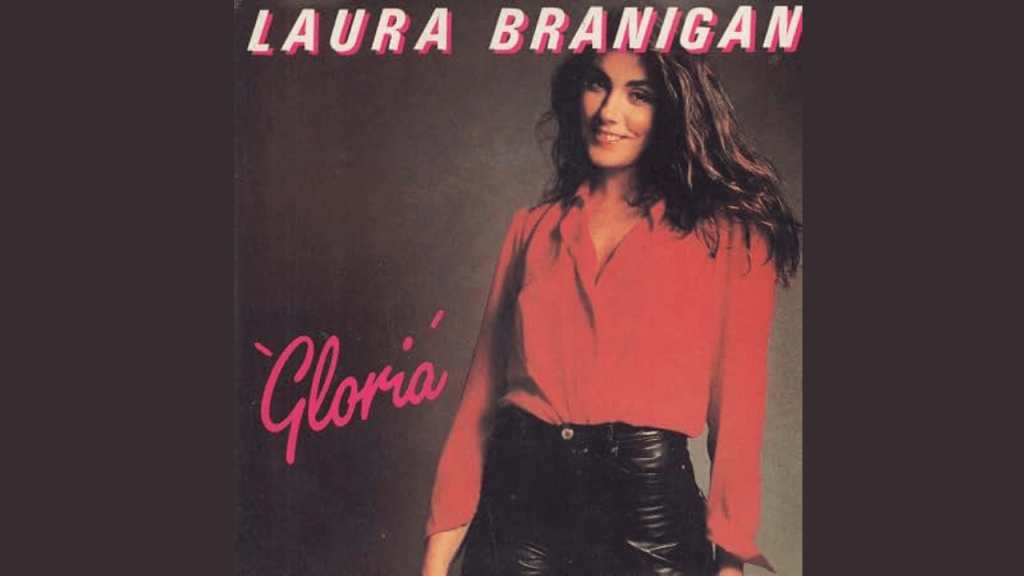
(“Are the voices in your head calling, Gloria? / Gloria, don’t you think you’re fallin’? / If everybody wants you, why isn’t anybody callin’?”)
- Reached #2: November 27th, 1982
- Number of Weeks at #2: Three Weeks
- #1 Song At the Time: “Truly” – Lionel Richie (Two Weeks) and “Mickey” – Toni Basil (One Week)
Was anybody going to tell me that “Gloria,” the signature song and biggest hit of singer Laura Branigan’s career, was a cover of a 1979 Italo disco hit by Italian singer/songwriter Umberto Tozzi? Or was I supposed to find that out on my own? Regardless, that fact fascinated me. I am familiar with both “Gloria” and the woman who made it a hit here in America, but could not have told you in a million years that it was a cover, nor that it was something we yoinked from Italians. I’d say Americans are the greatest thieves and repackagers of culture and art in the world, but Britain’s got us beat by a couple of hundred years, so I guess we still have a ways to go.
I learned that Tozzi’s original was a number two hit in Italy, so “Gloria” has special distinction as a song that has gotten the silver in two separate countries in two different years. The last time we encountered an American bringing a song from a foreign land onto the Billboard Hot 100, it was Juice Newton with “Queen of Hearts.” If you’re a stats nerd like me and you’ve been keeping score, this is now the fifth song on You Got The Silver that’s a cover version and the second one that covers something from the seventies. When Laura Branigan recorded her version of the song, she was just a backing singer who had impressed the head of Atlantic Records and scored a record deal. They needed to find a song that she could turn into a hit and her producer found the perfect candidate in “Gloria.” It’s the story of a song that had to get passed around to a few people, get translated into English, and then find the perfect songbird to deliver it to the masses to score a silver medal. It’s a story more interesting than the song itself.
Laura Branigan–no relation to famed starship captain Zapp Branigan–was born in Mount Kisco, New York on July 3rd, 1952, to Irish-American parents. She grew up in Armonk, attended Catholic school, had a guitar playing brother (Billy Branigan) who would become part of her backing band during her early career, and initially did not seek out a career in music. She initially studied acting, moving to Manhattan and attending the American Academy of Dramatic Arts at the start of the seventies. While she was there, she got interested in pursuing music and met two guys who shared a similar love, Walker Daniels and Chris Van Cleave. Together, the three of them formed a short-lived folk rock group called Meadow (nice name) in 1972. They were only together for a short time and only released one album, The Friend Ship, in 1973. It’s the kind of album you’d find if you’re digging around used record stores and buying it for four bucks out of sheer curiosity. I imagine it’s also a bit of a collector’s item if you’re a huge Branigan fan. Meadow was never successful, but even on something early like this, Branigan’s voice is immediately recognizable. She sounds great and it’s obvious that she had something special. It would just take a while for the world to catch on and hear her.
Branigan appeared again in 1976 when she became one of Leonard Cohen’s backing singers for a European tour. You can hear her on the single-only release “Do I Have To Dance All Night” from that tour. You can also see her performing with Cohen in the video linked below. Branigan returned to New York from that tour and became determined to have a career as a solo artist.
In 1979, Branigan auditioned for and impressed Ahmet Ertegun, the co-founder and president of Atlantic Records, who proceeded to sign her to the label. According to Branigan’s official website, Ertegun was fond of her and considered her one of his greatest findings. They immediately got to work on Branigan’s debut album, but it took a while. She had started work on an album that has been commonly referred to as Silver Dreams (it is unknown if that’s what it would have really been called), but due to a contract dispute and lawsuit with her management (of which I could find no specific details of), it got shelved and has never seen the light of day. Strange. Her earliest singles, which saw release in 1980 and 1981, were recorded for that project and eventually saw re-release on a reissue of her real debut album, 1982’s Branigan. There are bootleg versions of the supposed Silver Dreams album floating around on Youtube. Why it still has never been released is a mystery to me. If you get a job working at Atlantic Records, ask one of the higher-ups about it and leave me a comment about what you hear.
Branigan’s debut single, “Fool’s Affair,” was released in 1980. “Fool’s Affair” is a perfectly fine piece of adult contemporary balladry penned by Richard Kerr (the guy who co-wrote a bunch of Barry Manilow hits) and Troy Seals (the brother of Jim Seals, of Seals & Croft fame). It’s a very 1980 sounding song. Pretty, but nothing that really sticks and stays with you afterwards. Honestly, the part of this song that really sticks with me comes at the 1:10 mark, when there’s suddenly a Luther Vandross jumpscare on backing vocals. “Fool’s Affair” was recorded right at the tail-end of Vandross being a backing singer-for-hire, but when I heard him, my ears immediately perked up. I said, “Luther!? What are you doing on this track!?” I then had the thought that “Fool’s Affair” would be a much better song if Vandross had recorded it for his debut album, Never Too Much, which was just on the horizon at the time.
Branigan had two other early singles before “Gloria” came along and took off like a rocket. The first was the post-disco dance track “Looking Out For Number One,” which is a really solid and fun dance song. It didn’t crack the Hot 100, but it is the song that most closely resembles the kind of sound and vocal theatrics that will make “Gloria” a silver medalist. The other pre-”Gloria” single was “All Night With Me,” a glittery, mid-tempo romance song and the opening track to Branigan. “All Night With Me” was the lead single to her debut album and her first song to make it on the Hot 100, peaking at #69 (nice). Her next single would go on to do much bigger numbers and catapult her into the limelight. That single was “Gloria” and it had to go through a few changes (mostly lyrical translations from Italian to English) and get passed around by a few people before landing in Branigan’s lap. Let’s talk about Umberto Tozzi for a moment, because the story of “Gloria” begins with him.
Umberto Tozzi was an Italian singer/songwriter who found most of his success in Italy from the mid-to-late seventies. A few of his songs, such as “Stella Stai” and “Ti Amo,” found international success. “Gloria” was also one of them. For the sake of brevity, all you need to know is that “Gloria” became a major hit in late 1979 and 1980. Tozzi’s original lyrics were about yearning for an idealized concept of love, freedom, and happiness. He’s desperately waiting for Gloria, who serves as a symbol of his idealized concept. If you’re curious, there is no real “Gloria,” Tozzi just picked the name because it sounded good. Seeing Tozzi’s lyrics translated into English, it’s a very romantic song, but the rewritten lyrics for Branigan’s version make for a more interesting song. Musically, Tozzi’s original is more or less the same as Branigan’s version.
In November 1979, British singer/songwriter Jonathan King was the first to rewrite the lyrics of Tozzi’s song into English and record the song. Rather than keeping it as a song about a man yearning and waiting for his other half, King’s rewrite reimagines Gloria as a woman he sees only in his dreams. He says his friends think he’s crazy, but he believes in his heart that one day he will find Gloria and love her in real life, doing all the things he’s dreamed about with her. He refers to her as his “queen imagination” and his “golden girl of fascination,” both of which make me roll my eyes. Of all the different versions of “Gloria” I had to hear in the time before Branigan made it an American hit, King’s is by far the worst one. It sounds like a very cheap imitation of Tozzi’s original (the piano and bass line is too jaunty, which makes the whole song sound corny as fuck) and King’s lyrical changes and vocals are embarrassingly bad. It was not a hit (it peaked at #65 on the U.K. Chart, which is higher than I think it deserved). The music was there, but the lyrics were not. If “Gloria” was going to be a hit on American shores, it needed more compelling words and a singer worth a damn. Luckily, Atlantic had someone who would be able to supply some better words and a woman who could deliver them.
The story of how Laura Branigan found “Gloria” has two possibilities. One is that she learned about the song through her keyboardist, Greg Mathieson, who did the keyboards and arrangements on Tozzi’s original and suggested that she do the song. Another possibility is that the song was suggested by Branigan producer Jack White (not the one from the White Stripes). Whichever way she found it, she was initially skeptical about doing it, but after a lyrical rewrite, she came around and decided to do it. Jonathan King’s lyrics went right in the garbage and Canadian musician/producer Trevor Veitch came in and rewrote the words to the version everyone is familiar with. With a new set of lyrics, Branigan and her team gave the song an American kick and eventually had a major hit on their hands.
The rewritten lyrics on Branigan’s version have nothing to do with Gloria being the object of someone’s affection. In this version, Gloria is a woman who seems to be spiraling, possibly on the verge of insanity (“Are the voices in your head calling, Gloria?”), over a guy. Branigan’s version features her as a friend to Gloria, giving her warnings about the path she’s heading down. “I think you’ve got to slow down before you start to blow it” is one of them. “I think you’re headed for a breakdown, so be careful not to show it” is another one. She also offers some harsh and scathing truth bombs, the hardest hitting one being, “Gloria, don’t you think you’re fallin’? / If everybody wants you, why isn’t anybody callin’?” Branigan gets the best jabs in the third verse, which is just a barrage of hard-hitting questions, such as:
Gloria, how’s it gonna go down? / Will you meet him on the main line, or will you catch him on the rebound? / Will you marry for the money, take a lover in the afternoon? / Feel your innocence slipping away, don’t believe it’s comin’ back soon
Branigan’s version turning Gloria from object of desire to troubled heartbreaker on the edge is the song’s biggest change and easily the best one. It gives the song a lot more intrigue. What exactly is Gloria searching for? Why is she making these choices? What is Branigan referring to when she asks “Are the voices in your head calling, Gloria?” Is Gloria suffering from auditory hallucinations? When Branigan says, “You really don’t remember,” what’s that supposed to mean? We never get any answers, but it’s a fun set of lyrics to sit with and try to figure out. It’s a shame I don’t have much interest in doing that, since I never pay attention to the words when I hear this song. Even sitting with the song for this, I find the words are the last thing I care about. This is true of every version of “Gloria” I’ve heard.
If “Gloria” endures for any reason, it’s because people keep admiring what Laura Branigan brings to it as a vocalist. Musically, it’s Americanized post-disco goodness. Not a lot changed from Tozzi’s original beyond the production. The main riff has been beefed up and hits as hard as the original (which was not the case with King’s awful attempt), there’s more space for the electric piano to take up (doing melodic bits that are almost Toto-esque), the strings have been replaced with synths, and the beat has taken more of a backseat, with a lighter dance music thump than the pounding disco beats of 1979. Of all the versions of “Gloria,” Branigan’s sounds the best after Tozzi’s original. If we’re comparing vocalists on different versions of the song, Branigan easily clears everyone that tried it before her. Her voice has charm, fire, playfulness, and she balances that line between being comforting and scathing to Gloria without ever missing a beat. The way she belts out “Gloooooorrrrrrrriiiiiiaaaaaa” after asking if the voices in her head are calling is a great moment. The way she punctuates this line is another great moment: “don’t you think you’re fallin’, if everybody wants YOU” and then soaring with “Why isn’t anybody callin’?” She sounds incredible. You can understand why Ertegun might have had an interest in her. She’s got a really good voice.
Is this song still popular at karaoke nights? I have no way of proving if it is or isn’t, but this sounds like a song that would kill at one. I also imagine singing this song at a karaoke night is where you would, in real time, learn the hard lesson that this is a difficult song to sing well, especially if you’re using Branigan’s version as a base (which I’m guessing most people do). Spoiler warning, the Bonus Silver for this one is gonna feature some fascinatingly bad takes on this song. I listen to “Gloria” and I can hear all of the parts where it can all fall apart if you really stumble and mess up on something. With that in mind, it really is a testament of Branigan’s talents that she makes it sound so easy and natural.
“Gloria” feels like a moment out of time when compared with the rest of the silver medalists of 1982. Part of that comes from being a cover of an Italian song from 1979 (every song we’ve covered so far in Part 2 have been American songs from American acts). Another part of that comes from Branigan’s unique voice and being someone who had gone from relative obscurity to suddenly having a huge hit. The music video also feels out of time. You get the feeling nobody at Atlantic was prepared for the song to pop off the way it did (debuted on the Hot 100 in July, had a slow rise until its peak in November), because the video to “Gloria” looks and feels more like a performance video you would see on a show like Top of the Pops than a video airing on MTV. It’s an incredibly simple and possibly very cheap music video, but Branigan had already been performing the song on a whole bunch of television shows for months (seriously, there are so many videos of her doing this one song) before a full-on video appeared, so maybe they thought that was the move that made the most sense. She makes the most of it. She’s playful and knows how to play to the camera. It also helps that she is a very captivating and beautiful woman (it’s the eyes). She looks stunning in this (one of the perks of doing this project is that it gives me an excuse to watch, re-watch, and study music videos featuring attractive pop stars). I really like her fit too. The stylish sequined top is very disco, but looks comfy, which is more than I can say for a lot of peak disco fashion. Honestly, I’ve been thinking that if you’re someone who is looking for a “I hate Gay Halloween, what do you mean you’re [blank]” costume this year, Branigan’s fit in this video might be a good contender as a random pull nobody would ever expect or know (except for the biggest music nerds).
“Gloria” was blocked from the top spot by two songs. The first was Lionel Richie’s “Truly,” a sleepy adult contemporary ballad that bores the hell out of me for the most part. It sounds like pretty much everything Richie was doing in the early eighties, but he found a winning formula, so I gotta hate the game, not the player. “Gloria” is a much better and more interesting hit. It should have beaten it. The other song that blocked “Gloria” from climbing to the summit was Toni Basil’s enduring new wave cheerleading heater “Mickey.” Branigan stood no chance against that strange force. How do you compete with an accomplished dancer making a music video where she’s doing an entire cheerleading routine set to a truly infectious earworm? Branigan got defeated by a jester who just happened to have the right level of weirdness at the right moment. “Mickey” is a one of a kind thing. There’s nothing else like it (you could argue “Shake It Off,” but that’s nothing but cheap imitation, like eating Kraft singles and calling it American cheese from your local deli). But don’t feel too bad for “Gloria.” It stayed on the charts for a total of thirty-six weeks, which was an insane amount of time for a song to remain on the Hot 100 back then. Branigan had officially arrived on the strength of “Gloria.”
Branigan’s debut album ended up going gold on the strength of “Gloria.” I listened to the album in full and it’s not really what I’m looking for. If you like things that sound like Pat Benatar, you’ll love that first album. Branigan’s first album didn’t have a follow-up single after “Gloria” popped off, but she quickly produced a follow-up album (Branigan 2) that was released almost exactly a year after the first. That second album is a lot better in my opinion and it kept the momentum going. It also went gold and the singles from that album established Branigan as a pop star beyond that one hit. Lead single “Solitaire,” a theatrical, pumped up synth-pop jam that peaked at #7.
The album’s second single, “How Am I Supposed To Live Without You,” peaked at #12 on the Hot 100 and became Branigan’s only number one on the Adult Contemporary Chart. And yes, it is the same Michael Bolton song that eventually became a number one hit in 1990. Bolton wrote the song, but Branigan recorded it first in 1983, years before Bolton became a successful star in his own right. Till my dying breath I will tell you that Branigan’s version is a million times better than Bolton’s could ever hope to be (Branigan’s also the better vocalist by a fucking mile). Hers should be the one everyone thinks of when they think of “How Am I Supposed To Live Without You.” It should’ve been Branigan’s voice that woke me up at two in the morning when that Time Life Ultimate Love Songs Collection commercial started blaring out of my basement room television. In my eyes, Branigan’s version is the definitive one. Go listen to it. That’s an order. This wasn’t a single, but I also recommend Branigan’s country-pop take on The Who’s “Squeeze Box.” Branigan 2 is a fun album. I enjoyed my time with it.
In 1984, Branigan hit the peak of her career with her third album, Self Control. It was the only one of her albums to achieve platinum status. If you know any song from it, it’s the title track, which peaked at #4 on the Hot 100, went to number one in several countries, and a certified radio classic in Grand Theft Auto: Vice City. Beyond “Gloria,” “Self Control” is easily Branigan’s most well-known track. I would link the Youtube version of the music video, but I regret to inform you that the video for “Self Control” has been “enhanced” through really shitty AI upscaling. It’s really easy to spot. Everything looks suspiciously smooth and plastic and the brightness got turned way up, which makes it lose the atmospheric and hazy effect of the visuals. There are also a few points where the AI program (whichever one this was thrown into) has trouble stabilizing Brangian’s face, leading to moments where she looks like this:
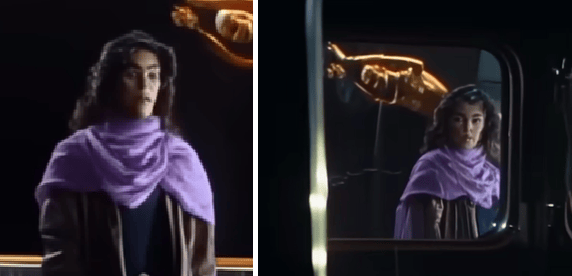
It really fucking sucks, for numerous reasons. It sucks because it deals lasting damage to real art. It sucks because if shitty upscale “remasters” can be done to this, it can be done to other videos as well (and it has). It’s fucked up because Branigan had absolutely no say in this (spoiler: she’s been dead since 2004). Finally, it sucks because the video for “Self Control” is really cool and it should be watched in its original, untampered glory. Luckily, you can still see it the right way! Thanks, Dailymotion!
“Self Control” was the last time Branigan ever hit the Top 10, but the album did spawn two Adult Contemporary hits. One of them was the album opener “The Lucky One” (peaked at #13 on the AC Chart, #20 on the Hot 100). The other one was “Ti Amo,” a second cover of an Umberto Tozzi song from 1977, with new lyrics in English (it peaked at #22 on the AC Chart). This song was one she actually performed with Tozzi. The two met after “Gloria” popped off and became a chart smash and Tozzi even ended up writing and contributing a song to Branigan 2 (the album cut “Mama”).
Once the mid-eighties arrived, Branigan’s hitmaking run came to an end. In 1985, she recorded the song “I Found Someone,” which was not a hit for her… but it was when Cher did it in 1987 during her late-eighties comeback era. Not to pit two beautiful queens against each other, but if we had to, Cher obviously wins. Duh. After all, she’s Cher, bitch. The last time Branigan scored a Top 40 hit on the Hot 100 was in 1987, when she recorded a version of “The Power of Love,” originally recorded by Jennifer Rush. Branigan’s version made it to #26, but Celine Dion eventually came along in 1993 and took her version all the way to number one. Branigan just seemed to have terrible luck with recording songs that went on to be bigger hits when someone did it after her. For what it’s worth, I think if you can’t stand Celine Dion’s voice and David Foster’s aggressively grand production of the song, you might dig Branigan’s more subdued version of it. Hearing her perform it is a treat. She really was a talented vocalist. You can hear her do it here, after Canadian star Alan Thicke gives her the weirdest, creepiest introduction I think I’ve ever heard given on a late night talk show.
Branigan scored one more hit on the Adult Contemporary Chart in 1990 with the tearjerking ballad “Never In a Million Years.” It’s not really my thing, but I can hear the kind of audience that would like it. After the release of her final album, 1993’s Over My Heart, she would more or less go on hiatus for the next few years, taking care of her husband and manager, Lawrence Kruteck, after his cancer diagnosis and focusing on him until his death in 1996.
She did two more noteworthy things during the nineties. In 1995, The Best of Branigan came out, which included a cover version of the Donna Summer heater “Dim All the Lights.” It’s a good and fun cover, updating the song from a disco hit into a nineties house groove, kinda similar to what Whitney Houston did when she covered “I’m Every Woman.“ The other one is the duet she contributed to the Baywatch soundtrack, where she and series star David Hasselhoff delivered an uplifting end credits song in the form of “I Believe,” which played at the end of episodes in seasons five and six. Strange appearances like this one are the kinds of things I live for with this project. This is peak nineties right here. God bless you, Hoff.
From 1996 to 2001, Branigan disappeared and was on hiatus. She was supposed to make her grand return in ‘01, but she fell from a ladder in her home and ended up breaking both her femurs, so her return ended up being delayed. In 2002, she played the role of Janis Joplin twice in a New York City musical called Love, Janis. I don’t know what that would sound like, but I would have loved to have been able to hear it.
Laura Branigan died in her sleep on August 26th, 2004 from an undiagnosed brain aneurysm. So it goes. At the time, it was incorrectly reported that she died at forty-seven, when she was actually fifty-two. Supposedly, she had been working on new material for another album, but if any of that exists, it’s never been made publicly available.
Laura Branigan will not appear in this project again, but her music lives on in a lot of cool ways. I had mentioned “Self Control” ending up in Grand Theft Auto: Vice City, but “Gloria” also ended up in Grand Theft Auto: Vice City Stories. In 2019, Branigan’s voice and “Gloria” became the sound of victory when the St. Louis Blues hockey team went on their incredible eleven game win streak during the 2018-19 season and became their victory song when they defeated the Boston Bruins in the Stanley Cup Finals that year. That event led to a lot of people discovering the song, as well as Branigan’s other hits, for the first time. In a moment of ridiculousness, there were multiple requests for her to perform the song live during that run… which was impossible, considering she died in 2004. I like to think she would’ve gotten a laugh out of that, or at the very least enjoyed the attention through a sports team latching onto a song as an unofficial victory anthem. Nowadays, that kind of thing is becoming more common. Olivia Dean’s “Man I Need” became a victory song for the Philadelphia Flyers during their playoff run this past year and Chappell Roan’s “Pink Pony Club” became one for the Edmonton Oilers. Hockey teams pick strange songs for victory anthems.
Branigan may be gone, but her voice and her music have stuck around. She had a nice little run of hits that make up a solid and respectable Best Of collection. Give it a listen sometime. If you need a place to start, the St. Louis Blues have this to say:
Play Gloria.
Bonus Silver
I couldn’t fit this into the main entry, so it’ll go here. In 1983, Branigan appeared on an episode of CHiPs and performed a live version of “Gloria.” Another example of the way that music and television was dancing with each other as a means of promotion during the decade. Give it some love here.
In the Glee episode “Trio,” Lea Michele and Naya Rivera’s characters perform the song while competing for the affections of Elliott “Starchild” Gilbert (Adam Lambert in a guest star role). Of all the Glee covers I’ve shared in this project so far, this is by far the worst one I’ve heard. This is truly awful and it did hurt my ears a bit. I wish I could just hear Adam Lambert sing it. I imagine he’d kill it. If you’re curious as to how bad a rendition of this song can get, you can hear it for yourself here:
In 2023, British singer and Steps member Claire Richards recorded a version for her second solo album, Euphoria. It’s a cool dance-pop take on it and I like it. Give her some love here.


Leave a comment