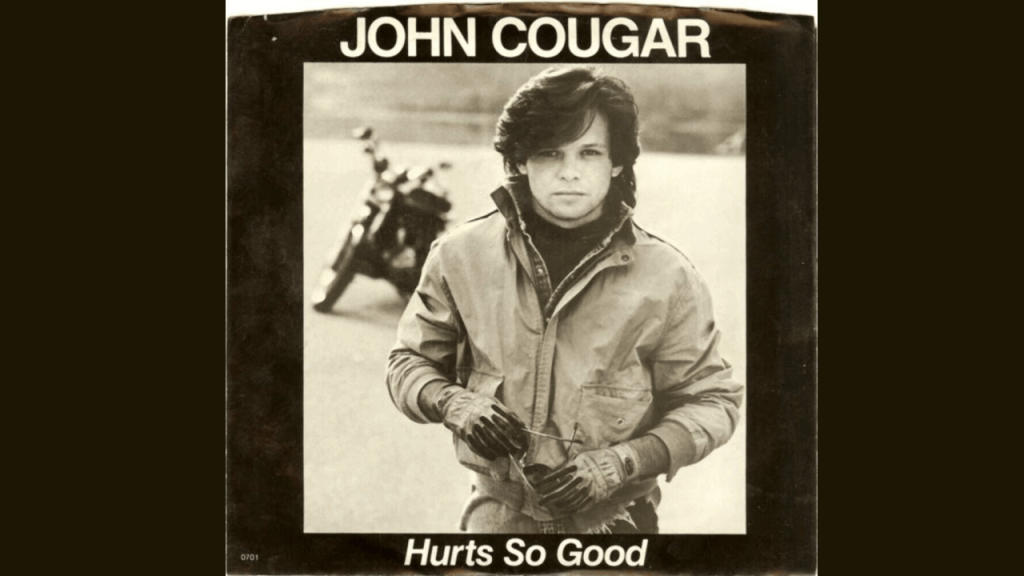
“Sink your teeth right through my bones, baby”
- Reached #2: August 7th, 1982
- Number of Weeks at #2: Four Weeks
- #1 Song At the Time: “Eye Of The Tiger” – Survivor
On May 22nd, 1974, music critic and producer Jon Landau wrote an article for the Boston area newspaper, The Real Paper. It was titled “Growing Young With Rock and Roll” and it chronicled his experiences at a concert he had seen at the Harvard Square Theatre in Cambridge, Massachusetts. In it, he wrote, “I saw my rock’n’roll past flash before my eyes. And I saw something else: I saw rock and roll future and its name is Bruce Springsteen. And on a night when I needed to feel young, he made me feel like I was hearing music for the very first time.”
Landau’s prediction of rock and roll future would end up being right, but the era of heartland rockers channeling (and attempting to rival) the Boss wouldn’t happen for a number of years. There have been a good number of guys who have been labeled the “poor man’s Springsteen” at some point (Bob Segar, Tom Petty, Bryan Adams, you can throw early Bruce Hornsby in there too), but only one guy got called that and eventually proved to be a genuine rival. Springsteen himself will eventually appear in this project, but today belongs to the original “poor man’s Springsteen,” a handsome, rough and tough, rock n’ roll boy from the Heartland with a silly name who was looking for a breakthrough and got one with a song about rough love that hurt so good.
John J. Mellencamp was born in a small town, that small town being Seymour, Indiana. He is one of four major eighties music stars in this project who hail from “The Crossroads of America” (the other three were all born seven years after Mellencamp, in the summer of 1958. They’ll all eventually appear multiple times in this project). The son of an electric company vice president, Mellencamp was born with spina bifida (which he had corrective surgery for as an infant), became a teenage father at sixteen, a college dropout by twenty-one. Mellencamp fell in love with music at a young age and started gigging in bars at age fourteen with his first band, a soul band named Crepe Soul (far from the dumbest first band name we’ve encountered). He also played with a local glam rock band called Trash (named after the New York Dolls song) and had a job installing telephones at one point before leaving Indiana.
In the mid-seventies, Mellencamp left Seymour for the Big Apple, hoping to make it in music and find a record contract, fortune, and fame. During the months he spent travelling between New York City and Seymour, he met Tony DeFries, the music manager and impresario who had managed David Bowie during his rise to the top. DeFries liked him and Mellencamp was signed to MCA Records through that connection. Famously, DeFries was the one who insisted Mellencamp change his name to “Johnny Cougar,” under the belief that “Mellencamp” was a name that wouldn’t stick and sell. Cougar would change his credited name a few times in his career, to the point where I jokingly think he should’ve added names to become John “Thundercougarfalconbird” Mellencamp, but that’s another world. Which name Mellencamp was going with at the time ended up working out for him because it does a great job at placing him within a certain era of his career. “Johnny Cougar” was the first of three names. We’re honoring the “Cougar” name for this, so from here on out, that’s how he’s gonna be referred to.
Cougar’s first album was Chestnut Street Incident, released in 1976. It’s mostly a covers album (“Oh, Pretty Woman” and “Jailhouse Rock” are two of the really good ones). Another notable song is “Sad Lady,” which is the first song Cougar and childhood friend George Green co-wrote. Green co-wrote “Hurts So Good” as well as a number of other songs during Cougar’s career. It barely sold anything. Cougar recorded a second album for MCA–The Kid Inside–but it was shelved and Cougar was dropped from the label in 1977 (DeFries eventually released it in early 1983, looking to capitalize on demand for more Cougar after achieving stardom).
It’s hard to keep a good man down, so Cougar soldiered on and eventually piqued the interest of Rod Stewart’s manager, Billy Gaff. Gaff signed him to Riva Records, a smaller label, and requested that Cougar move to London for almost a year to record and promote his second album, 1978’s A Biography. It wasn’t released in the United States, but lead single “I Need A Lover” ended up becoming a #5 hit in Australia. It’s a solid song. I wonder if it got big over there because some people confused him for Rick Springfield. Personally, I can’t get over how much he looks like James Hurley from Twin Peaks in this video. “I Need a Lover” finally reached us in 1979 on his self-titled album, where it became a #28 hit. By ‘79, Cougar had dropped the “-ny” part of “Johnny” and was just going by “John Cougar” now. “I Need a Lover” was the song that got his foot in the door, with Pat Benatar recording the song for her debut album the same year as well.
The big break was still a few years away, but Cougar was making strides with his 1980 album, Nothin’ Matters and What If It Did. That album yielded his two biggest Top 40 singles yet, “This Time” (peaked at #27) and “Ain’t Even Done With the Night” (peaked at #17). I really like both of those songs, “This Time” especially. In a December 1983 interview with Record Magazine, Cougar dismissed those songs, saying they were “stupid little pop songs,” which I think is an unfair assessment. Cougar has always been interested in authenticity and how his brand of realness wasn’t something people wanted at the beginning. He was dissuaded from using his real last name on early records. His record label more or less wanted to mold him into the next Neil Diamond (which is ridiculous, considering that anybody tuned in could’ve told you he’s Indiana’s version of Springsteen). He loves telling stories about how he had to fight tooth-and-nail for his authenticity and the music he believed in when making American Fool, the album that made Cougar a superstar. That’s all well and good, but I don’t think songs like “This Time” and “Ain’t Even Done With the Night” should be written off as “stupid little pop songs.” For all of Cougar’s talk about authenticity and fighting for his identity, he’s often written off or rarely acknowledged his instincts as a guy who knew how to write hits that appealed to a pop audience and sell himself as a down-to-earth everyman. He had great instincts and he knew how to craft a well-written pop song that stuck with people. That’s why I think he’s the only guy who’s ever truly rivaled the Boss.
I see Cougar in videos like the ones for “This Time” and “Ain’t Even Done With the Night” and not only do I hear a great songwriter, I see a guy who was comfortable in front of the camera, knew how to cut through the noise of early MTV, and establish himself as a star without playing any kind of games. Unlike Rick Springfield, an established television star who knew how to sell a certain image (heartthrob) to MTV’s audiences, Cougar didn’t play that. He presented himself in a very “what you see is what you get” manner and it worked. His anti-image, working class hero look and tough midwestern guy sensibility eventually became his image and it made him distinct during a time when rockers and pop stars were developing larger-than-life brands and personas for the MTV landscape. Cougar had all the qualities that MTV wanted in a rock video star–songs you could play over and over, good looks, charm, and the ability to captivate and hold an audience–but never lost the look and feel of a guy I could hang out with at my local bar on a Thursday evening.
In 1982, Cougar had the breakthrough he had been searching for with his fifth album, American Fool, where Cougar discarded the poppier elements of Nothin’ Matters and gave his sound a jolt of harder-edged rock. “Hurts So Good” was the lead single and the first in a string of big hits for the man. He had finally arrived. If you were putting your stock in CougarCoin in 1982, hearing “Hurts So Good” for the first time must have made you feel like your investment was about to blast off to the moon. The combination of that hard driving, mechanical beat and the main guitar riff alone make it a winner. Sitting with this song in preparation for writing this, I found I never once got sick of it. So many parts of this song are earworms that get lodged in my brain.
Cougar wrote the song with his childhood friend and collaborator, George Green, and claims they wrote the song as a goof. In a 1982 interview with The L.A. Herald Examiner, he explained: “My friend George [Green] said, why didn’t I write a song with the title ‘Hurt So Good’? We thought of it as like a Shel Silverstein thing. I wrote it in three minutes, scrawled the first line in soap on the glass door in the shower. It was really just a joke. I think all good things probably started as jokes. Wasn’t God having a laugh when he made this whole place?” I don’t think the lyrics to “Hurts So Good” sound like Silverstein’s words, but the music certainly captures Silverstein’s sound. If you’ve ever listened to anything from Silverstein’s Freakin’ at the Freakers Ball (like the title track or “Polly In a Porny” or “Masochistic Baby”), Cougar captures the same kind of devious, masochistic playfulness that Silverstein has, as well as that same kind of gravely croon. Cougar and Green traded lines back-and-forth with each other and Cougar claims that once he picked up a guitar, he had the chords and main riff in seconds. It sounds like the kind of thing you write in five minutes and then only later realize you had something really great happening.
“Hurts So Good” is a song all about getting older, so much older, which is funny, considering Cougar was only thirty when this came out. Maybe he felt older than he was because he had already been a father for years. He would be a grandfather by thirty-seven, so maybe his sense of time was all messed up. Regardless, it’s a song about getting older and yearning for younger, wilder days. Cougar meets a beautiful girl and proceeds to tell her, “Lord knows there are things we can do, baby.” Most of those “things” likely involve sex, preferably the kind that’s fun and hurts so good. There’s a masochism to the song and Cougar’s insistence that this woman make it “hurt it so good” brings BDSM to mind, but never trails into darkness. Cougar keeps it playful and PG-13. In a lot of ways, “Hurts So Good” reminds me of the Rolling Stones’ “Start Me Up,” another song that wasn’t shy about its subject matter and a straightforward rock song with a protagonist looking for rough and tough sexual thrills.
Like “Start Me Up,” “Hurts So Good” keeps things simple and straightforward, yet satisfying at the same time. Most of the song is built around that hard driving, mechanical beat and the main guitar riff, which is an all-time great one. That riff has gotten stuck in my head so many times while working on this. I am not a guitar player, but it sounds like the kind of thing you could play for a while while hanging out at home and not get bored with. I think of a song like “Hurts So Good” the way that videogamedunkey thinks of Tony Hawk’s Pro Skater. It’s three and a half minutes of good song. No part of it drags, no part of it is unnecessary, there’s no bullshit to be found with it. The whole song is the good part of the song. It’s just a good, solid track. It’s well-crafted and I think Cougar had better pop instincts than he ever let himself believe. He wasn’t a dummy. He knew what people wanted and how to give it to them. He knew how to play the game, even if he didn’t always want to. A well written and tight song like “Hurts So Good” doesn’t happen if you don’t have a clue about how to make something with a high level of mainstream appeal. Cougar knew how to make something that sounded great coming out of your radio and something that looked cool on your video screen. I find he’s a smarter man than he lets on.
There are so many moments of this song that just hit the sweet spot for me. I never have to think about any of them. The beat, the main guitar riff, the organ that comes barreling in during the bridge, that duhhh, duh duh, duhhh guitar part when Cougar is singing “walking around all day long,” the way he yowls out lines like “COME ON babey! Make it hurt so good” and “sometimes LOVE don’t feel like it should,” the Springsteen-esque organ that joins in during the last chorus. It’s toe-tapping, head-bobbing goodness. I don’t have to think hard about a song like this. You shouldn’t! It’s supposed to be fun. Let yourself go and let it take you. This is the kind of song you turn on in a bar and smile when bar patrons give you a nod of respect. A nod that says, “Good choice, son.” If you’re with a bunch of dudes that have a good buzz going, the chorus to this song sounds like a Friday night where you just got off of work and the whole weekend is ahead of you. You don’t know what might happen, but whatever happens, it’s hopefully gonna end with a story worth telling next Friday night! “Hurts So Good” is just fun to turn on and listen to again and again and again.
In Cougar’s 2018 concert film, Plain Spoken: From the Chicago Theatre, he shares more insight about what inspired the song:
When I first started playing in rock bands, I didn’t realize how crude and mean other fellas could be. How crude they were with women and how crude women were. That led me to write a song called ‘Hurts So Good’ because I was playing in these bars and I just could not believe the lows people would go to with each other. The thing that surprised me is that it fit my personality perfectly. I fit right in with all that.
Cougar’s thoughts about fitting in perfectly with those kinds of bar patrons informs the song’s music video, which Cougar shot in Medora, Indiana, a small town approximately twenty miles southwest of Seymour. According to video producer Paul Flattery in I Want My MTV: The Uncensored Story of the Music Video Revolution, Cougar was apparently a pain in the ass to work with. Whether he was or wasn’t, the result ended up being gold. Cougar simultaneously looks like the coolest dude on the planet and also a golden retriever (it’s the red bandanna he’s wearing that gives that energy). His boyishly handsome good looks and charisma on camera sets him apart from the bikers and other regulars that party in the bar as extras. Cougar is dressed in leather, along with others and the girls dancing with him on the bar, but he never looks or feels out of place amongst the people that are his audience. When the first chorus hits, he jumps from the bar and joins the people, being arm-in-arm with them. Even though he’s the star of the video, it never feels like he’s above these people. He looks like the town hero who everybody loves not because he’s “John Cougar” the rock star, but because he’s “John,” a certified cool guy in town that people like hanging out with.
I couldn’t find anything about Cougar’s feelings towards music videos and having to make them, but whether he liked making them or not, he was very good at making them. I watch the video for “Hurts So Good” and he just seems like a natural at this. There are moments in the video where Cougar looks like he’s taking cues from Mick Jagger’s book. I love the moment when he sings the line “sink your teeth right through my bones, baby.” First off, great lyric! Second, that little snarl while he delivers it and the way he moves up close to the camera like he’s about to bite it when he sings “Let’s see what we can do / Come on and make it a” is such a Jagger move. He plays to the camera the same way Jagger would in music videos. He looks like the coolest dude alive in this video, but also a cool dude you could possibly hang out with. It’s strange. He had the look of a rock star but also somehow conveyed the look and sensibility of the everyman. That’s a hard thing to accomplish and he somehow nailed it.
“Hurts So Good” was blocked from the top spot by the continued reign of Survivor’s “Eye of the Tiger,” which was somehow a number one hit for six weeks. We’ll eventually talk about Survivor when they appear in this project, but I’ll give you this for now: I don’t love “Eye of the Tiger.” It’s a song that only has one purpose in my eyes: soundtracking training montages in movies, both in serious and comedic contexts. That’s it. I have never had a desire to hear that song outside of that context. This is all to say that “Hurts So Good” didn’t deserve the silver. It should’ve been a number one hit. I wasn’t alive when these decisions were made, so I have to live with the aftermath. Don’t cry too much for “Hurts So Good” though, it achieved something almost better than being a number one. The song spent sixteen weeks in the Top 10 of the Hot 100, longer than any song during the decade. So who really got the last laugh, huh?
American Fool ended up going quintuple platinum. It’s a solid album and it’s worth your time if “Hurts So Good” or any of Cougar’s stuff before it left a good impression on you. “Hurts So Good” may have only won the silver, but Cougar won the gold medal when “Jack & Diane,” a little ditty about two American kids growing up in the heartland, became a number one hit in October 1982. No joke, “Jack & Diane” is one of the greatest songs ever recorded. I feel that in my bones and I’ll argue it with anybody who wants a fight. The way Cougar delivers the line, “Life goes on, long after the thrill of livin’ is gone” is lightning-in-a-bottle. Cougar only had one number one hit, but when that number one hit is “Jack & Diane,” what other number one hit would you need?
Cougar scored one more hit from American Fool, the song “Hand To Hold On To,” which peaked at #19 and feels like his own version of Springsteen’s “Hungry Heart.” Solid album track.
I would cover what happened to Cougar after American Fool, but we’re not quite done with him yet. He’ll appear in this project again eventually, so we’ll catch up with him then. When we meet him again, he’ll be at a level of stardom where he gets to have his real last name back. In the meantime, play it again, Johnny! Sometimes love don’t feel like it should, but at least you gave us a song that makes it hurt so good.
Bonus Silver
In 1982, music producer Dickie Goodman made “Hey E.T.,” a track where he asks E.T. questions and E.T. responds by using quick snippets of pop songs that were big at the moment. “Hurts So Good” is included in it. Goodman is basically doing Bumblebee from Transformers’ method of speaking with Sam Witwicky decades before that movie happened. A strange little piece of pop culture ephemera. Give it a listen here.
In 1985, Burmese singer Khin Maung Htoo made a foreign language cover of the song. If you’re keeping score, I have news: Mr. President, a second Burmese cover of an American pop song has hit You Got The Silver (the first time was with the Bonus Silver on The Pointer Sisters’ “Slow Hand”). I’m always fascinated with how far American songs can travel, so give this some love here.
 You Got The Silver
Leave a comment