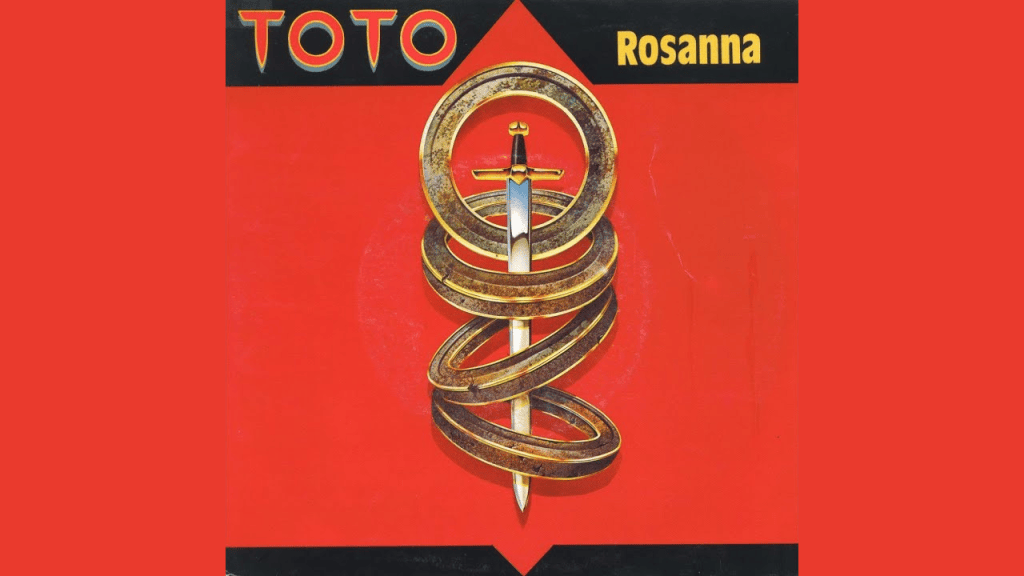
“I can see your face still shining through the window on the other side / Rosanna, Rosanna / I didn’t know that a girl like you could make me feel so sad”
- Reached #2: July 3rd, 1982
- Number of Weeks at #2: Five Weeks
- #1 Song At the Time: “Don’t You Want Me” – The Human League (Three Weeks) and “Eye Of The Tiger” – Survivor (Two Weeks)
In the Family Guy episode, “Ocean’s Three and a Half,” Stewie Griffin finds himself falling head over heels for Susie Swanson, the daughter of Joe and Bonnie. Hoping to find a way to express his feelings, Stewie decides to write a song for her, simply called “Susie.” When he shares the song with Brian Griffin, the family dog and Stewie’s best friend, and tells him the song’s title, Brian’s response is this: “Wow, a song named after a girl. There aren’t a million of those already.” Stewie then challenges him to present proof, leading Brian to name thirty-one songs named after a girl, which he does with ease (“Rosanna, Roxanne, Michelle, Alison, Sara, Angie, Brandy, Mandy, Gloria, Cecilia, Maggie May, Jessica, Nancy, Barbara Ann, Billie Jean, Layla, Lola, Polly, Helena, Jenny from the Block, Sherry, Laura, Wendy, Maria, Peggy Sue, Minnie the Moocher, Tracy, Jean, Jane, Mary Ann, Eleanor Rigby.”) Stewie then gets angry and tells Brian to go fuck himself.
Whenever a song is named after a girl, there’s an intrigue that comes along with it. We get nosy and we always want to know the inspiration behind songs and whether the names we hear in songs have any connection to real people or not. The names Brian says are all famous songs. Some of them have connections to real people, some do not. For example, Stevie Nicks named “Sara” partially after her real life friend, Sara Recor, and also the name she would have chosen had she ever had a daughter. Barry Manilow named his song “Mandy” because he didn’t want people confusing it with “Brandy (You’re a Fine Girl).” Eric Clapton wrote “Layla” about English model and former George Harrison wife Pattie Boyd. Billy Joel wrote “Laura” about his mother (who was actually named Rosalind). “Jenny From the Block” is Jennifer Lopez trying to convince you that even though she’s a glamorous starlet, she’s still real and still in touch with the streets (she’s not).
During the making of Toto’s fourth album, Toto keyboardist/vocalist David Paich was finishing up a song he was writing and needed a name. Other Toto keyboardist Steve Porcaro walked in with his at-the-time girlfriend, actress Rosanna Arquette. Paich thought the name “Rosanna” was a perfect fit for the song and decided to go with that. That song ended up being the opening track on the album, winning Toto a silver medal, and being one of the last hits scored during yacht rock’s golden age. It feels right that it went to the guys who were instrumental in bringing most of the yacht rock scene to glory. Paich didn’t write the song about Rosanna Arquette… but enough people have chosen to attach it to her (including Arquette herself) that he may as well have.
Toto is an interesting entity. As a unit, they were perfectly fine. They made a number of damn fine songs that have existed as popular rock radio staples and are fondly remembered as a fine band with a decent/respectable discography. They were basically the Weezer of their era. Individually, the members of Toto are the pillars of pretty much everything that came out of California in the seventies and early eighties. It is impossible to convey just how important the individual members are. Every member of Toto (barring vocalist Bobby Kimball) came up through being session musicians and those dudes stayed BOOKED and BUSY. It sounds hyperbolic, but when the guys in Toto tell you they played on thousands of recordings, they mean it. Look over the liner notes on any singer/songwriter or pop record you have from the seventies and I guarantee you that at least one Toto member will be credited on it somewhere. In California during the seventies and early eighties, if you needed a guy to play guitar, drums, bass, keyboards, do handclaps, spit into a glass next to a microphone, you could call up any of the members of Toto and they’d do it with no questions asked. The musicians that made up Toto were professionals and they were damn good ones. They could do anything you needed them to do and could adjust themselves to meet you wherever you were. Without them, there’s a whole generation of music out of California that never sounds the way it does because they couldn’t find session players worth a damn. Between the five musicians, Discogs credits them with about 7,000+ recordings. I’d be willing to bet there’s more that nobody has ever found. As we talk about the members, their Discogs pages will be linked so you can know for a fact that I’m not kidding around in regards to their accolades. Steely Dan, Seals & Crofts, Alice Cooper, and Sonny & Cher were just a few of the people they played for, but the list is truly enormous.
Toto’s beginnings start with two guys, keyboardist/vocalist David Paich and drummer Jeff Porcaro. The two men were high school classmates, played in a band together, and were both sons of prominent jazz session players (Marty Paich and Joe Porcaro, respectively). Both guys found their way into music and started building names for themselves through session work, starting in the early seventies. Paich’s first high profile gig was being the guy who co-wrote most of Boz Scaggs’ classic 1976 album Silk Degrees. Porcaro and future Toto bassist David Hungate are doing the drumming and bass work on that album on top of Paich playing piano. Like I said, they’re everywhere and you might not even know it until you bust out the liner notes and look.
Paich and Porcaro had played on many sessions together and started thinking about what it might be like to break out and start a band of their own. Porcaro liked the idea and the two men started looking for possible recruits. They pulled in David Hungate, who was also another session veteran, into this new band that was yet unnamed. Through their work with Scaggs, they discovered Steve Lukather, a guitarist/vocalist and session veteran (that makes four!) known for being able to deliver excellent guitar playing and solos on a dime. Jeff Porcaro brought in his brother, a keyboard player named Steve Porcaro, who had also been an in-demand session player (you can’t make this stuff up). With a full band assembled, all that was needed was a frontman. Luckily, they found a singer in no time.
Bobby Kimball was different from the rest of the guys in Toto. For one thing, he hailed from Louisiana instead of California. On top of that, Kimball wasn’t a guy who had made himself known through studio session work, he was a complete unknown that had mostly spent time as a vocalist in bands in the New Orleans area. He moved to California in the mid-seventies, hoping to make it. The closest he got before Toto was when he was the vocalist for the short lived project called S.S. Fools, which was a group with him and three former members of Three Dog Night (Floyd Sneed, Joe Schermie, and Michael Allsup). They released an album, but it went nowhere and they ended up breaking up. When S.S. Fools were rehearsing, David Paich and Jeff Porcaro were often hanging around, which is how Kimball got acquainted with his future bandmates.
When Paich and Porcaro were putting their own band together, they invited Kimball to try out for the role of lead vocalist. He auditioned with a song he wrote called “You Are The Flower,” which he wrote about his daughter, who had just been born. Kimball got the job and it would find its way onto the first Toto album. With Kimball, the original six members of Toto were finally assembled, signed to Columbia Records, and ready to put their first album together. The result was their self-titled debut album, which ended up going double platinum off the strength of the album’s biggest hit, “Hold the Line,” a strong contender for one of the best songs of the late seventies. It makes one hell of a first impression and it peaked at #5 in 1978. The other singles–”Georgy Porgy” and “I’ll Supply The Love”–barely squeaked into the Top 50, which is a crime. “I’ll Supply The Love” is one of Toto’s best songs. The people of 1978 weren’t ready for it yet… but their kids are gonna love it.
If you’re curious where they got the name “Toto” from, I’ll tell you, but it depends on who you ask and what you believe. In the early eighties, they all started saying they named the band after Dorothy Gale’s little dog in The Wizard of Oz, which is probably what most people think of when they hear the name. I’d be willing to bet that’s where they got the name from and it just stuck. Another story is that Jeff Porcaro used to write “Toto” on the band’s tapes while making the first album and they eventually decided that should be the name. The one I believe the least is the one where David Hungate saw “Toto” on the tapes and told the rest of the band that in Latin, the words “in toto” translate to “all-encompassing,” which would reflect how they were all session musicians playing on all kinds of different records across multiple genres. I think the funniest origin story would be that they got it from one of the guys seeing the word “Toto” on a toilet, which is a popular brand. One thing’s for sure! They did not name themselves after a dildo in a popular William S. Burroughs novel.
Anyway, critically, their debut album’s reception was mixed (though the album did hit the Top 10 on the Billboard Album Chart and went double platinum.) One reason for the mixed critical reception ties into their former lives as session musicians. For about a decade, the guys in Toto more or less helped define an entire generation of music through being the guys who played on everything. The downside of this is that when they broke away and started making music of their own… it had a tendency to sound like other things that were already out there. Other things that they played on. Their biggest hurdle in the beginning was establishing their own identity. I don’t think they ever fully succeeded in doing that, but they certainly did it as individuals. If you know what to listen for, you can get good at knowing when you’re hearing a Jeff Porcaro drum track or a Steve Lukather guitar solo, but the average person could listen to a collection of Toto hits and think those songs were made by at least three different bands. It also didn’t help that they had at least three different guys doing lead vocals and everybody in the band bringing different songwriting ideas with them. Their biggest issue was being jacks of all trades but not being masters at any one particular thing.
Toto struggled for the next few years to match that successful debut as far as making hits. Their sophomore album, 1979’s Hydra, went gold and was still commercially successful, but didn’t have much in the way of hit singles, beyond “99” (a song inspired by George Lucas’ THX 1138, of all things) reaching #26 on the Hot 100. They got a little weirder on Hydra and I think people in 1979 just didn’t really know what to do with songs like “St. George and the Dragon” or “All Us Boys,” which were singles that didn’t chart at all. Hydra is a weird second album, but an interesting one. Especially given the time it came out in. Toto weren’t new wave enough to roll with the new guard that was coming up, they weren’t trying their hand at disco, they weren’t doing anything that radically different from the first one, and they didn’t sound too out of step with the times, so I couldn’t pin down exactly why they had trouble.
The trouble continued on 1981’s Turn Back. For their third album, they tried becoming an arena rock band–which was not a stupid move in 1981–but couldn’t pull it off. Part of me thinks it was due to there being no shortage of arena rock bands making better stuff at the time. Between bands like former You Got The Silver subjects Foreigner and Journey, Styx, REO Speedwagon, and Van Halen, you had no shortage of great options. Turn Back ended up being a commercial failure and none of the singles ended up cracking the Hot 100, but I don’t think it’s a terrible album. It’s mostly underwhelming (the tinny production really holds it back) but there’s still some highs I really like off it, namely, “Goodbye Elenore,” which absolutely cooks. I learned that in an effort to sell the idea that they were really an arena rock outfit, they decided to make videos where they played the tracks live, as opposed to just miming to the studio track. MTV didn’t go for that and the video for “ Goodbye Elenore” didn’t get airplay, which is especially strange to me, considering some of the weird shit MTV was playing when the channel first launched. I don’t know why Toto were denied and while Turn Back is certainly a strange third move, it got critically thrashed more than it deserved. I found the Allmusic.com review of the album really funny: “[A] better title would have been Fall Back, as in, the band members always had their studio jobs to fall back on.” Ouch. After the album failed, the band decided not to tour in support of it and went back to the drawing board.
By the time they were ready to make Toto IV, Columbia was starting to lose patience with them. They were at a make-or-break point. They needed to make a hit or they were gonna be dropped from the label. So naturally, Toto IV ended up becoming the most successful album of their entire career. That’s how these stories tend to go. The album’s opening track and first single is the one that finally gave them the big hit: “Rosanna.”
The first seven Toto albums all had songs with a girl’s name in the title. Most of them were written by David Paich. These include: “Manuela Run” and “Angela” (Toto), “99” and “Lorraine” (Hydra), “Goodbye Elenore” (Turn Back), “Rosanna,” “Carmen” and “Holyanna” (Isolation) “Lea” (Fahrenheit), “Pamela” and “Anna” (The Seventh One). Out of all of them “Rosanna” is easily the best (“Holyanna” is a very close second). As far as I’m aware, none of these songs were written about any real women that Paich (or Steve Porcaro, who wrote “Lea”) specifically knew in real life, except for “Rosanna.” Paich has gone on record in several places saying that “Rosanna” is about several different girls he had known (one of them being a high school love) and none of them were Arquette. Paich just needed a name that sounded good in a song and Arquette was hanging around Steve Porcaro (whom Paich was living with at the time) and thought the name “Rosanna” sounded just right. But, because he got the name from someone who went on to be a big Hollywood movie star, it morphed into being a song about her through association… and mostly because she kept insisting the song was written about her when being interviewed on talk shows and magazines. In a June 1983 Rolling Stone interview with Arquette, she commented that the song was about “my showing up at 4 a.m., bringing them juice and beer at their sessions.” In a 2023 interview with Louder, Bobby Kimball justifies Arquette’s false claims, saying, “It was just an opportune moment for her to grab the brass ring and run with it … She was just starting her career, and the song was so big that she went on several talk shows and said it was about her. But I can tell you that it wasn’t.” He’s right that it wasn’t… but now it kinda is. It’s a strange thing.
The guys in Toto initially leaned into the idea that it was written about Arquette as a joke, but it definitely didn’t hurt the song’s success to have people think they wrote it about a very attractive actress that one of them was dating at the time. Toto needed a big hit and the buzz of having a rock band write a song about how amazing you are was good for Arquette, since she was still about three years from her breakout year in films like Desperately Seeking Susan (co-starring with Madonna, who will eventually appear in this project a few times), Silverado, and After Hours. If Arquette was going to claim any Toto song was written about her, she lucked out by having one of their best songs bear her name.
Everything about “Rosanna” is perfect down to the last detail. All of Toto’s strengths are on display from the first note to the last. The songwriting, the musicianship, the groove and feel of the song is top notch. It’s such a well-crafted piece of work. Just listen to Jeff Porcaro’s half-time shuffle that opens the song. It grabs you immediately and doesn’t let go. Porcaro played thousands of incredible grooves, but the one on “Rosanna” is one of his finest hours. If your band is going to do a cover of this song, it’s imperative that you have a drummer who can do that shuffle correctly. If they can’t do it, throw a chair at them and have them keep doing it until they get it right. It’s that serious. That shuffle gives the song such an immediate identity and a groove that’s irresistible. If you fuck it up, the whole thing falls apart and will never recover.
The beat you hear was cribbed from a few sources, namely the ghost notes and shuffle beats that the hitmaker Bernard “Pretty” Purdie provided for Steely Dan (specifically the songs “Home at Last” and “Babylon Sisters”). Porcaro also took inspiration from the beat you hear on Led Zeppelin’s “Fool In the Rain.” What he’s doing is a much faster tempo than those songs, but the influence is there in spades. That groove mixed with Paich’s piano lines creates a deadly combo and a stellar foundation. There’s a lot of moving parts to this song and a lot of fun moments to listen for. The way the song seamlessly slinks and moves from one distinct part to the other, the horns that come blasting in at the end of the first pre-chorus, Steve Porcaro’s overlapping keyboard solos and the way they dance through that middle section before Lukather comes in with a quick guitar solo, and the way the song eventually morphs into a jazzy piano-led improv section all makes for an enjoyable song that never feels its length or overstays its welcome.
The production of the song (and Toto IV as a whole) is really crisp, hard-hitting, exciting, and electrifying. You can tell they learned from the tinny and weak sounding production of Turn Back and wanted to make something with more explosiveness. The jump in production from Turn Back to Toto IV is massive. Every part of the song sounds fantastic.
There are so many interesting things going on in this song and so many great little details that it’s a joy to dissect this song and figure out what all the different parts are and how they operate. It’s like taking apart a clock or a car engine or a cassette player. You know what all the parts do when they’re together, but there’s an intrigue in figuring out what the individual parts do and how they all work in tandem to create the bigger picture. Before sitting down to write this, I had zero idea the song has a key change within it. It happens during the switch between Lukather’s parts of the verses and Bobby Kimball’s. I’m not well-versed in music theory so I can’t say more than that, but it sounds like such a natural switch that I imagine I’m not the only one who would find a fun fact like that interesting. The tag-team vocals of Lukather and Kimball is a really good choice. Lukather’s warm voice leads you through the first part of the verse before Kimball takes it and runs with it to exciting new heights. Paich and Kimball have that same tag-team during “Africa” and it’s a bit of a pity that Toto songs didn’t have more of that. It works really well here and enhances the song’s lyrics well.
Speaking of the lyrics, I find it interesting that anybody could fully believe Steve Porcaro wrote this song about Rosanna Arquette. Most of that is due to the fact that “Rosanna” is a breakup song and it would’ve been a little strange to write something like that about her while they were still together (they didn’t split until a few months after Toto IV), but also, most of Porcaro’s songwriting is ass (“Takin’ It Back” is the golden exception). The main piano riff alone is a very obvious tell that it’s Paich’s writing.
“Rosanna” is an odd kind of breakup song. Lukather’s part in the first verse frames it like it’s going to be a love song. It certainly starts like an average love song: “All I wanna do when I wake up in the morning is see your eyes / Rosanna, Rosanna / I never thought that a girl like you could ever care for me.” Kimball comes in during the second half of the verse and almost echoes the sentiment fully. He sings, “All I wanna do in the middle of the evening is hold you tight” but then switches it up and says, “I didn’t know you were looking for more than I could ever be.” In one line, Kimball takes what could be your run-of-the-mill love song about a girl into something with a little more intrigue. What happened between these two? We never learn. The pre-chorus only reveals that Rosanna left a year ago, but the narrator still wants her, willing to “meet her all the way” as opposed to meeting her halfway and trying to compromise. The narrator is willing to do whatever it takes to win Rosanna back and Lukather and Kimball have this really interesting duality; Luke is calm, cool, collected, romantic, wistful, while Kimball sings with anguish, heartbreak, an almost desperate quality to his cries to Rosanna. The way he delivers the line “I never thought that losing you could ever hurt so bad” really hits and sells it.
Lukather and Kimball’s tag-team vocals reflect the feelings one might have when looking back on a romantic relationship that ended. Time has passed (a year, in this case) and there’s this longing for what once was. One might look back on a relationship that ended and treat it like Lukather does, where there’s a desire to rekindle that love and have those special intimate moments–like waking up and having Rosanna’s eyes be the first thing you see–again. Other times, the feelings are more like Kimball’s delivery, which is howling and reflecting on what went wrong, like not being good enough for her standards or not realizing how much it would hurt to lose someone like her. The switch-up is so natural that I didn’t really notice any of this until I really sat down with the song and took it apart. I never bothered to learn what “meet you all the way” was supposed to mean, but the song grooves and hits so damn hard that I never worried too much about the words. If anything about “Rosanna” or Toto grabs you, it’s the musicianship on display. You don’t have to like it, but you do have to respect the craft. Every piece of the song is so well done and put together in a way that makes it enjoyable again and again and again.
I’ve always wondered if Cynthia Rhodes, the gorgeous dancer who appears in the video for “Rosanna,” was chosen because she kinda looks like Rosanna Arquette. Maybe it would’ve been too on-the-nose if Arquette had appeared. Nevertheless, the video for “Rosanna” is still surprisingly gorgeous for early MTV. The video was directed by Steve Barron (who also did the videos for “Africa” and “Stranger in Town”) and the West Side Story-inspired video is so full of character. Like the video for “Don’t Talk to Strangers,” you can see music videos begin to slowly develop a cinematic quality to them, especially with early ones that Barron did. Barron came up with the idea of filming music videos on 35mm as opposed to 16mm and video and you can really see the difference. There’s such a crispness to the video that’s still pleasing to the eye all these years later. A lot of this video is great. The shot compositions, the way the camera pans, and the way Barron captures Rhodes’ movements is fantastic. Barron is able to immerse you in this urban cityscape to the point where you stop noticing it’s just a decorated soundstage on a lot. I love the way Rhodes moves this in video and the way she teases the band (who are playing in a chain-link fence enclosure) during the instrumental break in the middle. Her bright red dress against the grey, muted colors of the cityscape make her stand out and she’s never lost in any of the shots she’s in. The rival gangs of dancers doing their stand-off during the final chorus before the closing instrumental starts is another great moment and is a precursor to what Michael Jackson would take to even greater heights for the “Beat It” video. Barron strikes a good balance of featuring Toto, but also featuring things that are, no offense, a lot more interesting than the band. They’re not lost in their own video, but you’d be forgiven if you only remembered Rhodes, the dancers, or the cityscape. Fun fact! Pre-superstardom Patrick Swayze is in this video in an uncredited role (he’s the guy in the white tank-top you see at the 4:25 mark). Another fun fact! Appearing in this video is what helped Cynthia Rhodes get cast in the 1983 cult classic Staying Alive (the lesser known sequel to Saturday Night Fever). Another fun fact! Swayze and Rhodes’ paths would eventually cross again a few years after this when they appeared in Dirty Dancing together. Small world! Final fun fact! The bass player you see miming the song in the video is Mike Porcaro, who replaced original bassist David Hungate after he left (he left when Toto IV was completed). Overall, great video. Probably the best one we’ve seen so far in this project. Steve Barron directed a lot of videos I like. We’ll see his work again later in this project.
“Rosanna,” for as great of a song as it is, was kept off the top spot by two very different songs. The first was the Human League’s synth-pop classic “Don’t You Want Me” for three weeks (a song that also had a Steve Barron directed music video). There’s a case to be made that “Don’t You Want Me” is the first number one hit from an eighties act who couldn’t have gotten big in the seventies. As synths were creeping more and more into pop music, “Don’t You Want Me,” and by extension, the Human League, looked and sounded like a signal of things to come, similar to Kim Carnes’ “Bette Davis Eyes.” Even now, “Don’t You Want Me” sounds like the future, the sound of a world moving on. Toto stood no chance. They were too old school to compete with them. The other song that kept “Rosanna” from the top was Survivor’s “Eye of the Tiger.” That one has an easy explanation. Survivor (a band who will eventually appear in this project) lucked out by having their song play during the opening montage of Rocky III, one of the highest grossing films of 1982. When your song soundtracks Sylvester Stallone being a badass and scoring knockout after knockout, you’re pretty much guaranteed a hit that’s gonna stick around. Personally, “Eye of the Tiger” is fine, but I’ve heard it in so many damn movies, television shows, and commercials over time that it barely registers as a song to me. Most of Survivor’s discography is either “music that plays in training montages” or “wait, I thought Journey did that song,” but we’ll get to that when they eventually appear in this project proper. Regardless, “Rosanna” is an infinitely better song. In a better world, it would’ve been a second number one for Toto.
I don’t think I need to tell you what Toto’s lone number one hit is. You know what song it is. After “Rosanna” made a huge splash, they needed to keep the momentum going. They released the album’s second track, “Make Believe,” as a second single. It’s a really solid song, but it only reached #30. But while that second single was stewing, the record label and the band noticed that one of the songs from the album–a song that almost didn’t even make the album–was gaining some traction in New York dance clubs. The label decided to go for it and put it out as a third single. That song was “Africa,” the biggest song of Toto’s entire career and the one that’s lived a very strange but wonderful life. Billboard writer Andrew Unterberger did a whole oral history on “Africa” in 2018 that’s worth the read. It’s one of those stories you need to read to truly believe. Every time I start to think the song is overrated and bad, it somehow pulls me back in and I say, “Fuck, I gotta give it to ‘em.” I think it’s because Paich really is a good writer and his warm, smooth vocals really sell me on the song.
Toto delayed touring in support of Toto IV because they had bigger jobs to worry about, like playing on Chicago’s Chicago 16 album and Michael Jackson’s Thriller. When Jackson appears in this project, three of Toto’s members (David Paich, Steve Lukather, Jeff Porcaro) will be playing on the track that gave him a silver medal. Toto IV went on to win six Grammy Awards in 1983. Toto would never be as big and successful as they were during that 1982-83 period.
Toto had trouble when it came time to make the follow-up to Toto IV. For starters, Bobby Kimball was fired from the band in April 1984 when his drug addiction was starting to affect his voice and he was becoming increasingly unreliable. So, without a lead singer, they focused on other projects, namely, ones that didn’t require needing a lead singer. One project had them composing the theme for boxing at the 1984 Olympics. Another project was composing the score for David Lynch’s version of Dune, which is like if Queen’s score for Flash Gordon was mid as hell. Dune in all of its forms (Frank Herbert’s original novel, Lynch’s film, Denis Villeneuve’s films) bores the absolute fuck out of me, so please don’t ask me to talk about Dune. I couldn’t care less.
Toto did eventually find a lead singer in Fergie Frederiksen (a name that sounds like the fake name I give when I want to secretly check into hotels) and finished Isolation, released in October 1984. It went gold, but compared to Toto IV going four times platinum, that’s a steep drop. Personally, I like about half of Isolation. I could turn it into a really good EP easily. Even though the album didn’t do stellar, I still think there are really good moments on it. The album did spawn one hit in the form of “Stranger In Town,” which hit #30 on the Hot 100 and #7 on Billboard’s Mainstream Rock Chart. The follow-up single, “Holyanna,” wasn’t a hit by any means, which honestly kinda sucks. It deserved a little better because it really rips. It’s one of Toto’s best songs and it’s easily my favorite song they ever did. If you couldn’t tell, I tend to really love Toto songs where Paich is doing the lead vocal, to the point where it boggles my mind why they didn’t just make him the lead singer after Kimball got the boot. Considering he’s the voice you hear on their biggest hit, that would’ve made the most sense. Anyway, justice for “Holyanna.” Listen to that joint right now.
Frederiksen ended up being dismissed after the tour for Isolation and the role was filled by singer Joseph Williams (the son of mega famous composer, John Williams) and the band soldiered on into the second half of the eighties. They released Fahrenheit in 1986, a truly odd but honestly kinda lovable album that I would love to see someone deliver a passionate defense on someday. If you want to hear Toto play with more jazz elements, check it out. I think Williams is the best replacement they found in the post-Kimball years. He had a great chemistry with the band and I think you hear that immediately on album opener “Till the End.” Also, somehow they got Miles Davis, of all fucking guys, to play on the album closer “Don’t Stop Me Now.” I had never listened to Fahrenheit in full until sitting down to write this, but the more I sit with it, the more I kinda fuck with it. Ask me in a few months for my hot takes on Toto’s Fahrenheit album.
The album did about the same that Isolation did, though Toto did score two Top 10 hits on the Adult Contemporary Chart, the place where Toto and most of the California yacht rock scene ended up after the golden age had passed. “Without Your Love” peaked at #7 and it’s perfectly fine. The other one was “I’ll Be Over You,” which went to number one and features my all-time favorite Michael McDonald jumpscare. He truly appears right out of nowhere at 2:17 and then is just there for the rest of the song. It rules. It’s even funnier in the video because he doesn’t appear before that and then is suddenly in the shot with the band. Where did he come from?
In 1988, Toto released The Seventh One, which became their best received album since Toto IV. The song “Pamela” was a Top 10 hit on the Adult Contemporary Chart and peaked at #9. It’s also a pretty solid track. The best moment on The Seventh One is “Stop Loving You,” which did not chart, but is one of the strongest songs Joseph Williams ever did with Toto. You get the feeling he really got comfortable with the band and he really delivers. He would split from Toto until returning in 2010 (he’s still their frontman at the time of this writing). “Home of the Brave” is also a really strong moment.
I’ll jump the gun now: I don’t think anyone really needs any Toto past The Seventh One. That ten year run from 1978-1988 is a respectable one. Even the weakest moments are far from bad. It’s a discography anyone would be proud of. But beyond that? I don’t know. I didn’t find much attachment with their later years. By the nineties, Toto had mostly settled and become a legacy touring act. It was a decade of a lot of shake-ups and changes. For starters, Jeff Porcaro tragically died on August 5th, 1992, from a heart attack brought on by the hardening of arteries (which happened through excessive cocaine use over the years). He was thirty eight. So it goes. Toto almost broke up after that and I don’t think I would’ve minded that. However, once you get going, it’s hard to ever stop and call it a day. They soldiered on.
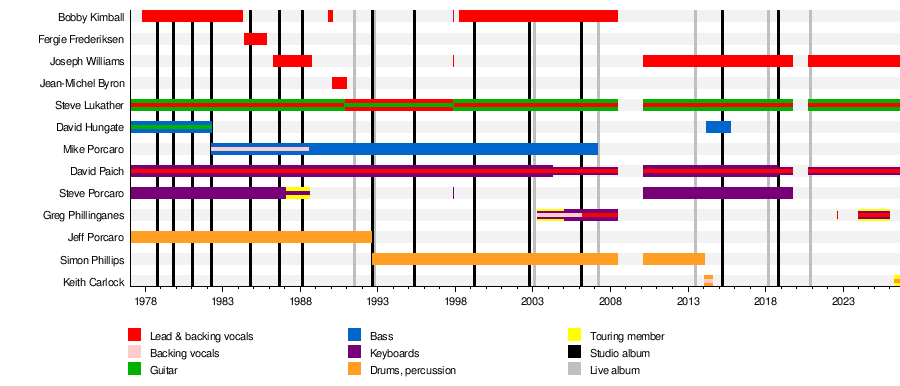
Steve Lukather became the lead vocalist for most of the nineties and backing singers got added, drummers came and went, and there have been enough band and touring lineup changes, hiatuses, and people returning between 1992 and the present day that their band member timeline looks like this:
and their touring lineup looks like this:
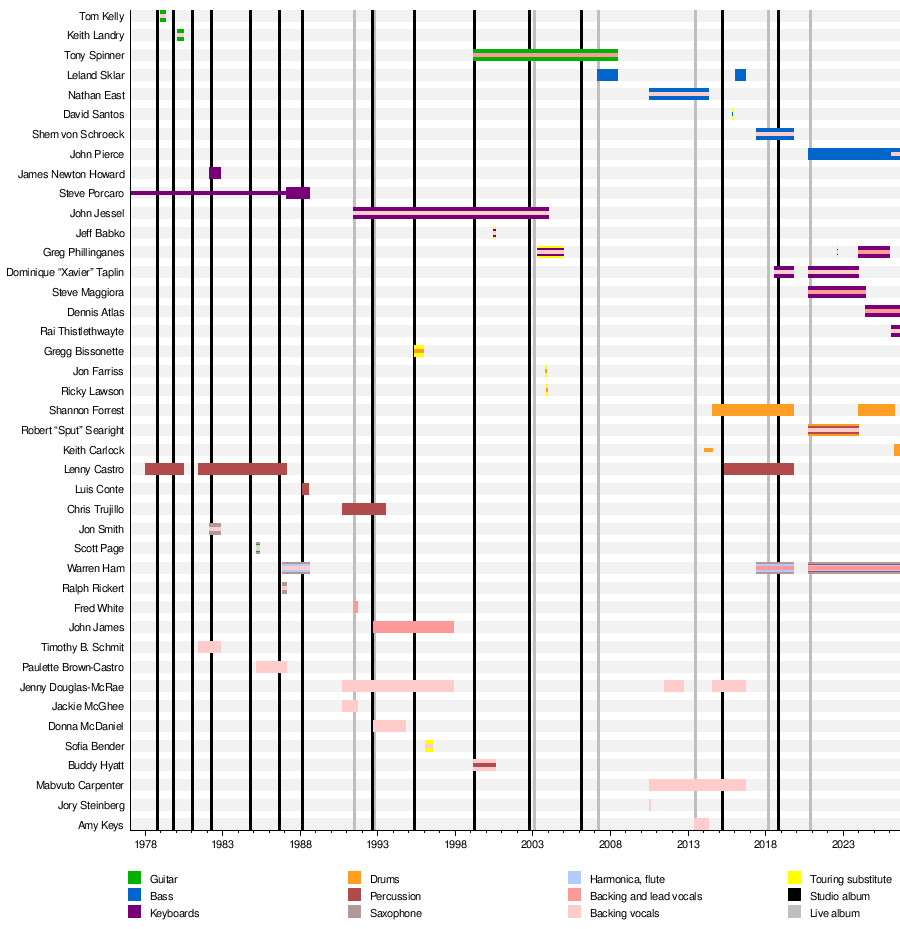
How the fuck do these exist for a band like Toto? It’s insane.
Between 1992 and the present day, they put out seven albums. I had gotten my fill of Toto by The Seventh One, so you’ll forgive me if I wasn’t as thorough with the back half of their discography. It’s certainly there if you’re curious and you want more Toto! They’re still out there and they’ve done fine for themselves. They have a healthy catalog of hits that keep them going.
The last time Toto really made waves was when Weezer covered “Africa” for their covers album in 2018. The Weezer version is… fine, if uninspired. There’s nothing really wrong with it, it’s just strange that it ended up being a viral, runaway cover hit for them. A lot of people I know do not like that cover, so it played a role in people rediscovering the Toto original… which led to a new generation discovering Toto. Toto songs never fully disappeared from the zeitgeist (their stuff still appears in plenty of places) but that Weezer cover gave them a level of attention they hadn’t seen in years. They were good sports about the whole thing, to the point where they repaid the favor and did a cover of Weezer’s “Hash Pipe.” It’s not bad! I’ve always considered Weezer to be the spiritual successor to Toto (in the sense they’re both solid bands made up of complete dorks who have stuck around longer than anybody thought they would) so it was kinda fun to see those two worlds collide. The guys in Toto seem like fine, upstanding guys I would enjoy having a beer with.
In recent days, some of the members of Toto appeared in HBO’s documentary about yacht rock (there’s a funny joke where Lukather jokes about the name, being pissed that he played on so many records yet never got enough money to afford his own yacht) and reflected on their time as superstars and how they helped shape the music of that era. Again, they seem like fine, upstanding guys I would enjoy having a beer with.
Toto will not reappear in this project, but the members of Toto will. I wouldn’t be surprised if we keep finding Toto members on some of the songs we cover in this project. Those guys truly said “yes” to any job as long as the check cleared. They had their brushes with super stardom for a brief moment, before their curse of always giving a boost to the careers of people who weren’t them (Rosanna Arquette, Cynthia Rhodes, every musician in the state of California who needed session men) continued, but don’t cry for them. In their time, the guys in Toto were the Atlases holding up the world. Think of their own music however you will, but things would be a lot different without them holding it down in studio sessions. They could do anything you asked them to. They were all-encompassing. With that in mind, maybe “Toto” was the only name that could have ever truly fit them.
Bonus Silver
Obviously, we’re starting this off by sharing the legendary episode of the web series Yacht Rock that told the 100% real story of how “Rosanna” was written. In this version, Steve Porcaro wrote a song so freaking awesome that Rosanna Arquette had no choice but to fuck his brains out. It’s a solid contender for the best episode in the entire series. So many amazing bits. Hollywood Steve being caught at the funeral for a loved one. The setup for Michael McDonald’s fear of becoming an irrelevant joke. Toto HQ (and the fact that none of the guys look anything close to Toto at all). The Canadian money joke. Christopher Cross’s too-late apology. “It’s called the 80s, and it’s gonna be around forever.” The look on Steve Perry’s face at 3:16. The radio DJ saying “forgive my Francais but fuckin’ shit!” in regards to playing the song. McDonald’s shocked look at the radio. It’s all so wonderful. Give it a watch and stay smooth.
In 2010, British hip-hop group Diversion Tactics sampled the song’s chorus for “Return of the Ladies Man.” Really good use of it! Check it out here.
In 2018, days before Weezer released their cover of “Africa,” they posted a cover of “Rosanna.” I forgot they did this, mostly because their cover of the song is absolutely atrocious. I’m so sorry, but Patrick Wilson can’t pull this off for shit and the shuffle is all wrong. Rivers Cuomo does not have the voice to pull this off either. I also think this is produced like shit. Give it a listen here. It will give you a greater level of respect for Toto if you didn’t have any before.
In 2023, The Hindley Street Country Club took on the song and did a really solid job with it. Give it some love on their Youtube channel here.


Leave a Reply