“I’ve been waiting for a girl like you to come into my life”
- Reached #2: November 28th, 1981
- Number of Weeks at #2: Ten Weeks
- #1 Song At the Time: “Physical” – Olivia Newton-John (Nine Weeks) and “I Can’t Go For That (No Can Do)” – Daryl Hall & John Oates (One Week)
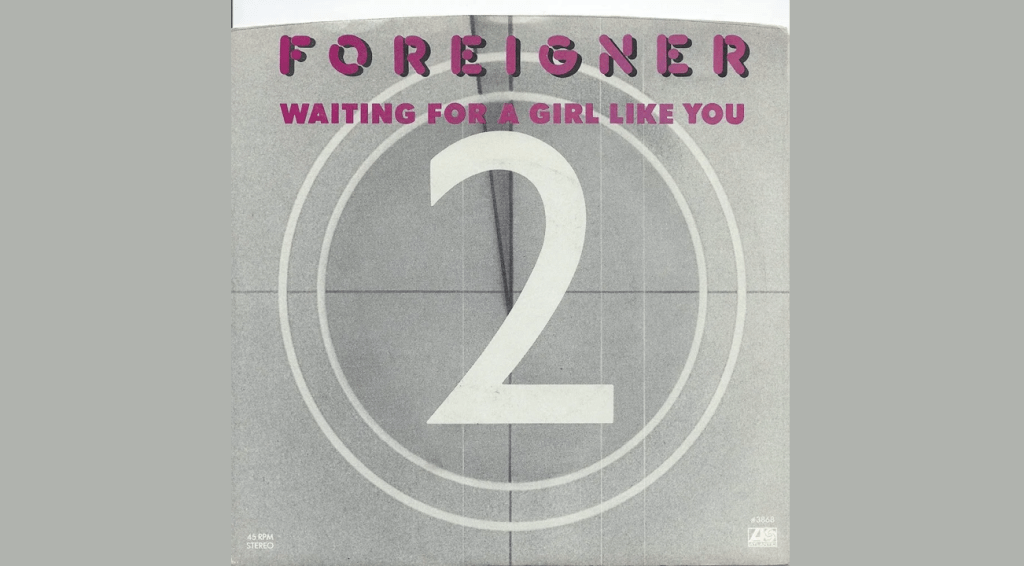
In the prologue for this project, I wrote out the reasons why I wanted to write about every single song that ever hit number two on the Billboard Hot 100 during the 1980s. I want to see how a decade of music is shaped by only looking at songs that were very successful, but just missed the top of the chart. I want to explore the stories behind those successful songs and the artists who made them. I want to see what songs beat them and try to offer an explanation as to why that might have happened. Are there number two hits that should have been number ones? Are there number two hits that shouldn’t have been hits at all? Those are the things I’ve aimed to do with this project. But, there’s another reason for this project’s existence, one song that served as the spark and inspired me to start exploring every number two hit in the eighties: Foreigner’s “Waiting For A Girl Like You,” the song that, along with Missy Elliot’s classic 2002 track “Work It,” still holds the record for most weeks at number two without ever reaching number one. That big “2” you see on the cover for the single is in reference to the song being the second single from Foreigner’s sextuple platinum fourth album, 4, but in hindsight it feels like they were cursing themselves, like they already sealed its fate upon arrival. ANTHB (Assigned Number Two Hit at Birth).
In the days before streaming changed the way the Hot 100 operates, the top spots used to work in a uniformed, orderly pattern like this: a song would rise and hit number one and another song would rise and get to the number two spot. If the song at number two stayed around for a while, it would have a pretty good chance at rising and becoming a number one if the current song that reached the top started losing steam and fell from the top. The problem for Foreigner was that their song came out at the same time Olivia Newton-John unleashed “Physical,” her smash hit that stayed at number one for ten weeks and blocked Foreigner from the top spot. When it finally fell, Foreigner looked like they might have had the chance to reach number one… but then Hall & Oates’ “Private Eyes” leap-frogged from #3 to #1 and the game was over after that. Just tragic. It wasn’t even just in America either!! This song peaked at number two for two weeks in Canada, blocked from the top spot by the Jon and Vangelis track “The Friends of Mr. Cairo.” There’s something astounding about how this one song just seemed to be cursed and doomed to loom right behind other songs, like the woman who’s always the bridesmaid but never the bride. Even more astounding is how the song was even a number two hit for so damn long, considering “Waiting For A Girl Like You” really isn’t even that good of a song to begin with!
“Waiting For A Girl Like You” is the kind of song that is tough to really tackle because I find myself conflicted about it. There are parts of the song that I really admire. I can hear what it did and how it helped shape the kinds of soft-rock/power ballads that followed in its wake. On the other hand, there are plenty of things I dislike about it that prevent it from being a song I enjoy going back to again and again. That said, the song is easily the most fascinating of all of Foreigner’s big hits, if nothing else than for its status as the one hit that marked a significant shift in their sound as they charged boldly into the eighties. This soft-rock ballad is a lightning-in-a-bottle that they managed to somehow catch three times, the second of those times scoring them a number one hit and the final time giving them their final Top 10 hit towards the end of the decade. Out of all the arena rock bands that dominated the scene in the late seventies/early eighties–Styx, REO Speedwagon, Journey (who will appear in this project very soon)–Foreigner were the ones that lasted the longest and saw the most success.
Foreigner’s story begins with guitarist Mick Jones, a British journeyman who had been in a number of different bands before finally starting his own. As a teen, he was a member of Nero & the Gladiators, an early-sixties group that only ever notched a few minor hits, namely a version of “In the Hall of the Mountain King” that sounds like it wouldn’t be out of place as a goofy needle drop in a terrible spy show. In the mid-seventies, Jones found himself in Spooky Tooth (absolutely killer name), the rock band led by keyboardist Gary Wright. They were never huge, but they retain cult classic status. If you enjoy obscure seventies rock bands, Spooky Tooth is one of those bands you can name drop to show people that you know ball.
Spooky Tooth broke up in November 1974, after which Jones joined up with guitarist Leslie West and joined his band for a spell in 1976. It didn’t last long and it left Jones stranded in New York City. Unsure of what to do, Jones thought that maybe it was high time he tried forming his own band, with blackjack and hookers. Luckily, New York City has no shortage of musicians looking to get on the ground floor of something big, so Jones started looking around and recruiting guys. He found a couple of good candidates, linking up with keyboardist Al Greenwood, former King Crimson founding member Ian McDonald, drummer Dennis Elliot, and bassist Ed Gagliardi. The only trouble was finding the right guy to be lead vocalist and frontman. Luckily for Jones, he just so happened to hear an album that featured a guy who sounded exactly what he was envisioning. Also lucky for Jones was that this vocalist was someone who needed a job.
Enter Lou Grammatico, a guy who had been the singer in a band called Black Sheep (decent name). Like the bands Mick Jones had been a part of, Black Sheep wasn’t the ticket to the big time. The band had released two albums in 1975 and were invited to join KISS on tour, but a truck accident destroyed their equipment and knocked the wind out of their sails. They broke up shortly after and I don’t blame them in the slightest! I’d probably jump ship too! Regardless, Jones and Grammatico’s paths crossed backstage at a Spooky Tooth show in 1974, where Grammatico gave Jones a copy of the first Black Sheep album. Jones still had that album and decided to give it a spin. He was blown away and believed Grammatico was the missing piece that this new band needed in order to really make it. After learning that Black Sheep was done, Jones invited Grammatico to audition with this new band he was putting together. Grammatico auditioned, got the job, chopped off part of his last name to become “Lou Gramm,” and this new band was ready to get started. Mick Jones and Lou Gramm would become the twin flames of the band, both serving as the band’s main songwriters and sonic architects.
The last things to solve were giving this band a name and finding a record label to champion them. The band’s original name was Trigger (awful name) and once they made a demo tape, they started shopping it around. They were rejected by every place they took it to. However, as these stories usually go, all it takes is one person to really believe in it and give them a fighting chance. Atlantic Records A&R man John Kalodner had seen the tape from Trigger on the desk of Jerry Greenberg, Atlantic’s president. Kalodner had listened to a tape from another band named Trigger and discovered this new tape wasn’t the same one. Kalodner convinced Greenberg to take a chance on the band, arguing that at least one of the songs on the tape had the potential to be a hit. Kalodner won and the band got signed, but, since there was already a band with the name Trigger, they were gonna have to change theirs to something else, which is fine! That name sucks! Mick Jones ended up proposing the name Foreigner (there it is!) and thought it reflected them well. Three of the band members were American (Gramm, Greenwood, Gagliardi) and three of them were British (Jones, McDonald, Elliot), so no matter where they went, they would always be “foreigners.”
The newly-christened Foreigner quickly got to work and spent the rest of 1976 rehearsing and working on the songs that would become their self-titled debut album, released in March 1977. That album was an immediate success, going quintuple platinum and giving the band their first three major hits: “Feels Like the First Time” (peaked at #4), “Cold As Ice” (peaked at #6), and “Long Long Way From Home” (peaked at #20). They had arrived.
Their sophomore album, 1978’s Double Vision, did even better than the first one. That album went seven times platinum and spawned even bigger hits, like “Blue Morning, Blue Day,” the title track, and “Hot Blooded,” a song I cannot hear without thinking about it soundtracking WKRP in Cincinnati’s pathetically lovable Les Nessman giving himself a makeover, courtesy of a hairpiece from Mr. Macho. They carried that momentum into 1979 with Head Games, the first album to introduce a change to the lineup when bassist Ed Gagliardi was fired and replaced with Rick Wills, the first part replaced in a band that would eventually become the musical equivalent of the Ship of Theseus. That album brought them two more big ones: “Dirty White Boy” (crazy they wrote a song about me and some of my friends) and “Head Games.” As the band moved into the eighties, they were getting ready to make their fourth album, which would be called 4 and would have that title because it was their fourth album (woah, no way!) and because Foreigner would go from having six guys to only four. Ian McDonald and Al Greenwood got canned by Mick Jones after they expressed wanting to take a more active role in songwriting. Jones wanted it to be clear who’s band it was and wanted to keep control of the songwriting between him and Lou Gramm. Session musicians were brought in to cover what was lost with their departures. They also brought in a producer that would take them to even greater heights: Robert “Mutt” Lange. South African producer, Ex-husband of Shania Twain, and guy who looks like he would come in third place in a Rowdy Roddy Piper look-alike contest. In the seventies he had produced Clover, the band Huey Lewis was in before becoming a superstar, and bands like Boomtown Rats, The Rumour, and Outlaws. His best work would happen during the eighties. By the time he got on board for 4, Lange was just coming off of producing AC/DC’s monster album Back in Black. 4 was the first project he took on after getting AC/DC to the next stage. Foreigner was already a hugely successful, streamlined, commercial rock powerhouse, but maybe Jones felt like they needed to find somebody to make them sound bigger in the wake of the band becoming a quartet. Maybe he knew that things were starting to change as the new decade got started and felt like they needed to find somebody who could give them a sonic update. Whatever the reason, Lange was a good choice and would go on to become one of the main drivers of how rock would come to sound in the eighties. He knew how to take what already worked for the band and make it bright, clean, crisp, and bigger than they had ever been. He did it for Foreigner and would go on to do the exact same thing for the Cars when they made Heartbeat City. I can tell you that the process of making 4 took longer than expected, to the point where Lange had to leave towards the end to produce Def Leppard’s High ‘n’ Dry (which began his long relationship with that band).
Listening to the Foreigner discography leading up to “Waiting For A Girl Like You,” there really is no song on their first three albums that sets a precedent for this. They always had keyboards and synthesizers as part of their work, but this song is different. That almost Eno-esque ambient intro has that specific kind of eighties spaciness and twang to it that gives the song a great start and creates an atmosphere that’s strange yet inviting. It pulls you out of one world and takes you to another. For a song all about finally finding the person you’ve been waiting so long to find, that intro sounds like the moment they appear before you and you realize you’ve finally found them. It sounds like clarity and the way it leads into the main keyboards and synths of the first verse is well done. It’s one of those things that still sounds like the future. That whole intro was cooked up by Thomas Dolby, the guy who is mostly recognized for being the one who brought us the 1982 classic “She Blinded Me With Science.” He was a session musician before striking out on his own. Working with Foreigner was one of his first big jobs. That intro and the way it’s weaved through the song gives it something it was missing in its earlier state. When 4 got re-released last year in a Deluxe Edition package, an early version of the song was included before Dolby’s parts got added into the mix. The song is pretty much the same, but it feels a lot emptier. Dolby’s contributions completely change the vibe of the song and give it a more haunting and beautiful quality, to the point that he probably should’ve gotten a songwriting credit for that significant addition, but I don’t get to decide those things (and I doubt Mick Jones was looking to add another name besides his and Gramm’s). Without his contributions, the song just sounds like a leftover Eagles track.
Lyrically, this song is simple and par for the course when it comes to eighties power balladry. Lou Gramm meets a girl and it’s love at first sight. He’s been searching so long for this girl that he just somehow knows this is it. This is the one. He moans, “When you love someone, it feels so right, so warm and true.” He needs to know if the girl feels the same way. He asks her, “Won’t you tell me if I’m coming on too strong?” Considering this is the early eighties, he probably is! But he also talks in the second verse about how “when we make love it’s understood.” So, whatever he said obviously worked. The chorus is all about how he’s been waiting for a girl like this one to come into his life and make him feel alive, bring him a love that will survive. The usual stuff. I will say this, if the lyrics, “From the moment I wake up ’til deep in the night / There’s nowhere on earth that I’d rather be than holding you tenderly” was the thing he said to this girl to get her on his side, that’s probably what hooked her. If you sound like Lou Gramm singing those lines, I imagine that probably works on some sweet girl somewhere.
It’s weird to listen to this song during the day, because if any song in this project so far has sounded like night music, it’s this song. The whole song has this cool, relaxed, vibe to it that just fits the early night, when the sun has just gone down and the night is just beginning. This song can perfectly soundtrack a walk down a city street in the early night, when you’re just looking around at your surroundings and seeing the neon lights of stores turn on, the soft lights of restaurants, the air getting a bit colder and relaxed. Lou Gramm delivers the lyrics not in his usual strained yowl, but in a smoother, cooler tone. I vibe with what’s going on… and then he sings the chorus and I’m taken out of it entirely.
That’s the tough part about “Waiting For A Girl Like You.” There are plenty of things I like about it and realistically there should be enough about it that works to get me to give the song two thumbs up… and yet, there are too many parts that just don’t work for me and make me click off. For starters, I like what the song does during the pre-chorus, but absolutely hate what the chorus does and I think it’s Gramm at his absolute worst vocally. If you want me to get hyper-specific, it’s the way he sings and holds the word “waiting” that I can’t stand. He sounds like a whimpering dog every time he does it and I don’t like it. “I’ve been Wait-eeen.” The backing vocals whispering and repeating the phrase “waiting for a girl” throughout the chorus are unnecessary and add nothing. It’s trying to fill up space where it doesn’t need to. The song has enough going on in it through its built-up atmosphere that’s great! It doesn’t need that pointless addition.
I like that little keyboard moment at the 3:40 mark, where the song fades down and that little keyboard bit brings the song back to the main synth riff played towards the start. One place I do like the backing vocals is when they chime in with “I’ve been waiting for a girl like you” during the outro. They’re pretty and I think they add to the atmosphere of the song in a better way. What I don’t like is Gramm doing vocal ad-libs for the final minute of the song. The final minute should just be instrumental. Actually, the more I’ve sat with it, the more I think some of my issues with this song would be solved if I had a proper instrumental version of it. I found one on Youtube that was pretty good and I’m starting to prefer listening to it that way. But even then, “Waiting For A Girl Like You” isn’t a song I love. It’s a fine song and it’s a well-crafted hit, but how it stayed as a number two hit for ten weeks still eludes me. I’ve never had to hear this or any Foreigner hit too many times, but I imagine if I had to hear this several times a day on the radio for ten weeks, I’d probably start getting tired of it pretty damn fast.
The biggest problem with a lot of Foreigner is that even at their best, they’re fine. Not amazing, not terrible, they’re fine. They made plenty of music I like, but they never made anything I really love. The more that I’ve sat down preparing my thoughts on this song and the band, the more I’ve realized they are not that interesting to learn about and engage with. At least Styx had drama! I’m continually enthralled by the story of two guitar playing knuckleheads who grew to despise the cornball dork who just wanted to make rock n’ roll showtunes! Journey and REO Speedwagon had to be around for a decade before anybody really wanted them! Foreigner, by contrast, were successful right from the drop and somehow maintained that success for longer than any of their peers. They are not an album band, which I learned by marathoning their first four albums and learning I wasn’t missing much. I could’ve just listened to any Greatest Hits album and called it a day. They don’t have a truly great album the way REO (Hi-Infidelity) or Styx (The Grand Illusion) or Journey (Escape). Their albums all have about three great songs each, but nothing really in the way of deep cuts, besides maybe “I Have Waited So Long.” There’s nothing wrong with being a band that makes single statements! But it makes you wonder how Foreigner moved so many units. What was so special about them that made them so successful so damn long? It’s headscratching.
It especially doesn’t help when Mick Jones talks about the writing of songs like “Waiting For A Girl Like You” by talking about them like he was struck by divine inspiration and the muses carried him to the finish line. Here’s Mick Jones talking to Songfacts about the song:
“Sometimes it’s sort of mystical where these ideas come from.” My brother, we’re talking about a fucking Foreigner song. That whole rant is a bunch of bullshit from a guy who’s trying to make this all sound more artistically grand than it really is. Foreigner was not a band that made high-brow art. They made commercialized rock songs with the edges sanded smooth. They made rock songs for the guy who talks up a big game about how his Friday night is gonna get sooo crazy and wild and how he’s really going to let loose, only to later find himself throwing up in an Applebee’s parking lot by 9:00 PM after getting a tummy ache from drinking two beers and telling the waitress she’s hotter than any Instagram influencer. I won’t deny that “Waiting For A Girl Like You” left an impression on him. Plenty of artists make a song and just know they’ve made something that’s gonna hit. He’s also definitely right that it’s still a song that a lot of people like and still play at weddings or when making playlists for their significant other. This song still means something to people, but let’s also be real: there’s nothing “mystical” about this or any other Foreigner song. There was nothing that special floating around that only the dudes in Foreigner knew how to grasp. We take pop music seriously here, but we can also zoom out and look at the bigger picture. We have to be able to ask ourselves, “What are we doing here, man?”
I also really love this story from Lou Gramm’s memoir about recording the song.
He admitted that he pretty much made this up, by the way. I doubt you needed me to tell you that. I’m not doing this as a “gotcha!” I’m sharing these because I always find it funny when old rock n’ roll guys blatantly lie about stuff and don’t even try to make it sound believable. I don’t think any crazy thing has ever happened while Foreigner–of all bands–were recording albums.
I still haven’t answered the million dollar question: why couldn’t “Waiting For A Girl Like You” beat out Olivia Newton-John’s “Physical”? Easy. Olivia had the right song for the right moment. She also had the more fascinating narrative that gave the song extra intrigue. Olivia Newton-John, the soft Australian balladeer who used to sweet and innocent songs like “I Honestly Love You” and “Hopelessly Devoted To You” had shifted gears and become a woman with a more sexy and assertive look and persona. She basically did what Sandy in Grease did and it worked beautifully. Also, the music video helped. A lot. Foreigner were never great playing the music video game, while Olivia was a natural. Your mileage may vary on the short haircut she was rocking at the time, but she is spellbindingly hot in that video. The idea to dress Olivia like an aerobics instructor and having her try to get (gay) men into shape made for great imagery that allowed for the kind of sexually-charged energy that was just hot enough to be able to show on cable (a new concept at the time). The hazy Vaseline filter over the whole video gives it this weird shine that still looks strangely cool even now. There’s a brightness on Olivia, thanks to the brightly colored leotard she wears, that makes her look angelic in certain shots. Giving the song that imagery of aerobics was perfect because the song hit right at the moment that aerobics classes and videos were becoming popular. Shortly after the song was a hit, celebrities like Richard Simmons and Jane Fonda would take that craze all the way to the bank. Timing and what’s going on in the world at large is important when looking at what becomes a hit and why. Also, early eighties Olivia Newton-John getting lustful and telling you things like “let’s get animal” and “let me hear your body talk” is a slam dunk. Foreigner stood no chance.
The song might not have been a number one, but the album was. 4 stayed at number one on the Billboard 200 Album Chart for ten weeks (it also became the album with a numerical title to do that, if you’re a fan of useless fun facts). They scored a final Top 30 hit from 4 with “Juke Box Hero,” which might be their strongest hit.
In 1985, Foreigner finally made up for their ten weeks at number two when “I Want To Know What Love Is” became a number one hit for two weeks. That one became a number one purely due to them going as over the top as possible and creating the power ballad to end all power ballads. The lyrics are stronger, the hooks are sweeter, the chorus soars, and the fucking choir they put behind them is just the icing on the cake. It’s a much cheesier song, but a better song all around. The final minute of the song is mid-eighties excess at its finest.
1984-85 saw Foreigner promoting Agent Provoceteur, their fifth album and their last to achieve multi-platinum status. There was one more hit off of the album when the second single, “That Was Yesterday,” hit #12. Foreigner’s last album of the decade came in 1987 with Inside Information, with lead single “Say You Will” peaking at #6. The band’s final Top 10 hit was in 1988, when “I Don’t Want To Live Without You” peaked at #5. By the time that song came out, Mick Jones knew that every Foreigner album needed its own version of “Waiting For A Girl Like You.” Normally, I would call this a desperate attempt to make lightning strike more than once, but Foreigner avoided this by having each of their attempts to recreate the success of “Waiting” result in songs that I like more than “Waiting For A Girl Like You.” If I had to pick a favorite romantic Foreigner song, it would be “I Don’t Want To Live Without You” without a second thought. That one is very beautiful and I really like it. There are much worse final Top 10 hits to have.
In May 1990, Lou Gramm left the band to focus on a solo career and open for the Steve Miller Band. Mick Jones decided to do what he did whenever somebody decided to leave Foreigner: find a replacement. Mick Jones replaced him with singer Johnny Edwards, who had been the frontman for a bunch of small bands I’ve never heard of and Montrose, when they reunited in the late eighties (Montrose was the band that Van Halen’s Sammy Hagar was in before he became a superstar in his own right). Foreigner released their seventh album, Unusual Heat, in June 1991. It was the first album in the band’s history to not go platinum at all. Listening to the two singles from the album, “Lowdown and Dirty” and “I’ll Fight For You,” I can tell you that it failed for two reasons: 1) It’s middle-aged hair metal album made right before Guns N’ Roses, Pearl Jam, Nirvana, and Metallica all released unbelievable albums within a forty-four day stretch and became the new kings. 2) It’s a Foreigner album made in the nineties. Their moment was nothing but a distant memory. What the fuck were they still doing here?
In 1992, Lou Gramm’s solo career and the new band he founded, Shadow King, wasn’t doing well. Mick Jones and Lou Gramm reunited in Los Angeles (during the L.A. Riots, of all times to patch things up) and decided to renew their creative partnership. They wrote and produced three new songs for a Foreigner Greatest Hits album, The Very Best… and Beyond. The “Beyond” part was advertising the new songs that begin the album. They got good enough buzz from the song “Soul Doctor” (which peaked at #5 on Billboard’s Mainstream Rock Chart) that they decided to try and stage a comeback with 1994’s Mr. Moonlight. By this point in time, Foreigner only had two original members in it, which were Gramm and Jones. It was not the comeback they hoped for, as Mr. Moonlight became their worst selling album. Makes sense. I have never met a soul who has ever said, “Yo, turn on that nineties Foreigner.” Mr. Moonlight marks the last time the band ever charted on the Hot 100, which is when the song “Until The End Of Time” peaked at #42. After that, they were done as a recording act and became a touring machine, delivering the hits from their glory days year after year. Lou Gramm struggled in the late nineties when he underwent surgery to have a brain tumor removed. He was prescribed medicine that led to weight gain and a weakened singing voice. He left Foreigner again in early 2003, which left Mick Jones as the only original member still standing.
It happened slowly over decades, but Foreigner eventually became the music industry’s go-to example for a rock band becoming the Ship of Theseus. In early 2024, Mick Jones announced that he had developed and been struggling with Parkinson’s disease for some time. He still occasionally appears on stage with the band and is still listed as a member, but also not really. At this point, I just assume he kinda looms in the background and plays wise sage for them, like he’s Gustavo Rocque guiding the boys in Big Time Rush. Foreigner is not the only band that exists without any original members. There were two versions of the band Yes at one point in the 2010s. Blood, Sweat & Tears still exists with no original members. The Platters, the Drifters, the Four Tops, the Coasters are all vocal groups that continue to exist without any original members around. Molly Hatchet and Lynyrd Skynyrd don’t have any original members. Former You Got the Silver subject The Spinners still exist without original members. I say all of this because for some strange reason, Foreigner is the thing everyone thinks of when I ask for a band that has no original members. For some strange reason, people get pissed that there are six guys running around performing as “Foreigner” but had nothing to do with the creation of the music they’re playing more than anyone else. I imagine that people would be less pissed if they just simply called themselves… anything else. The problem people have seems to be that it’s false advertising, which it really kinda is, but if I’m being honest, I just find it really funny that people think it’s a horrible betrayal to the good name of Foreigner to have six dudes masquerade as the band. We are not talking about a sacred institution. We’re talking about Foreigner, of all bands. Who fucking cares! Honestly, just let those new guys pretend to be the real thing. Who are they truly hurting?
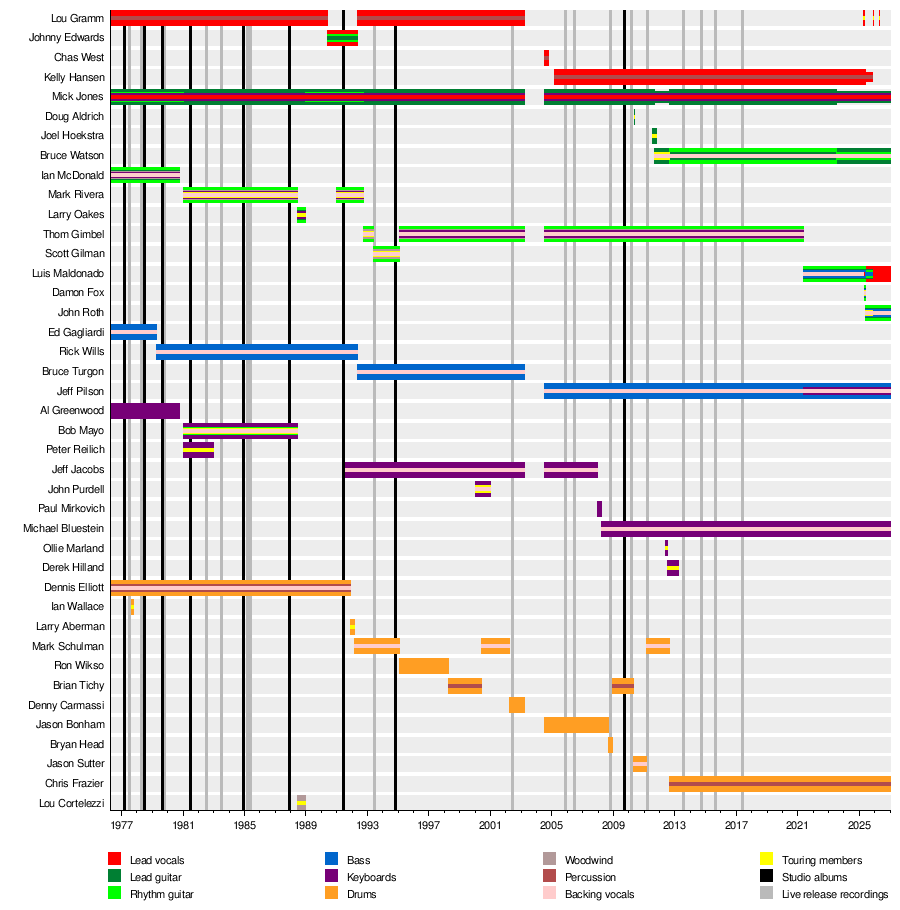
(“How the fuck is this a real timeline that exists…”)
Hot Take: I want them to keep calling themselves Foreigner and I want to see if we can keep it going for fifty more years. I want to be in 2076 and Foreigner is still somehow touring. I want to see if we can go for, like, three more complete sets of replacements. At Foreigner’s centennial, I want to see six guys get up on stage who were all born in the 2040s. I want Foreigner to become a fluid state of being. If you and five of your boys are hanging out together, you can achieve a heightened state and be allowed to call yourselves Foreigner if you are true believers. You become hot blooded if you are true and pure of heart, cold as ice if your heart is full of lies.
Foreigner will not return in this project and I’m not confident that they will ever disappear from the world. Mick Jones has somehow orchestrated a concept, a thing that can and will outlive him. His story is ultimately a tragedy akin to Frankenstein. He wanted to create a band and he did by using players he found in New York. It came to life and eventually broke away from him and started living a life of its own. Besides Lou Gramm (who left of his own will), Mick Jones slowly removed all the original parts until Foreigner could move on and become a self-sustaining and ever changing machine divorced from its creator. Was it worth it?
Bonus Silver
In 1996, R&B group 4U did a cover version for their Just For You album. The wildest part of this cover is when they do the echoing “wake up wake up wake up wake up” bit from Marvin Gaye’s “Sexual Healing” right before the first verse. Now this is how you make a song your own. Listen to that one here.
In 2005, Rick Springfield, a guy who will appear in this project soon, recorded a cover version of it for The Day After Yesterday. Check it out here.
Lil B, the Based God, quasi-rapped over an instrumental version of the song in 2011 for the freestyle “It’s Alright.” Thank you, Based God. Give that a listen here.
The song was included as part of the 2005 jukebox musical Rock of Ages, which got a film adaptation in 2012. The film version is here.
The third episode of Stranger Things opens by cutting between Barb dying a brutal death and her friend Nancy Wheeler getting it on while “Waiting For A Girl Like You” plays. Check it out here.


Leave a Reply