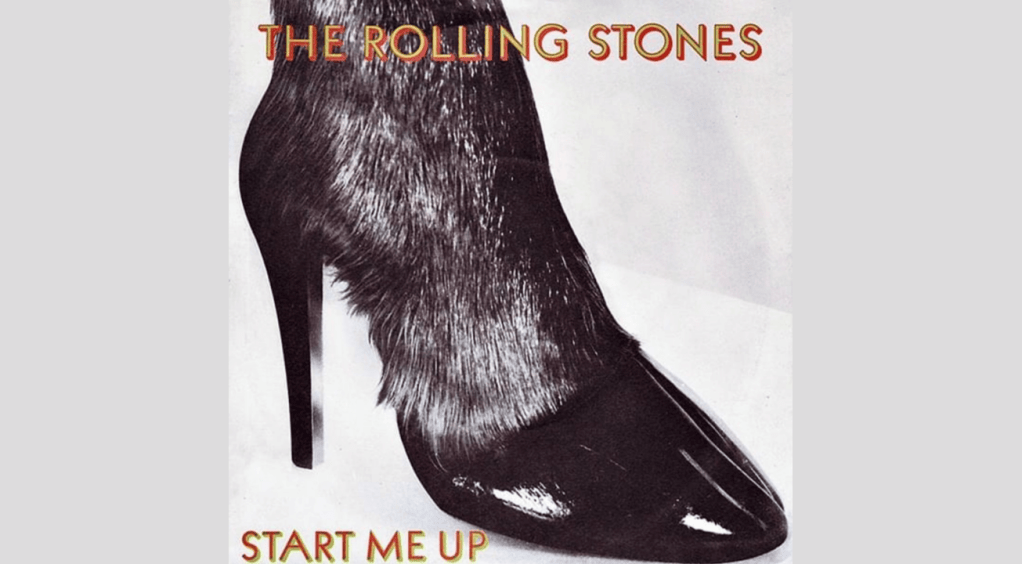
“I’ve been running hot / You’ve got me wrecking, now don’t blow my top”
- Reached #2: October 31st, 1981
- Number of Weeks at #2: Three Weeks
- #1 Song At the Time: “Arthur’s Theme (Best That You Can Do)” – Christopher Cross (One Week) and “Private Eyes” – Daryl Hall & John Oates (Two Weeks)
“This song isn’t about a car, is it, Dad.” No, it is certainly not about a car, though I certainly thought it was when I was a kid who didn’t know any better. My poor dad had to explain sexual innuendo to me when I asked him what the line “You make a dead man come” means. I’m certain I’m not the first nor last person to not fully grasp what Mick Jagger is really singing about. I have a feeling nobody has ever given a shit that “Start Me Up” is just a song about having sex. The Stones have had plenty of hits that are songs about sex (Examples: “I Can’t Get No Satisfaction,” “Let’s Spend the Night Together,” “Honky Tonk Women,” “Brown Sugar,” “Beast of Burden”) but “Start Me Up” might be the most impressive. The innuendo is very easy to catch, but it’s also a song that’s been used in advertising so much that I don’t think it even registers as a sex song anymore. Microsoft paid $3 million to use it in an ad to sell Bill Gates’ ubiquitous operating system! Ford used it to sell cars! You still hear it used at all kinds of sporting events before the start of games or before the action gets going! We’ve officially turned it into something else. By 1981, the Stones were creeping up on twenty years of their career and beginning to slide into middle age, but with “Start Me Up” and Tattoo You–an album that remains one of the best of their entire career–they provided they still had the juice to create an enduring hit after so many years. The story of the last truly classic Stones hit is a story of pulling something out of the trash that you originally thought was bunk, but then realizing you almost threw away a crown jewel after giving it a good polish and trying again. “Start Me Up” is what happens when the greatest rock band to ever do it isn’t getting along with each other and their frontman needs to cobble together a bunch of old demos and pieces lying around in order to stitch a new album of songs together before a big American stadium tour. It shouldn’t have worked and it wouldn’t have worked for a lesser band, but the Stones were always a different beast. They could stare down any challenge and come out of it with a devilish grin.
First, a quick disclaimer: The history of the Rolling Stones is incredibly long (they’ve existed for over sixty years now), storied, complex, and complicated. Their story from 1962 to 1981 alone has so much within it that someone could write a book longer than Infinite Jest and they would still probably miss some stuff worth touching on. This is to say that for our purposes here, I’m only offering a very abbreviated history lesson on this band. If we cover every single moment, this post will be the length of a novella by the time we’re done. So, if you notice there are things that are glossed over, don’t worry too much. The Stones have enough books, podcasts, interviews, and documentaries on them that can give you much more than what this will offer and those sources are worth seeking out if you have any interest in the band or their history beyond this. With that out of the way, let’s get started.
The Rolling Stones were born through the West London club scene in 1962, when singer Mick Jagger, guitarist Keith Richards, and multi-instrumentalist Brian Jones joined forces. That trio was joined by bassist Bill Wyman, human metronome/drummer Charlie Watts and pianist/keyboardist Ian Stewart (who quickly got demoted from member to being road manager and a touring member). Once formed, the Stones played in and around various pubs and clubs, notably becoming the house band for the Crawdaddy Club when it opened in 1963 (that’s to the Stones what the Cavern Club was to the Beatles). The legend goes that Jones was the one that gave the band its name after seeing “Rollin’ Stone” written on a Muddy Waters LP when he was on a phone interview and asked what the name of the band was.
In the beginning, they were nothing more than a cover band.Their entire set was just American blues music from the fifties and had no originals. In the earliest days, Brian Jones was the leader, acting as the band’s manager, promoter, and the guy steering the ship. In 1963, Andrew Loog Oldham stepped in and became their manager, bringing with him a few changes. For starters, he knew that they’d be making better money and have better odds at a sustained and successful career if they started writing their own material instead of giving out songwriting royalties to others. He ordered Mick and Keith to learn how to start writing their own songs, which began the birth of a songwriting partnership that would rival Lennon/McCartney. The first Jagger-Richards composition to become a Top 10 hit in America was “The Last Time” in 1965. Right after that, the next big hit was “(I Can’t Get No) Satisfaction,” the song which became a number one hit on the Hot 100 and started putting them in direct competition with other British Invasion bands like the Beatles, the Who, and the Kinks, after the Stones had previously struggled to find American success.
The Stones also made a name for themselves in America by becoming the anti-Beatles, an idea spearheaded by Oldham. The Beatles were clean-cut, charming, respectable mates who all dressed the same and lads you could bring home to mom. The Stones, by contrast, were dirtier, rougher, and more wild. The Beatles were viewed as a soft breeze, the Stones were a hurricane. Nevertheless, once the Stones arrived, they kept a steady momentum going. They scored several number one hits through the second half of the sixties: “Get Off My Cloud,” “Ruby Tuesday,” “Paint It Black,” and “Honky Tonk Women.” The Glimmer Twins (the nickname for the Jagger-Richards songwriting partnership) were the guys who were now steering the ship and the sonic direction of the Stones, much to Brian Jones’ dislike.
While the Stones never lost their roots as a straightforward blues band, they evolved into an incredibly versatile rock band through the Glimmer Twins’ songwriting. Listening through the Stones discography as a kid, they were the ones that provided a gateway and first real taste of genres like blues, psychedelic-pop, country, reggae, hard rock, and so much more. As a multi-instrumentalist, Jones added a lot of texture to those early Stones albums and allowed the Stones’ more experimental ideas to come to life, but Jones was also a self-destructive figure who was hard to work with and getting increasingly uninterested in where the band was heading. Jones’ drug use was getting worse and they couldn’t tour in America by 1968 because he was denied entry due to earlier drug arrests. He started distancing himself from the band and becoming increasingly unreliable around that time, with Beggar’s Banquet being the final album to have significant contributions from him. He would be credited on two songs from 1969’s Let It Bleed, but was given the boot on June 8th, 1969 after Jagger and Richards had gotten fed up with him not showing up to sessions or having much interest in working with them. Guitarist Mick Taylor replaced him and Jones joined the infamous twenty-seven club when he died in his pool under mysterious circumstances less than a month later. It’s a shame. A promising young talent who self-destructed.
It wasn’t all sunshine and rainbows for the Stones though. Just a few days after releasing 1969’s Let It Bleed (the album that contains the song this project got its name from), the band ended their U.S. tour with a free concert/festival at Altamont Speedway in California, with Santana, Jefferson Airplane, the Flying Burrito Brothers, CSNY, the Stones, and the Grateful Dead all on the bill. It ended in complete disaster. What was meant to be “Woodstock West” ended up turning into a nightmare when the Hells Angels biker gang–who had been hired as security for the event–turned stabbed and killed eighteen year old black man Meredith Hunter during the Rolling Stones’ set. Three other people died during the event. The events at Altamont go far beyond what we’re here to cover, so if you want more information on that whole thing, you can read this or just watch Gimme Shelter, the stunning 1970 documentary that captures the Stones’ 1969 U.S. tour as well as everything leading up to and including Altamont.
Despite all that, the Stones toured through 1970 and returned with 1971’s Sticky Fingers, one of the finest rock albums ever made.The entire album is just a beautiful front-to-back odyssey that is quintessential Stones. If you’ve never listened to it, do yourself a favor and fix that. Same with 1972’s Exile On Main Street. They spent the seventies as world travelers (mostly because of their status as tax exiles) and great experimenters when it came to making albums like Exile, 1973’s Goat’s Head Soup, and 1974’s It’s Only Rock n’ Roll. They scored two more number one hits during the first half of the seventies: 1971’s sex-fueled rocker “Brown Sugar” (great song that totally doesn’t have anything controversial about its lyrics at all…) and 1973’s “Angie,” the heartbreaking ballad of two poor lovers parting ways. I could easily make a Top 30 list of every great track the Stones put out during the seventies and there would still be things I’d have to cut. I know this all sounds like glazing, but understand that in their prime, they really were that good.
In December 1974, guitarist Mick Taylor had endured enough and left the band (and effectively ended my dad’s favorite Stones era). There’s a couple reasons why he split. For one, he wasn’t getting songwriting credits where he felt he deserved them. It was when he didn’t get credited for what he brought to “Time Waits For No One” (the guitar soloing is some of his absolute best) that ended up being the last straw for him. That, coupled with him and Keith Richards not really getting along and his drug use (he got hooked on heroin) reaching a point of no return and finding it hard to survive the Stones lifestyle all makes for good enough reasons to split. By the end of ‘74, the Stones themselves had started feeling burnout, so he might have thought the band wasn’t going to last much longer anyway and felt like getting out was the best move. He ended up being very wrong, because the band kept going for decades. But at the time, who the fuck could’ve confidently told you that in 2026, the Rolling Stones will still exist and both Mick Jagger and Keef will still be alive and in their eighties? That’s like betting on the New York Jets to make it to the playoffs and win a playoff game.
Mick Taylor left right as the band was getting ready to start work on what would become their 1976 album Black and Blue, so they had to figure out what the hell they were going to do and who they were going to find to take Taylor’s place. They also weren’t entirely sure which direction they should be heading in, so Black and Blue ends up being a mish-mash of a bunch of different ideas, like funk (“Hot Stuff”), reggae (their cover of “Cherry Oh Baby”), straight ahead rockers (“Hand of Fate”, “Hey Negrita”, “Crazy Mama”), jazzy blues (“Melody”), and mellow balladry (“Memory Motel” and “Fool to Cry”). They were also recording as a way to put out a new album and audition a new guitar player. Harvey Mandel and Wayne Perkins are each on a few tracks, but the guy who got the job was former Faces guitarist Ronnie Wood. He stepped in and has now been with the band for fifty years. He picked a really good moment to show up and there’s an argument to be made that his presence saved the band. He brought a new energy to the room, got along with Keith, and immediately fell into a groove with the rest of the band. There’s no mistaking what Taylor brought to the band and what they lost when he left, but Wood brought his own style to a band that needed some new life and energy. Black and Blue is an album that I really love, even if a good number of people argue it’s their weakest seventies album. “Start Me Up” was born during the sessions for Black and Blue, which we’ll talk about in just a moment, I promise.
The mid-seventies were a bit tough for the Stones commercially. They were in a bit of a slump and you might even say they were a bit chopped. As the late seventies arrived and punk started rising up in the U.K., the Stones were seen as a bunch of geezers. Out of touch and old hat. They were considered “unc” if you will. They needed to do something to prove they still had it. So, they released 1978’s Some Girls about it, an album where they met the current moment by taking their sound and infusing it with the raw, rough, and rowdy energy of punk and even dabbling in a bit of disco, which gave them their final number one hit (“Miss You.”) There was a new guard coming up in rock music, but the Stones were still here and they weren’t going anywhere yet.
The Stones took that rejuvenated energy and flew into the eighties with Emotional Rescue in June 1980. It’s a fine album, but it isn’t one I tend to go back to much. That said, the title track, a disco-tinged groove in the vein of “Miss You,” is still solid and became a #3 hit. 1980 was also where the first hints that Mick and Keith were not getting along started showing. The eighties would end up being the toughest decade for them to endure, both commercially and interpersonally, but there was one undisputed triumph early in the decade: Tattoo You, released on August 24th 1981. It is widely agreed to be the final album of the Stones’ prime years.
Tattoo You, on paper, should be a complete disaster and you should be able to hear right through it and be able to tell that it’s a Frankenstein’s monster of a work. It’s an album made by a band that wasn’t getting along and were barely in the same room with one another, to the point where it’s a project mostly led by Jagger. It’s an album that exists purely because the band and management needed something to release and promote during their giant U.S. stadium tour and they needed new rockers to play, but there wasn’t any time to write anything new and keep the tour scheduled. It’s an album made entirely out of canned songs and scrapped ideas that the Stones had previously thrown away, with some of them thrown away as early as 1972. “Start Me Up,” the album opener, was originally born during the sessions for Black and Blue in 1975, reworked during the making of Some Girls in 1978, and was finally finished in 1981. “Tops” and “Waiting For a Friend” were canned in 1972/73 and still have Mick Taylor (who wasn’t credited and eventually demanded royalties from the album) on the backing track of the finished versions. “Slave” and “Worried About You” were worked on during the Black and Blue sessions. “Black Limousine” was born during the Some Girls sessions, and everything else were things left over from Emotional Rescue. In another world, Tattoo You is a mess and it sounds like a rush job; a horrible, stitched-up monstrosity that’s the musical equivalent of The Appetizer from Spongebob.
But it’s not! The entire album is amazing and it remains probably my favorite album that the Stones ever did. You’d be forgiven for not knowing anything about the strange way the album came into being. It’s like watching Alfred Hitchcock’s Rope, the 1948 movie that follows two murderers hosting a dinner party for a friend they just murdered. Rope is the film where Hitchcock attempted to film the entire thing in one long take and use as few cuts as possible. When you watch it now, the cuts and the way Hitchcock hides them are a bit obvious, but when you lose yourself in the illusion and immerse yourself in the film, you don’t really bother noticing or trying to find where the cuts are. Tattoo You works in a similar way. It’s created and put together in a way that it offers the illusion of a standard rock album and the cuts and stitches are easy to forget about. You can also think of it like a car. It’s fascinating to learn what all the different parts are and how they work together to create something you can drive around in, but you don’t have to necessarily know what every single little piece of the car is and what it does in order to drive one. Jagger, the band, and the crew that made Tattoo You hid the album’s origins as a bunch of refurbished rejects really well. Nobody in 1981 suspected that “Start Me Up” was a song that had been born six years prior, but it worked out that the Stones found themselves in a moment when the number two spot of the Hot 100 was getting nostalgic and looking backwards, rather than forwards. In a time when a bunch of musicians who were pushing middle age were suddenly finding themselves with number two hits, the Stones couldn’t have arrived with “new” material at a better time.
In a 1995 interview with Rolling Stone, Mick Jagger reflected on Tattoo You and its material, arguing, “It doesn’t have any unity of purpose or place or time.” I disagree about its lacking unity of purpose (Side One is all rockers, Side Two is all chilled out ballads, all of it unified as “we need new songs to play on the road this year”) but I do agree with his argument that it doesn’t have unity of place or time. That’s not a bad thing. If anything, that’s one of the biggest reasons why I think “Start Me Up” has endured the way it has. It doesn’t feel like it belongs to any one moment or place and that means something. It was born from a jam in 1975, but it fits the Stones’ overall style so well that they realistically could’ve released this song at any point during that 1975-81 era and it wouldn’t have felt out of place.
“Start Me Up” is a great track because there’s no special tricks with it. It’s as straightforward of a rock song as the Stones ever got. It locks into that main riff and groove and rides it for the entire song. That riff can and will get lodged in your brain if you allow it to. I’m not a guitar player, but it sounds like something that’s easy and really fun to play for a while (Keef cited it as a favorite riff in 2012). That main riff is the foundation of the entire song, running through every verse and only changing during the chorus. Charlie Watts provides a simple backbeat with his signature flourishes and it has such a great weight behind it. I’ve heard this song thousands of times, but this was the first time I ever really took notice of Bill Wyman’s bass playing on this one. It’s fucking incredible! It sounds thick and great. The little things he adds in the spaces between Mick’s vocals and the way he weaves through what the guitarists are doing is simply sublime. My old man used to say that Bill was the last Stone you took notice of when sitting with a track and he’s still right. The whole song has a simplicity to it that just delivers in the best ways. It doesn’t waste my time. Once it gets going, it never stops (heh heh). It gives me that good shit and fills me with the exact same feeling that all great Stones songs give me: “I should go wild and start driving down the freeway recklessly” or “I need to fight somebody just for the thrill of it.” It’s a song where once it grabs you and has a hold, it won’t let go. I’ve tried fighting against it, since I’ve heard it hundreds of times, but every now and again I find myself letting go and letting the song take me again. That little escalation and “WOO!” that Mick lets out near the 2:15 mark is the same sound I make when I find myself getting into the song. Great little moment. Also, I haven’t mentioned it yet, but Jagger’s vocal performance on this track is superb. Honestly, all of Tattoo You showcases just how electric and great of a frontman and vocalist Jagger was.
The song’s biggest issue and hurdle to overcome, both for the listener and the song’s status as a big hit, is being absolutely ruined by overplay. My dad had that problem with this song. He had heard it for over thirty-five years and went through phases of “This song kicks ass” and “This fucking song has been beaten to death and I’m tired of always hearing it.” My dad had to hear it in all those ads for Microsoft, at sporting events, when he saw the Stones live, and back in the days when he was stuck with classic rock radio. He had it bad. I’ve had that same issue of overplay, but it’s been greatly lessened by the fact that I haven’t lived as long to have heard it as often as he had to. Still, I know it’s a song that requires you to hear it a bunch and then, hopefully, you don’t have to hear it in places for a while. If you’re lucky and you can return to the song with fresh ears, it’s like a refreshing glass of lemonade in the sweet summer sun. You can hear it again and go, “God… DAMN! I forgot how good this shit was!” Before writing this, I hadn’t revisited the song in a while, so I was able to do that. Believe me when I say that this shit holds the fuck up.
“Start Me Up” initially started life, supposedly, as a reggae tune in 1975 during the sessions for Black and Blue. I say “supposedly” because there is a 1975 demo of the song floating around on Youtube, but it sounds pretty damn close to what the finished version of the song sounds like. There’s a short reggae-ish break in the middle, but not enough that I believe the song ever fully sounded like that. If it did, there’s no audio I can easily point to in order to prove it. Still, the demo of the song that’s available on Youtube is still eye-opening and this marks the first time on You Got the Silver where I have a demo version of the song that I can listen to and talk about. The demo has a variation of the finished song’s main riff, written and provided by Keith Richards, running through the song. There are barely any lyrics besides the phrase “never stop,” though there’s an interesting moment where Mick sings the line “start it up” and then sings a different melody, almost as if you can hear the gears turning in real time and he proceeds to start developing what will become the main vocal melody. That’s the really cool thing about demos. You get to be a fly on the wall and really get a taste for how songs evolve and develop.
The backing track you hear on the finished song is a take from 1978, which was a rock take after the song had found itself being cut as a reggae tune repeatedly. The band tried it again when making Emotional Rescue, but still couldn’t get it right. Tattoo You associate producer Chris Kimsey was the one who revived the song and believed it was worth finishing. It was also the song that kickstarted Kimsey’s thought that Tattoo You could be an album made from leftover Stones material that never got used. Jagger also thought the song had potential, so he took the rock take they had, wrote lyrics for it, and turned it into the finished song that became a hit. The Jagger/Richards songwriting partnership was similar to Lennon/McCartney in the way that both of them were credited, even if only one of the two actually wrote it. “Start Me Up” is a genuine collaboration from the two. Richards brought in the main riff and the basic structural ideas, Jagger wrote the words and eventually tightened it up into the rock song that eventually appeared on the album.
“Start Me Up” is, plain and simple, a song about having sex and how he’ll never stop if you get him going. Next to “Sex Drive,” it’s probably the Stones song with the most blatantly obvious lyrics about sex, though Jagger does disguise it with a barrage of car innuendos. If you start him up, he’ll never stop. He’s been running hot. You’ve got him leaking, going to blow his top. He tells you to kick on the starter, give it all you got. He calls the woman of his fancy a mean, mean machine. You get the idea. The only time Jagger gets any kind of vulgar with it is towards the end of the song, when he sings, “you make a dead man come,” which is more funny than anything. In a song where Jagger is singing about getting his rocks off via car innuendos, it feels like he uses the last lyrical moments as a way to try and remind you that even in middle age, he’s still a little rebellious and wants to try and get away with a little sleaze. It’s also funny to hear him just decide to drop the act and stop playing coy at the end of the song. This all works because by 1981, the Stones had built up enough cool cred that they could get away with a song like this. This would’ve sounded a little silly if a younger, more fresh band on the come up had tried it. People would’ve seen through it too quickly and made fun of it. But the Stones were a different breed. They had already delivered sleaze, so this was just building off of what they had already done before.
Maybe I’m giving them too much credit since I’m still a huge Stones fan, but, rewatching the video for the song (which I hadn’t watched in a long while), Mick Jagger really does have an unmatched aura that allows him to play for a camera and do it in his own bizarre, coked up fashion, and still somehow remain one of the coolest motherfuckers around. He struts, dances, does his thing and it doesn’t look awkward or weird, which is how it would look if I tried doing anything he does in the video. Maybe it’s rose-tinted glasses for a time I never got to be a part of, but the Stones really do just have this classic cool to them that makes them magnetic to watch. I know you hear it a lot, but seriously, we don’t make ‘em like this anymore. Also, it’s nice to see ol’ Charlie Watts again. I love the close-up shots where you see his “You see what I put up with?” face mixed with the times he’s smiling and having a good time. Shoutout to the moment at 2:25 where Charlie and Bill shoot that look at each other that just says, “There they go again, those crazy bastards.” If you’re a classic rock lover, it’s just easy to fall for these guys. There’s a reason we’ve let them stick around as long as they have.
The studio track of “Start Me Up” is great, but I think it really takes on new life in a live environment. The band gets to play it in that signature style where they’re a little sloppy and loose, yet still tight as hell, and they get to play with a bit of increased tempo. It makes for a great concert opener. My personal recommendation is when they played it in Atlantic City in 1989. There’s no guitar solo on the original track (I imagine they didn’t get that far when initially laying down the basic track that eventually got used) but when played live, they get to wander a little bit and the results are always fun to hear.
“Start Me Up” is often considered the last major hit the Stones ever had, but it was not the last time they hit the Top 10 on the Hot 100 during the eighties. The years after “Start Me Up” and Tattoo You would end up being their most tumultuous. Jagger and Richards entered a feud that wouldn’t be patched up until the end of the eighties. They weren’t getting along during the making of 1983’s Undercover, which was full of interpersonal drama and tension. Jagger wanted to keep the band current and explore modern sounds. Richards, who had finally started getting sober after a decade of debauchery, wanted to bring the Stones back to their blues rock roots. Undercover is far from a masterpiece, but it’s a fascinating era to explore since the Stones were one of the first middle aged rock bands that had to figure out how to modernize and get with the times. They wouldn’t be the last rock band that had to figure that out. That said, “Undercover of the Night” is still a certified heater and it was a #9 hit.
After 1983, the Stones were more or less on hiatus and were treated as a broken unit. Mick Jagger started getting a bit high off his own ego, to the point where on the final stretch of the ‘81 tour, you can see the jumbotron would introduce the band as “Mick Jagger and The Rolling Stones,” which really pissed off Richards. There was a point in time where Jagger thought he could be bigger than the Stones. He certainly tried to make that happen. He spent the mid eighties trying to launch a solo career that would do just that. It didn’t work, but there were still some highlights. He did a few team ups: In 1984, he and Michael Jackson delivered “State of Shock,” the only truly memorable moment from the Jacksons’ terrible Victory album. In 1985, he linked up with David Bowie for a cover of “Dancin’ in the Streets,” which is known for being a fun and decent version, but much more remembered for giving us possibly one of the gayest music videos of all time. You can view it in glorious 4K quality now.
The Stones “reunited” in 1986 for Dirty Work. I say “reunited” because none of them were really in the room together while making that album. I still think it’s their worst album, but you can find defenders who have argued it’s aged better than other works made around the same time by the Stones’ peers. I will say this: “One Hit (To the Body)” has grown on me over time. I like that one. However, I do not extend that same kindness to their cover of the 1963 Bob & Earl song “Harlem Shuffle,” a song that hit #5 on the Hot 100. I do not get why people like that one and call it the one highlight from Dirty Work. It’s the Stones operating at their most autopilot. Ugh. Personally, no thanks.
The Jagger/Richards feud kept going until 1989, when the two finally buried the hatchet and got the band back together in style. For my money, I’m willing to bet it was because the two realized they needed each other and were better together than they were as separate forces. They released their comeback album Steel Wheels in August 1989 and it outsold Undercover and Dirty Work by going four times platinum. They also scored their final Top 10 hit with “Mixed Emotions.” Of all the work they’ve done after their prime years, Steel Wheels remains my favorite. It’s a strong comeback and it’s one I will continue to defend and love despite knowing people tend to argue that it’s not great.
After Steel Wheels, the Stones were well into middle age and proceeded to become rock’s premier elder statesmen. Across thirty-seven years, they’ve only made five more albums: Voodoo Lounge in 1994, Bridges to Babylon in 1997, A Bigger Bang in 2005, Hackney Diamonds in 2023, and now Foreign Tongues, which came out earlier this month (you can make it six if you count Blue & Lonesome, their 2016 cover album of blues songs). They’ve spent the last third of their career doing whatever the hell they want and make new music whenever they feel like it, which is perfectly fine. By the nineties, they were rock royalty and could get away with just touring and playing an assortment of songs from their massive catalog. They never found a way to eclipse what they did on Tattoo You, the album that every reviewer always cites when they want to tell you a new Stones album is really good. I remember when Hackney Diamonds came out, that was the comment I saw the most from critics. “Their best since Tattoo You.” I’ve already seen that comment used to describe Foreign Tongues. Is it their best since 1981? I don’t care. I will tell you that Foreign Tongues isn’t mindblowing, but I do think it’s fine for what is probably the last Stones album that will ever exist. If it’s not, I think I’ll lose my mind at how nothing seems to stop them. Based on recent reports about them not touring this year and possibly considering residencies instead, I have a feeling that the end of the Stones is on the horizon sooner than we think. Nothing lasts forever.
The Rolling Stones will not reappear in this project, but they will never disappear. They’re too important to the fabric of rock history and they’re still the gold standard, even all these years later. If you haven’t explored the Stones, do yourself a favor and explore their prime years. Pick any Stones album made in the seventies and get started. Their work through that decade is a generational run and none of them will disappoint you. Even the mid-seventies albums that are usually considered “weaker” like Goat’s Head Soup, It’s Only Rock n’ Roll, and Black and Blue still have intriguing moments that make those albums worth spending time with and studying, even if they’re not the greatest thing you’ve ever heard. It would be impossible for me to synthesize every great track they did during the seventies. I have lived with their 1969-1978 run since childhood and have loved it for over half my life. It’s one of those things where if there are weak moments, I can’t hear them. They were so fucking inventive and ever changing. Just when you think you’ve heard every trick they have in their bag, they would pull something new out that would make you look like a fool.
Even when this band physically dies and leaves this mortal coil, they will continue to live on spiritually. As long as you stick your tongue out and start going wild whenever rock music is playing, the essence of the Stones will never die. They’re a freight train that just keeps running down the tracks at breakneck speed, laughing and enjoying the freedom of being wild, rough and tough, sex-hungry maniacs. We started them up and now nothing will ever stop them. We’re better for it.
Bonus Silver
In 2001, reggae band Toots and the Maytals recorded a reggae version of “Start Me Up” for a Stones tribute album. I can see what Keith Richards might have originally been going for when he was initially writing the song. Give it a listen here.
In 2003, the fictitious SNL-turned-quasi-real comedy band The Folksmen–consisting of Christopher Guest, Michael McKean, and Harry Shearer–performed a hilarious rendition of the song on Late Night With Conan O’Brien. If I had a nickel for every fake band Michael McKean has been a part of, I’d have two nickels (not a lot, but interesting that it’s happened twice). It’s delightful and you can check it out here.
In the Glee episode “Never Been Kissed,” the girls on the show perform the song by mashing it up with Bon Jovi’s “Livin’ On a Prayer.” It’s pretty bad, but it’s peak 2010. If you’re curious, listen to it here.
Not a cover of “Start Me Up,” but it is another song that uses the line “make a dead man come.” Blues singer Lucille Bogan sang the line as part of the hilariously vulgar and fascinating 1935 recording “Shave ‘Em Dry.” It’s not out of the realm of possibility that Jagger knew about this song and that line when writing lyrics for “Start Me Up.” She’s the closest the thirties ever got to having 2 Live Crew. She walked so Megan Thee Stallion, Cardi B., and Cupcakke could run. Listen here.


Leave a Reply