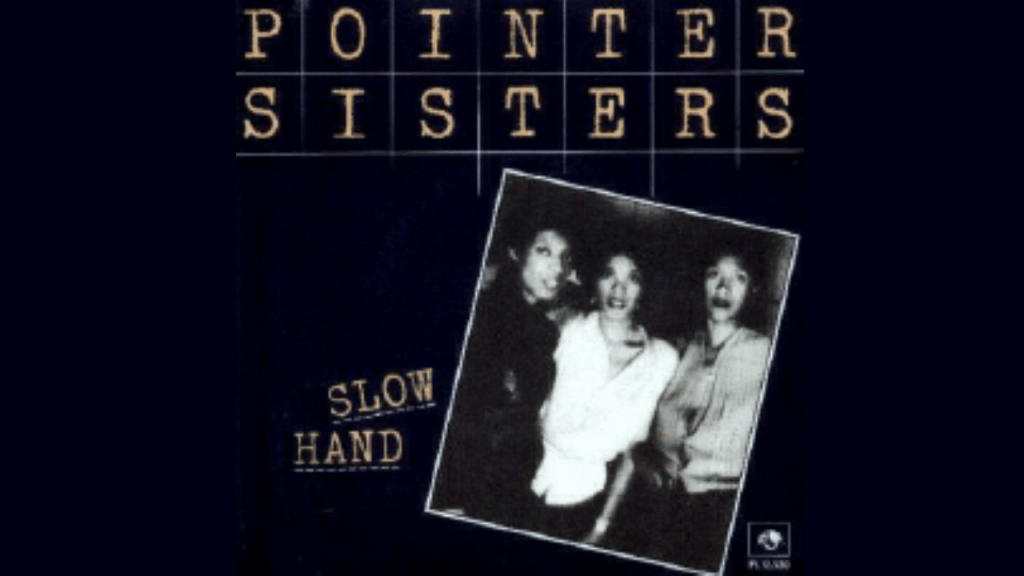
“When it comes to love, I want a slow hand”
- Reached #2: August 29th, 1981
- Number of Weeks at #2: Three Weeks
- #1 Song At the Time: “Endless Love” – Diana Ross and Lionel Richie
Once is an accident, twice is a coincidence, three times is a pattern. This is now the third time this project has covered a black artist that got started in the sixties, found success in the seventies, and scored their biggest hit in the early eighties. The first time was when Grover Washington, Jr. and Bill Withers teamed up for “Just The Two Of Us.” The second time was with Smokey Robinson and “Being With You.” This time, we have a trio of sisters with a sensual and romantic ballad about the desire for passionate lovemaking, but a slowed down and gentler version. They were tired of fast moves and their slow groove scored them a silver medal.
Let’s just get right into it. In the beginning, there were four Pointer Sisters: Ruth, Anita, Bonnie (who will have left the sisters by the time “Slow Hand” is made), and June Pointer. The sisters hailed from Oakland, California, under the religious and watchful eye of the Reverend Elton and his wife Sarah. The girls grew up around gospel music and learned to sing through participation in their local church, Church of God in West Oakland. The Pointer parents were deeply religious, being the types that believed rock n’ roll and blues music was the devil’s music. You can guess what kind of music the sisters sought out and sang along with when the Reverend and his wife weren’t around. Even with that interest in other music, the church was where each of the sisters received their first vocal training and first audiences.
After graduating high school in the late sixties, Ruth and Anita both got married and began having kids, while Bonnie had bigger dreams. She had dreams of stardom! Bonnie enlisted the help of baby sister June (who is still a teenager at this point) to help her become a singer and the two became a duo, Pointers Au Pair (doesn’t sound quite right. There’s gotta be a better name). The two started performing in clubs in the Bay area. Before long, Anita quit her job, joined the duo, and changed the name to the Pointer Sisters (there it is! Much better.) The new trio started touring and provided backing vocals on studio sessions for the likes of Grace Slick, Sylvester, Boz Scaggs, Taj Mahal, Elvin Bishop, and Betty Davis.
In 1971, Atlantic Records vice-president Jerry Wexler heard the sisters singing for Elvin Bishop at the famous Whiskey-A-Go-Go in Los Angeles and signed them to a deal. Their debut single, “Don’t Try To Take the Fifth,” is perfectly fine, but there were a lot of songs in 1971 that sounded like it. This wasn’t a hit by any means. These days, you would only really go back to it as a curiosity to see where the Pointers got their start. At this earliest stage, it’s hard to imagine they will eventually evolve into eighties dance floor darlings. But you gotta start somewhere!
The Pointers couldn’t find much success with Atlantic. They got taken in and signed to the Blue Thumb label once their Atlantic deal was done in 1972. Meanwhile, Ruth Pointer had been watching her sisters from the sidelines (and occasionally filling in for June) and noticed they were enjoying themselves despite the lack of success. Ruth decided that she should get in on the fun too and the Pointer Sisters became a quartet in December 1972.
When the Pointer Sisters started recording their debut album in 1973, they made the choice that they were gonna tell the Top 40 to go kick rocks. They were gonna sing the kind of music they wanted to make. The kind of music they picked was old school jazz, scat, and bebop. They committed to this and took the idea further by choosing to sing their new songs in old threads. They hit thrift stores and looked for things that were trendy in the 1940s. This meant a lot of floral dresses, wide-brimmed hats, feathered boas, knotted pearls and platform shoes. The throwback look won them praise when they performed on stage and it became the original Pointer Sisters style. I had never heard their debut album prior to writing this. I only know them from their prime hitmaking years in the eighties. I can happily report that their debut absolutely fuckin’ rules. Listen to songs like “Cloudburst,” “Jada,” and “Sugar” to get a good idea of what they were doing. You’ll be glad you did. The sisters’ debut received strong reviews and they scored their first Hot 100 hit and got up to #11 with the album’s opening track, the Allen Toussaint-penned “Yes We Can-Can.” Once that hit, the ladies were off to the races (and dressed like they were ready to go to the races as well).
Their second album, 1974’s That’s a Plenty, continued in the direction that had made their debut strong, doing their own rendition on old forties songs like “Salt Peanuts” and “Black Coffee” (both of which feature the great Herbie Hancock on piano), but that wasn’t got got peoples’ attention. The song that became the Pointers’ second Hot 100 Hit was the song “Fairytale,” a country song penned by Anita and Bonnie. That song crossed over into the world of country music and led to the Pointer Sisters being the first black women to perform at the Grand Ole Opry in Nashville, Tennessee. They also won Best Country Performance by a Duo or Group at the Grammy Awards in 1975, which is noteworthy because a black woman wouldn’t win that award for fifty more years (it was Beyoncé).
The sisters scored their only R&B #1 in 1975 with the funky “How Long (Betcha Got a Chick On the Side),” another song penned by Anita and Bonnie. In 1976, the sisters moved from the wax to the screen, appearing in the Richard Pryor flick Car Wash (where they perform their song “You Gotta Believe”) and showing up for some memorable appearances in Sesame Street, with “The Alphabet Song” and “Pinball Number Count.” One two three four five, six seven eight nine ten, eleven, twelve! That song has absolutely no right going as hard as it does, but Sesame Street always had a certain swag to it that remains unbeatable. The sisters were doing well for themselves, but they were about to have some trouble, as well as a bit of an identity crisis.
June Pointer was suffering with health problems during 1976 and Bonnie was contemplating leaving to become a solo act. The last Pointer Sisters album to have all four sisters was 1977’s Having a Party and even then, June is only on the title track. After that, Bonnie left the group and signed to Motown for a solo career that had middling success. Ruth, Anita, and June spent the bulk of ‘77 wondering if they could continue on without her. They were also thinking they were in a bit of an artistic funk. They were starting to feel stifled by their forties throwback image and success as a jazz act. The sisters decided to stick together and soldier on as a trio. If the sisters were going to head into a bold new chapter, there needed to be some bold new changes.
In 1978, the Pointer Sisters returned in a big way. Everything was brand new and the Pointers were ready to reintroduce themselves to the masses. For starters, they threw out the old wardrobe and started adopting a more contemporary style. Also, the sisters’ deal with Blue Thumb was up and they decided to take a deal with Planet Records, where they met and started working with producer Richard Perry, known for his work with Barbra Streisand and Carly Simon. He helped strip the past away from the sisters and brought them into a more modern world with the album Energy. That album is great and it’s a killer set of songs. Considering most of the songs on the album are originally rock songs from white bands, my guess is that Perry had a big hand in selecting most of them. Regardless, the trio sound amazing on these songs. Their version of “Dirty Work” might be better than the Steely Dan original. Ruth delivering the Bob Welch-era Fleetwood Mac tune “Hypnotized” is fan-fuckin’-tastic. Other songs like their versions of “As I Come of Age” and “Echoes of Love” are also killer. But there was one song that ended up being a major hit. It was when they scored a #2 hit on the Hot 100 with a song originally written by Bruce Springsteen (who will eventually appear in this project. That song was “Fire” and it made them a silver medalist in two decades. They did not think it was going to be a big hit and they did not know who Springsteen was when they recorded it. It didn’t matter. It’s a great song and a Springsteen-penned song can take you places (just ask Manfred Mann’s Earth Band).
1979’s Priority tried the same tricks–having the sisters do songs from mostly high profile white rock bands–but it didn’t quite work as well as it did when Energy did it. Richard Perry and the sisters were gonna need something else to really keep the fire (heh heh) burning. They switched things up a little for 1980’s Special Things, bringing in more synths and adopting the kind of R&B and pop production that was the style of the moment. Special Things was the album where Perry and the Pointer Sisters finally found the sound that would carry them into their most successful period. The big song from that one was “He’s So Shy,” a #3 hit on the Hot 100, a certified heater, and the blueprint for a lot of what they would do going forward. It still sounds like a version of the future and I can’t imagine how this must have sounded when hearing it in 1980. This is great (all of Special Things is, go listen to it).
The stage was now set for “Slow Hand,” the lead single from 1981’s Black & White and the second time the Pointers became silver medalists. Richard Perry knew it had the potential to become a hit because it was basically the sisters doing “Fire” again. It’s a slow, romantic song detailing intimacy and Anita Pointer is on lead vocals. But “Slow Hand” is different because the sisters sound way more comfortable on it and it’s in a style that suits them better. “Fire” is too much of a Springsteen song for the sisters to truly rip him out of it and make it their own. With “Slow Hand,” they were able to recapture what made “Fire” a hit, but do it in their own distinct way.
1981 was a year full of women delivering songs about romantic desires that were written by men. Consider: Karen Carpenter wanted you to touch her while you’re dancing with her. Olivia Newton-John wanted to get physical and hear your body talk. This song is a third entry in that category, being written by Michael Clark and John Bettis (the guy who’s most famous for writing Carpenters hits like “Top of the World” and “Goodbye to Love”) and having Anita Pointer give you clear and easy instructions on how to give her good love and the correct speed you should use when the lovemaking starts.
Anita’s instructions are simple and sweet: She wants a man with a slow hand. She wants a lover with an easy touch. She wants somebody who will spend some time and not come and go in a heated rush. She wants somebody who will understand. Is that really too much to ask? It should be easy to find someone who fits that description, but, as the old saying goes, a good man is hard to find. Men historically don’t like taking their time and they don’t usually consider tenderness and real care to be essentials when it comes to pleasuring women sexually. Think of it like this: If a man with a slow hand was commonplace, would we need an entire song about it?
In a lot of ways, “Slow Hand” has a good deal in common musically with Smokey Robinson’s “Being With You.” Both songs are very soft, breezy, sensitive tunes driven mostly by electric piano and a steady groove that runs throughout the song, fitting the nature of the lyrics being all about taking your time and not rushing. This is the kind of song that soundtracks a nice nighttime car makeout session. You’re not going at it like crazy, you’re just enjoying the night, enjoying time with your partner, and keeping a good pace. If not that, it’s a song to dance to in the kitchen while making dinner with someone. It fits well with the other R&B songs we’ve covered in this project so far, smooth and breezy love songs that focus on tenderness, devotion, and love that lasts. The main difference between this and the other two songs we covered is this: They didn’t have Anita Pointer on them, who delivers one of her best lead vocal performances here. She’s soft, sensitive, and sensual without sounding small and meek. She’s self-assured and in command the entire time without forcing anything. She’s the one setting the pace and she delivers it in a way that you would look foolish if you denied someone like her. She’s not asking for too much. Take some time and love her the right way.
Anita brought the same things to “Fire” that she does here and it’s no surprise Ashe was the one who took the lead this time. She’s fantastic on this track. Anita was usually the lead vocalist of the group, but one cool thing about the sisters was that they all got their chance to shine on songs that became hits. They were always really smart when choosing which sister took the lead on which song and that’s evident here. Ruth Pointer’s voice was a bit too deep and husky to really pull off what Anita does here and June Pointer tended to be the lead on their more bouncy, excitable songs like “He’s So Shy” and “Should I Do It,” so she wouldn’t have been right for the lead either. Spending time with the sisters’ discography, you start to learn just how damn smart they were when it came to selecting who sang lead on what song. Ruth, Anita, and June all knew their strengths and weaknesses and were able to say, “Hey, you should take the lead on this one.” One thing I’ve always admired about the sisters is how unified they sound together and their chemistry. You can hear that chemistry and that vocal blend during the chorus and second verse of the song. When Ruth and June come in and emphasize phrases like “slow hand,” “easy touch,” and “heated rush,” they pack such a punch. Even when they join Anita during the end of her sentences in the second verse, it’s the same thing. The three are a perfect unit and they never overpower Anita’s lead, they enhance it at just the right moments. It’s simply stunning. It’s not a Diana Ross situation where she’s clearly the star and the other Supremes are treated like second fiddles or like having Gladys Knight and being able to enjoy her, regardless of whether the Pips are there or not. If you removed Ruth or June from the mix, you would lose something integral.
One interesting thing I find when listening to this, especially after having written about “Just The Two Of Us” and “Being With You,” is just how good of a year 1981 was for R&B. The pop hits of the early eighties tend to get forgotten and cast aside because they don’t fit in line with what the eighties became. 1980 and 81 often get dismissed as “bad” or “mid” years for pop music because of that. While I suppose that can be argued, my assessment is this: the mainstream pop music and number ones of that moment might have been lacking, but a good deal of the R&B and black pop hits of the time were great! “Slow Hand” is great proof of that, but 1981 also had Raydio’s “A Woman Needs Love *Just Like You Do).” Champaign had the classic “How ‘Bout Us.” Earth, Wind, & Fire unleashed “Let’s Groove” that year! Lionel Richie forgot he was an easy listening balladeer long enough for The Commodores to burn it up with “Lady.” Anybody who tells you the early eighties didn’t have heat isn’t looking in the right places. I don’t agree with people talking smack on the early eighties. 1981 was a good fucking year.
There’s a music video for this song and since we are now past August 1st, 1981, that means MTV is now on the air. We’ll wrangle with that beast in a special post soon. I have such an affection for early music videos because there’s such a simplicity to them. It was the wild west and videos had no standard mold yet. They also hadn’t become a constant contest of artists trying to one-up the successful video that came before. You will eventually see both of those things happen as we go along. The video for “Slow Hand” is just the three sisters in nightgowns on a bed singing the song. They look lovely, especially Anita. I adore the hazy, angelic bloom filter they put on. The whole video has a dreamy look to it, but I also laugh that every single woman over the age of thirty back in the day got that treatment. I call it “The Maddie Hayes Filter” because that’s how Cybill Shepherd got filmed on Moonlighting all the time and that’s the first thing I think of, but you can also look at any woman that ever appeared on Star Trek to see the same effect. Still, the sisters look glamorous and they would only get more so as the decade went on. They came a long way from thrifting clothes from World War II.
In the wake of the success of “Slow Hand,” the Pointer Sisters only got more successful. The first half of the eighties would bring their best and most enduring hits. “Should I Do It” was a Top 20 hit right after “Slow Hand,” an underrated little sixties throwback tune with a cute Happy Days inspired video and a solid June Pointer lead.
In 1983, the Pointers released Break Out, their most successful album and the one I guarantee you know the most songs from. That album still sounds like a future we were robbed of. It’s an incredibly solid and fun album and sounds like the blueprint for the entire aesthetic Grand Theft Auto: Vice City wanted to capture. Just listen to “Automatic,” a contender for one of the greatest songs of the entire decade. Even more than “He’s So Shy,” this song must have sounded like it came from another dimension, or a timeline where we really did get ivory tower buildings and flying cars. Everything about it is just fucking amazing. I’m in complete awe every time I hear Ruth Pointer get insanely low and bellow “a u t o m a t i c” at the end of the chorus. I need you to know that wasn’t a vocal effect Richard Perry put on her, she could just get her voice low and do that naturally. It’s a transitory listening experience if you’ve never heard it.
Break Out plays like a Greatest Hits CD at times because it might as well be one. “Jump (For My Love),” “I Need You,” “Neutron Dance” (that got featured in Beverly Hills Cop), and deep cut “Dance Electric” are all certified dance floor heaters. The sisters were so powerful during that 1983-84 era that they remixed 1982’s “I’m So Excited” (a modest #30 hit upon release) and turned it into a #9 hit on the Hot 100. I enjoy this song a good deal and I just can’t hide it. And yes, I know what immediately popped into your head as soon as the song got mentioned (good scene even after being memed to death).
Who the fuck was gonna tell me the Pointer Sisters were part of “We Are The World,” the infamously cornball 1985 charity single event that featured every major star of the moment (and Bob Dylan)? Every time I feel I can list every person that appears in it, I rewatch the video and see someone I’ve never registered before. I genuinely forgot past You Got the Silver subject Smokey Robinson was in the chorus of stars. I don’t think I’ve registered that every single one of Michael Jackson’s siblings (except Janet) and Sheila E. are present. Sorry for getting off topic, that song just keeps delivering new observations.
The Pointers scored their last major hits in 1985 and 1986, with the songs “Dare Me” (featuring a cool boxing themed video with the sisters dressed as old time gangsters) and “Goldmine.” After that, the fire cooled down and the sisters entered into a commercial decline. They ended up parting ways with longtime producer Richard Perry (who produced everything they made in the eighties) and tried to save things with Right Rhythm in 1990, but by that point, their time in the spotlight was done. They eased into being pop elder stateswomen, which ain’t a bad place to be. They still got to do some pretty cool stuff. In 1995, the sisters became the stars of a U.S. national tour for Ain’t Misbehavin’, the broadway musical tribute to composer Fats Waller and a time when swing was king. It was a perfect fit for the sisters, considering the music they were making at the start of their career. There’s an entire cast album available on Youtube if you’re interested.
They got a star on the Hollywood Walk of Fame in 1994. They were inducted into the Soul Train Hall of Fame. In 1996, they performed the closing ceremony of the Summer Olympics in Atlanta, alongside Stevie Wonder, Al Green, Gloria Estefan, and Faith Hill. After that, they kept a busy touring schedule and found a comfortable niche as a nostalgia act. June Pointer stuck with her sisters until April 2004, when she was ousted for a cocaine addiction she had for years. She actually got arrested in 2004 and charged with felony cocaine possession and misdemeanor possession of a smoking device. In February 2006, she suffered a stroke and got diagnosed with end-stage gastric cancer, which took her life on April 11th, 2006. She was fifty-two. So it goes. Ruth and Anita soldiered on and Ruth’s daughter, Issa Pointer, took over.
Between 2009 and 2015, the Pointer Sisters were a quartet again, consisting of Ruth, Anita, Issa, and Ruth’s granddaughter, Sadako Pointer. They were usually performing as a trio and rotating whenever needed. In 2015, Anita Pointer retired due to increasingly ill health. Anita passed in 2022 at seventy-four, which now leaves Ruth Pointer as the sole original sister. So it goes. As of this writing, Ruth is still performing occasional shows with Issa and Sadako. Last year, the upcoming video game Grand Theft Auto VI showed the Pointers some love by featuring their 1986 song “Hot Together” in the game’s second trailer. Their music just seems to suit GTA games.
The Pointer Sisters will sadly not reappear in this project, but they were something special. Go check out some of their stuff if you’ve never done so. They provided so many great songs and because of them, we can dance this dance forever.
Bonus Silver
Most cover versions of “Slow Hand” are country songs. John Bettis has gone on record saying the Pointer Sisters were the furthest from his mind when composing the song and I’m inclined to believe him. This song works surprisingly well as a country song. Consider country singer Del Reeves, one of the first to offer up a countrified version of the song. Check it out.
Country star and occasional Family Guy musical guest Conway Twitty covered the song in 1982 and turned it into a big country hit. Listen to it here.
Motown legend Mary Wells covered the song in 1982 and mostly stuck to the Pointer Sisters version. Still worth sharing! Check it out here.
Foreign language cover time! In 1987, Burmese pop singer L Kuhn Yi recorded a version of the song. If it wasn’t clear by this point, I am always fascinated by foreign language covers of American pop songs. Give it a listen here.
“Slow Hand” once appeared in a 1987 Schick Plus Razor ad. The new Schick Plus! For the easy touch. Check it out here.


Leave a Reply