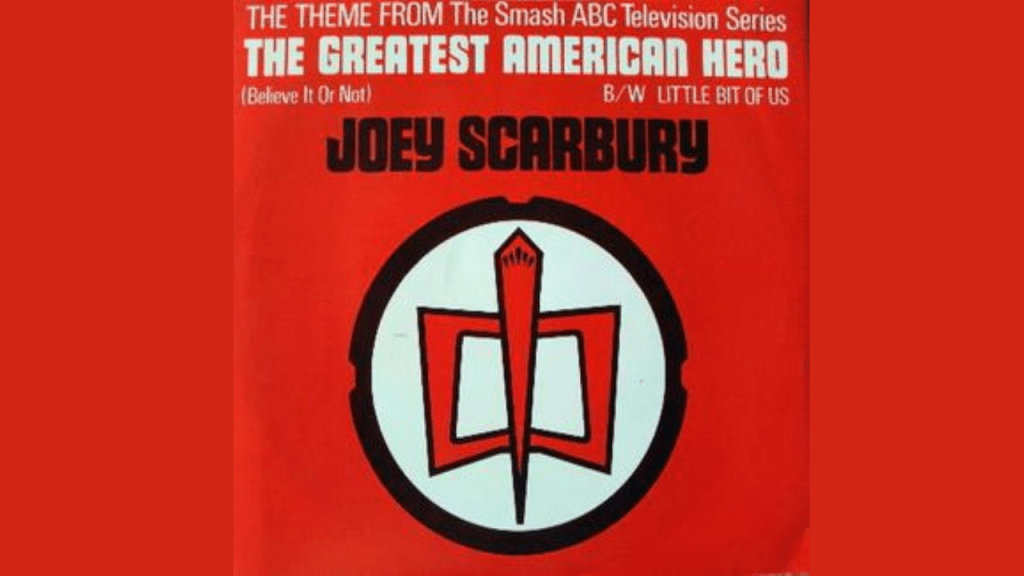
“Look at what’s happened to me / I can’t believe it myself”
- Reached #2: August 15th, 1981
- Number of Weeks at #2: Two Weeks
- #1 Song At the Time: “Endless Love” – Diana Ross and Lionel Richie
Believe it or not, television show theme songs appearing on the Billboard Hot 100 is not as strange as you might think. In the history of the Hot 100, five television show themes have hit the number one spot: “TSOP (The Sound of Philadelphia” by MFSB (Soul Train), “Theme From S.W.A.T.” by Rhythm Heritage (S.W.A.T.), “Welcome Back” by John Sebastian (Welcome Back, Kotter), “Miami Vice Theme” by Jan Hammer, and “How Do You Talk to An Angel” by The Heights (The Heights). Other television show themes that have had their theme songs chart on the Hot 100 include: Peter Gunn, Secret Agent Man, Bonanza, Batman (the sixties Adam West show), Hawaii Five-O, Friends, Cheers, WKRP in Cincinnati, The X-Files, Hannah Montana, and more. It doesn’t happen much these days, since most people probably hit the “Skip Intro” button when watching shows on streaming services. Television show themes are still released on show soundtracks and scores, but songs like the Stranger Things theme or the theme to Succession never became chart topping hits, which is fine. Those pieces weren’t designed to be pop songs and help advertise a show the way that old television themes were. But one thing that old and new age television have in common is this: they don’t turn the people that make theme songs into big stars.
Consider the case of Joey Scarbury: a singer/songwriter from Ontario, California who had a brief moment of stardom in 1981 when he became the guy who sang the theme song to an odd early eighties television show. The theme song is the only thing most people remember from the show. I have never met a single person besides my mother and myself (who watched three episodes as research) who has seen it, but the theme song remains well known due to breaching containment and enjoying a life in pop culture far beyond the show. What does it say about the quality of a television show when only the theme song, something that plays for one minute at the beginning of a show that runs for close to an hour, is the one thing people remember? Or, is the song just that good that people simply divorced it from the show it was advertising and felt it was worth keeping?
This story begins with the original Greatest American Hero: Superman. Christopher Reeve made the world believe a man could fly when he portrayed the Man of Steel in Superman (1978), which hit the big screen in December of 1978. The iconic hero celebrated his fiftieth birthday in style with a film that remains one of the greatest superhero films ever. It also helps that it was a commercial success and made $300 million at the box office (adjusted for inflation, that’s well over a billion now). Its sequel, 1980’s Superman II, had a famously troubled production, but was still a success and raked in $216 million upon release in 1980/1981 (It was marketed weirdly, so different parts of the world got it at different times. Australians got it first in December 1980, the U.K. got it in April ‘81, we didn’t get it until June).
During that initial buzz of Superman’s early days as a big screen hero, a television show appeared in March 1981 that re-imagined Superman as a small screen hero and a more comedic figure: a Superman with all the heroic spirit and powers, but having none of the respect. A Supes that retains Clark Kent’s mild-mannered, bumbling persona… and also never properly learning how his superpowers actually work. The show was called The Greatest American Hero, and it was a science fiction superhero comedy that ran for three seasons and forty-five episodes from 1981-1983. It is very hard to watch the show and not think of Superman, but there are enough unique elements to it that it’s not fair to call it a 1:1 Superman ripoff. Warner Bros. (who owns DC Comics) thought differently and tried suing ABC over it (their case was eventually dismissed).
The Greatest American Hero was created by television titan, Stephen J. Cannell, the guy who had a hand in creating such classic shows as The Rockford Files, 21 Jump Street, and The A-Team. Cannell got his start working for Universal Television in the early seventies and created a lot of different crime dramas, but broke away from them in 1979 to start his own production company, Stephen J. Cannell Productions. His first show after leaving Universal was a short-lived, one season show called Tenspeed and Brownshoe in early 1980, which I have never seen. It does have a very young Jeff Goldblum in the starring role, so it’s probably a curiosity watch for that alone.
After that show’s quick cancellation, Cannell needed a bonafide hit to really get his company going. Luckily, ABC was looking for something that Cannell was able to play with. ABC drama chiefs, Tom Werner and Marcy Carsey, were looking for a superhero show for their 8:00 time slot. It had to be something that was tame enough that young viewers could watch it, which wasn’t usually the case with Cannell’s brand of detective shows. Cannell was game to do the superhero show, but only agreed to it on the grounds that he could do it his way. ABC let him play ball and Cannell proceeded to create a show that took reference from some of the gritty crime shows he had done previously, while flipping superhero and genre cliches on their head. What Cannell did was basically make a crime show that was more of a comedy. A superhero show with a superhero that has any power the plot demands, but got no proper training.
The Greatest American Hero starred William Katt (the guy who took Carrie White to prom) as Ralph Hinkley, a mild-mannered special education teacher who, along with FBI agent Bill Maxwell (Robert Culp) gets visited by an alien spaceship in the desert. The aliens (who are usually only heard, never seen) give Ralph a box that contains a superhero suit that grants him pretty much every power Superman has when he wears it (and any power the plot of an episode demands) and tell him that he and Maxwell (who leads Ralph and lets him know of crimes happening) must use this gift to help the world. For some unexplained reason, only Ralph gets to wear the suit. Nobody else gets to wear it and it is never explained why Ralph specifically is the one chosen to be this hero. The aliens just seemed to have picked the first dude they found. In the show’s biggest establishing moment, Ralph loses the instruction manual that comes with the box the suit is in without realizing it, which means that for the rest of the show, he has to figure out what powers he even has and how the powers work through trial and error. Whatever you want to say about the show, that is a very funny setup for a superhero show. Even funnier is when the aliens give him a second one later in the series and he somehow loses it again.
That one idiotic mistake is where the bulk of the show’s comedy comes from. Ralph has super strength, but he doesn’t know how it works, so it takes him at least two tries to break through a wall. Ralph can fly, but a random kid has to tell him to try the classic superhero running start and do the “up, up, and away!” movement (even then, he still looks like a wild idiot while flying because he isn’t good at it). He’s impervious to bullets, but he doesn’t know that until he gets shot at and it doesn’t work. Along with Maxwell and his attorney/girlfriend, Pam Davidson (Connie Selleca), the three work together to try and figure out what the suit’s powers are and stop major crimes. Before you ask, no, they never call him “The Greatest American Hero” in the show (Ralph never gives himself a superhero name) and I don’t know why they call him that. My guess is that the show’s title is meant to be a joke, since Ralph usually fails at being a proper superhero and everything about him is pretty lame by design.
I had never seen the show before having to do this entry, but I know the theme song very well. The way that I know it is from back in the early 2010s, when I was a high school student that watched a lot (possibly too much?) of The Cinema Snob, Brad Jones’ internet review show where he reviewed weird Z-grade schlock and porn parodies. He used “Believe It Or Not” as the theme for his show for the first few years, which started a trend of Jones’ internet shows having eighties theme songs used in the opening credits. If I ever hear the song, even now, I immediately think of the Snob. I went and watched the first three episodes of Greatest American Hero (available on Tubi!) to get an idea of the show. I thought it was fine, but there wasn’t really anything that made me want to watch the rest of the series. There’s probably some manchild out there in his early sixties that thinks it’s the most underrated superhero show ever made. He can have it.
Well, a successful television show needs a hell of a theme song. If you were looking for a theme song to a primetime show in the eighties, the jackpot was getting one of the most successful dudes working in television music composing. Enter Mike Post.
Mike Post is one of those guys who is everywhere in the world of classic television music if you know where to look. His website boasts that he’s written over seven thousand hours of music for television. Normally, that would sound like an inflated lie, but I fully believe Post could easily back that up if you drew up a resume of every single thing he’s ever done. Here’s a short list of places you’ve heard his work: NYPD Blue, The Rockford Files, Magnum PI, Hill Street Blues, L.A. Law, The A-Team, Quantum Leap, Doogie Howser MD, Blossom, Hardcastle & McCormick, News Radio, Silk Stalkings, pretty much every Law & Order show that’s ever existed. That list doesn’t even begin to cover all of it. His domain is mostly television, but I also learned that he was the guy who produced Dolly Parton’s classic hit “9 to 5” (as well as the 9 to 5 and Odd Jobs album), which I never would’ve guessed.
Post had provided the theme song and done music for several of Cannell’s shows during the seventies, so Cannell already had an established connection with the guy and immediately knew who to call when he needed a theme song for Greatest American Hero. And this time, Post would be writing a theme song that had lyrics, rather than just being strictly instrumental. In a 2005 interview with Television Academy, Post says Cannell gave him this description of what the show would be: “This guy’s flying around in a suit and he lost the instructions, and he’s got this right-wing CIA agent for a control guy.” Post’s response was, “Cannell, this is nuts.” Nuts, sure, but apparently not nuts enough for Post to turn it down when Cannell asked if he wanted to do the song. Cannell gave Post the suggestion that it should have lyrics, which Post didn’t have a problem with. He had already had a taste of writing television theme music with lyrics and vocals when he provided the theme song to Cannell and Steven Bochco’s short lived series, Richie Brockelman, Private Eye, a spinoff of The Rockford Files and a show with a theme song that is basically a Beach Boys song, to the point where the real Beach Boys were probably scratching their heads wondering if they made it or not.
That song had lyrics written up by Peruvian composer and lyricist Stephen Geyer, who had been Post’s musical collaborator since they were introduced to each other back in 1973. Geyer would assist Post in the creation of the theme for Greatest American Hero, as well as themes for shows such as Hardcastle & McCormick and Blossom. When Cannell was pitching the idea of “Believe It Or Not” having lyrics, Post suggested they call up Geyer and see if he could “write a lyric where maybe he can make an analogy between love and flying in a suit.” That’s exactly what Geyer did. We’ll talk about the lyrics shortly.
Something I didn’t know about “Believe It Not” before sitting down to write this: there’s a hell of a roster of great players on this thing! Similar to when we covered “Ride Like a Wind,” there’s a good number of west coast heavy hitters who have played for big names here. Willie Ornelas (Al Jarreau and Loggins & Messina) is on drums, Leland Sklar (James Taylor, Linda Ronstadt, Phil Collins) is on bass, Steely Dan alum and session man Larry Carlton is on guitar. The wildest thing I learned about the lineup for this is that a young, pre-famous Bruce Hornsby is also on this song doing piano/keyboard work alongside Post. That’s a crazy lineup for a television show theme. The last remaining piece is singer Joey Scarbury. His name is the one credited on the single as the artist, so I suppose it’s time to talk about him.
It’s hard to find much to say about Scarbury. He’s easily the least interesting part of this whole thing. He has no real career before and after this. Information on the guy is scarce beyond “he’s the guy who sang the theme song to The Greatest American Hero,” but I’ll do my best. Here goes: Scarbury was born in Ontario, California in 1955. As a teenager, Scarbury scored a recording contract, but quickly found himself without a record deal when his first single, a cover of the Jimmy Webb-penned song “She Never Smiles Anymore,” flopped and went nowhere in 1968. If there’s a recording of Scarbury doing that song, it’s been lost to time. I cannot for the life of me find any trace of its existence. Scarbury somehow found himself on the lower end of the Hot 100 in 1971 when he released another Jimmy Webb-penned song, “Mixed Up Guy,” and it peaked at #73. This one I can fully confirm is real! After that, he had zero chart success for the rest of the decade and spent a good deal of the seventies serving as a backing singer for much bigger artists, country star Loretta Lynn was the name I usually came across. He met Mike Post at some point in the early seventies, when Lynn was recording with Post, who acted as producer. Post confirms in that 2005 interview that he had produced Scarbury’s material on at least three record labels with no success. Again, if it exists, I cannot find any trace of it. Despite the lack of success, Post thought Scarbury was a great singer. My guess for how Scarbury got the gig for “Believe It Or Not” is one of two theories. Theory One: He was somebody Post knew and liked and genuinely felt he was the guy for the job. Theory Two: Post and the showrunners of Greatest American Hero didn’t have a lot of time, so they needed to find somebody and Post just went to the first dude he could think of. I’d lean closer towards Theory One being the more plausible.
Scarbury’s vocals on “Believe It Or Not” are solid. He does a really good job with it. He’s gentle on the verses in a way that yacht rockers like former You Got the Silver subject Christopher Cross scored hits with and absolutely soars and delivers during the big choruses. It’s not hard to hear why Post wanted him to do it… but I also don’t think it’s him specifically that makes the song great. It’s similar to how in the show, the suit makes Ralph great. Ralph by himself is just an average guy. The same thing applies here.
The song is just incredibly well written and constructed. There’s a good chance it might have been a hit regardless of who they got to do the vocals. Scarbury’s vocal track is just extra toppings on the delicious deep dish pizza that is “Believe It Or Not.” The song has to be able to play constantly and soundtrack the big moments where Ralph Hinkley is actually being superheroic, so it has to work as both theme song and as instrumental fanfare. It absolutely does. If the show had to have the theme song without the vocals, it would still be just as effective. That said, having the lyrics helps.
Stephen Geyer took Post’s suggestion of “an analogy between love and flying in a suit” and delivered on it. I would argue that one reason the song has lived a longer life than the show it was a theme song too is because Geyer focused more on the “love” part and made the “flying in a suit” part take a hike. The only verse that really has ties to the show is the first verse. Makes sense, since the song is edited down to only the first minute when used on the show. Here it is:
Look at what’s happened to me
I can’t believe it myself
Suddenly I’m up on top of the world
It should have been somebody else
It can either describe Ralph becoming a superhero or it can describe the feeling someone gets when they realize they’ve fallen in love and think they’re too lucky for it to actually be the real thing. In the three episodes of the show that I watched, “it should have been somebody else” sounds like something Ralph would actually say. Not because he thinks he’s undeserving, but because he thinks being a superhero is a major burden. It should have been somebody else…’s problem. None of the lines in the other verses really relate to Ralph Hinkley and the show. “Breaking me out of the spell I was in / Making all of my wishes come true” is just a lie, because Ralph didn’t wish to become a superhero. He got chosen to be one and couldn’t say no without feeling guilty about it. Geyer’s “Believe It Or Not” lyrics are about falling in love. If you don’t care about the superhero part (and I imagine a lot of people who like the song do not), then Geyer made it really easy to not have to care.
When viewed purely as a song about the excitement and luck of falling in love, it’s great. Geyer’s lyrics and Post’s music capture the feeling of falling in love and feeling like you’re flying up in the clouds, throwing caution to the wind and “flying away on a wing and a prayer.” If something about this song stuck with people beyond William Katt flailing around in a stupid looking suit every week, it was that it spoke to that sense of wonder. “Believe It Or Not” is a very sincere song attached to a show that was comedic and satirical in tone. There’s a triumph and a joy with the second verse that’s a perfect description of what happens when you suddenly find yourself in love and feeling like a superhero. “Just like the light of a new day / It hit me from out of the blue / Breaking me out of the spell I was in / Making all of my wishes come true.” Geyer captures that feeling in four lines and Post’s theme makes it sound incredible.
You want to know why “Believe It Or Not” became a hit? It’s because that chorus really sticks with you. It has gotten stuck in my head constantly since I first sat down to write this. It won’t leave. I catch myself singing it while doing dishes, taking out the trash, or working on a puzzle. It refuses to leave. It’s infectious in the best way that pop songs are. It’s where Scarbury really goes for it and delivers. The whole chorus has this triumphant feeling to it that really does make you feel like you could get a running start and fly sky high. The chorus is the sweet spot, but there’s a lot of other moments that work and give the song something worth writing home about. There’s that little descending keyboard run that happens right after Scarbury sings “who could it be” that’s just beautiful. The drums that come in right before the chorus hits are that good shit. That’s the running start that happens before the nice takeoff. The entire bridge of the song is sublime. That piano part when Scarbury is singing about how this is too good to be true sounds like looking out the window of a plane and seeing all the tiny city lights on the ground. If you imagine yourself as a flying superhero, that whole bridge is probably what plays when a hero flies across a city at night and just takes in the whole view. The added synthesizer after Scarbury sings “look at me, falling for you” adds to it as well. There’s a weightlessness and dreamlike feeling to the whole part that’s just gorgeous and captures the wondrous superhero fantasy that some early eighties kids could have realistically had while watching Ralph Hinkley try (and usually fail) to be a superhero or the feeling of discovering comic books for the first time and seeing all kinds of heroes pull off impossible feats. The song has lived a life outside of the show it was written for because it not only captures the feeling of new and exciting romance, but also the childlike wonder that comes from seeing superheroes be, well, super.
The Larry Carlton guitar solo here is also primo. The back and forth of Carlton’s soloing and Scarbury singing “believe it or not!” is fun. Carlton was a big L.A. session guy that played on all kinds of records (I mostly think of his work with Steely Dan) and had a very melodic way of playing that was always adaptable to any kind of song you needed him on. If this song fits into any pop moment we’ve explored so far, it would fit into what the guys in the yacht rock scene were doing. It’s a distinctly more cheesy version of that scene, but the instrumentation and structure echoes the kind of stuff that guys like Cross had built careers on in the early eighties. It does its job of serving as a television show theme song, but Post and Geyer wrote a song that transcended that original purpose and the song escaped, becoming a genuine pop hit that eventually divorced itself from The Greatest American Hero.
The song that prevented “Believe It Or Not” from flying away and becoming a number one was the Diana Ross and Lionel Richie duet, “Endless Love,” from the film of the same name and a theme that absolutely does not fit the story of the film. Endless Love is a really shitty and poorly written melodrama based on a 1979 Scott Spencer novel exploring teenage love and what happens when obsession goes too far. It was remade into an equally shitty film in 2014. I imagine the theme song succeeded because it’s a romantic ballad from two people who were each having a great run in 1981. Diana Ross was in the middle of enjoying a career comeback when Diana and “Upside Down” became a number one hit. Lionel Richie (who will eventually appear in this project) was on a hot streak, scoring number one hits with the Commodores at the end of the seventies, writing Kenny Rogers’ number one hit “Lady,” and would go on to have several more number ones in the eighties. Richie’s brand of easy listening/adult contemporary balladry just struck a chord in 1981, so it doesn’t shock me that “Endless Love” beat this. But don’t cry for “Believe It Or Not,” because, if you can believe it, this song peaked at number two and then proceeded to stay on the Hot 100 for two consecutive years. That doesn’t happen often. So keep in mind that as we move along and cover the silver medalists of 1982 and ‘83, “Believe It Or Not” is still lingering in the Hot 100 somewhere. Joey Scarbury would do no such thing.
Scarbury’s post-”Believe It Or Not” career is basically non-existent, but there are some things we might as well cover. Here they are: Very shortly after “Believe It Or Not” became a hit, Scarbury hastily put an album together called America’s Greatest Hero. Classic one hit wonder mistake. The second you have to reference your one hit to remind people who you are, it’s game over. I listened to the album, you’re not missing much. It has more numbers on streaming than I would’ve thought, which might be due to people who are crazy for yacht rock having adopted it. It’s a bit too country music sounding to really fit into the rest of what people call “yacht rock”, but whatever. Scarbury charted on the Hot 100 one more time when the song “When She Dances” peaked at #49. It’s fine, but you could find a whole bunch of other songs, both in the yacht rock and country categories, that easily clear this.
After that, Scarbury stopped being a concern to popular music, but did record more television themes. I have never heard of the show Jennifer Slept Here, but I have to admit that I do kinda fuck with the theme song for it. He worked with Mike Post again to record vocals for “Back to Back,” the second season intro to Hardcastle & McCormick. Meh. It sure is a television theme song. It’s not one I find particularly memorable. In 1984, he teamed up with singer Desiree Goyette to perform “Flashbeagle” and “Snoopy” for the Peanuts special It’s Flashbeagle, Charlie Brown. These songs are fun, but they lack the sophisticated swag of a Vince Guaraldi Trio score, so they’re curiosities at best. After that, Scarbury’s trail runs cold. The only other thing of note I could find is that he and songwriter Even Stevens co-wrote the 1990 Oak Ridge Boys hit “No Matter How High.” “You’ll always be number one, I’ll settle for number two” speaks to the nature of this project, so it gets a tip of the ten-gallon cowboy hat from me.
It’s honestly funny how every single person who worked on this song went on to have a long and successful career except the guy who sang the song. The players on this song–Willie Ornelas, Leland Sklar, Larry Carlton, and Bruce Hornsby–all went on to continue being incredible session men, with Hornsby eventually achieving pop stardom in the mid-to-late eighties. Mike Post and Stephen Geyer went on to compose more theme songs and music for almost every successful show Stephen J. Cannell had on the air during the eighties, such as The A-Team, Hardcastle & McCormick, Riptide, and 21 Jump Street. Their partnership ended during the nineties. I don’t know what either man is currently doing at this moment (Post’s social media accounts haven’t been updated in almost a year), but I can tell you that Geyer became a steady guitar player in places all over California and went to graduate school at Pacifica Graduate Institute to pursue a Masters degree in Depth Psychology Counseling. Post kept doing work for television, but also found time to do things that were outside of the world of television. In 1994, Post put out an album called Inventions From the Blue Line, which is a collection of his theme songs and pieces from various cop shows he’s worked on, like NYPD Blue. It’s all instrumental, but the liner notes are copaganda. I really don’t want to know what Mike Post’s opinions are about cops, especially now in the 2020s. Moving on! In 1998, he served as producer for Van Halen’s Van Halen III album. That’s the really bad one that didn’t have David Lee Roth or Sammy Hagar on it. Todd in the Shadows made a really great Trainwreckords episode about it a few years ago. Worth the watch. The only other thing of note he’s done was in 2024, when Post made an album called Message from the Mountains & Echoes of the Delta, a double album that’s a fusion of classical, bluegrass, and a little bit of rock thrown in for flavor. It kinda sounds like the music to a Red Dead Redemption-esque game. It’s not entirely my thing, but I didn’t hate it. I think it’s worth your time if you have any curiosity.
Stephen J. Cannell kept creating successful shows in the eighties and did that well into the nineties. He was also an occasional novelist (mostly wrote mysteries). Cannell passed away in 2010 from melanoma at sixty-nine.
It should be incredibly obvious that Joey Scarbury will not appear in this project again. Maybe it should’ve been somebody else, but for a brief moment in 1981, he was up on top of the world. The planets aligned and the stars selected Joey Scarbury to accept a brief brush with pop stardom and he took it, all while flyin’ away on a wing and a prayer.
Bonus Silver
There aren’t many real covers of this song, but it does keep appearing in plenty of television shows.
You knew this one was coming. In the Seinfeld episode “The Susie” (Season 8, Episode 15), George Costanza is avoiding all contact with his girlfriend (Allison) so she can’t break up with him after she tells him “we need to talk.” Jerry calls him and we hear George’s legendary answering machine message, which is George singing “Believe It Or Not.” The little shoulder shrug he does the second time after the “where could I be” line kills me every single time. View that treasure here.
The Family Guy episode “The Man With Two Brians” begins with Peter Griffin and friends filming their own Jackass-style stunts. For some reason, Peter dresses up as Ralph Hinkley and proceeds to sing the song before flying off of a ramp. Peter Griffin’s performance can be viewed here.
In ER, Dr. Morris is seen singing this song while driving through Chicago traffic.
In Gilmore Girls, the fictional band Hep Alien performs a grunge version of the song at Jackson Belleville’s rally for becoming Stars Hollow’s new Town Selectman. Shoutout to the hilarious moment where Sebastian Bach works in the beginning of “The Star Spangled Banner” into the song. Belleville’s got my vote! View it here.
In Supernatural, Castiel sings the song to try and comfort a crying baby that he’s babysitting. I have never watched the show, so the context for the scene is sadly lost on me. View it here.
 You Got The Silver
Leave a comment