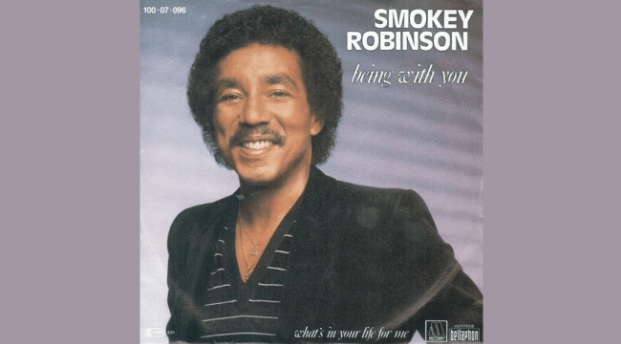
“I don’t care about anything else / But being with you, being with you”
- Reached #2: May 23rd, 1981
- Number of Weeks at #2: Three Weeks
- #1 Song At the Time: “Bette Davis Eyes” – Kim Carnes
He was gonna give this one to Kim Carnes. That didn’t happen, so he kept it for himself and ended up recording it. It’s a good thing he did, because it made him a silver medalist and gave him the biggest hit of his solo career. Sometimes, a songwriter needs to keep a song and do it themselves because they’re the best equipped to deliver it to the world. That’s how tracks like “Being With You” happen.
Just like Grover Washington, Jr. and Bill Withers, this is another case of a famous black entertainer greeting middle age (Robinson was forty-one in 1981) and scoring a big hit in a time where the pop charts were still a free-for-all. By 1981, Robinson had already lived several musical lives and helped build an entire musical empire. Through “Being With You,” Smokey got to enjoy being in the Top 5 of the Hot 100 one final time before the times changed and that musical empire started crumbling.
William “Smokey” Robinson, Jr. was born and raised in Detroit in 1940. The nickname “Smokey” was bestowed to him by his Uncle Claude when he was a boy. The two shared a love of cowboy movies and his cowboy name was “Smokey Joe.” Everybody started calling him that and the name stuck. Robinson eventually dropped the “Joe” part. He lived a few houses down from the Queen of Soul herself, Aretha Franklin, and developed a love of music from what he was hearing on the radio as well as hearing Franklin play piano whenever Robinson visited her house to play with her older brother. Music remained his biggest interest and he formed a doo-wop group while he was in high school. That group started as The Five Chimes in 1955, before eventually becoming the Matadors two years later. The Matadors started touring Detroit venues at the end of the fifties and eventually changed their name again. They finally settled on being called The Miracles and never looked back.
In 1957, Smokey Robinson met the man who would change his life forever: Berry Gordy, one of the most important record executives to ever walk the earth. Gordy was the man who founded Tamla Records, later to be called Motown in 1960, which went on to become one of the most successful record labels of the sixties. Gordy was impressed with Robinson’s singing as well as the songs he had been writing and made Robinson and the Miracles the first act he ever signed. On top of being a member of the Miracles, Robinson became the Vice President of the label, as well as serving as in-house producer, songwriter, and talent scout.
It’s almost overwhelming to consider how many songs Robinson is responsible for writing and delivering to the world. Even if you only look at the songs he wrote and performed with the Miracles, it’s still astonishing even now. Here’s a highlight reel: “Shop Around,” “You’ve Really Got a Hold On Me,” “Ooo Baby Baby,” “The Tracks of My Tears,” “Going To a Go-Go,” “More Love,” “Tears of a Clown,” “I Second That Emotion.”
It didn’t stop with the Miracles. You want some more smoke? He had a hand in writing and producing these songs as well: Mary Wells’ “My Guy” and “You Beat Me to the Punch,” The Temptations’ “My Girl,” “Get Ready,” and “The Way You Do The Things You Do,” Marvin Gaye’s “Ain’t That Peculiar.” That’s not even the full scope. It cannot be understated how important Robinson was to Motown’s early success.
As the sixties kept rolling, Motown started getting more songwriting talent in the form of songwriting team Brian Holland, Lamont Dozier, and Eddie Holland (often known as just “Holland-Dozier-Holland”). They’re the guys who wrote every great Martha & the Vandellas hit and every great track the Supremes ever recorded. Norman Whitfield, along with Barrett Strong, came along and took the Temptations to new heights, turning them into chart conquerors. Stevie Wonder and Marvin Gaye eventually took artistic control and started writing their own original material that did seriously good business. A ton of great stuff happened at Motown during its heyday and that history is worth learning about. For our purposes, this is important because all these talented guys running around allowed Smokey to focus on being the frontman for the Miracles. He “retired” from music in 1972 because he wanted out of the Miracles and wanted to focus on being a family man. That didn’t happen. He returned a year later and put out his debut solo album, where he scored his first solo hit on the R&B Chart with “Baby Come Close.”
In 1975, Robinson released A Quiet Storm, one of the best soul albums of the decade and the album that confirmed that Robinson still had the juice after being a recording artist for over fifteen years. He scored an R&B/Soul number one with “Baby That’s Backatcha” and the #7 hit “The Agony And the Ecstasy,” but the enduring achievement was the album opener “Quiet Storm.” That song wasn’t a major hit (#25 on the R&B Chart, #61 on the Hot 100) but it did something very important: it named an entire sub-genre and black late night radio format that started in 1976. That song provided the framework for WHUR-FM in Washington, D.C. personality Melvin Lindsey to build an entire format built around smooth, sophisticated, romantic, and jazz-influenced black soul music that catered to mature listeners. The history of that whole thing is fascinating, but goes beyond the scope of what we’re here to cover. I recommend checking out this really cool video Vox put out a few years ago covering that if you want to learn more.
He scored more high charting R&B/Soul hits in the late seventies, such as “There Will Come a Day (I’m Gonna Happen to You)” and “Daylight and Darkness,” but the biggest hit he made right before becoming a silver medalist was 1979’s “Cruisin’.” It hit #4 on the Hot 100 and it oughta be illegal for a song to be as smooth and soothing as this one is.
The story of how “Being With You” came to be begins with the person who would be sitting at number one while Smokey was a silver medalist, which is the first time this has ever happened in this project. Normally, the song that sits at number one has no tangible connection to what the number two hit is. Not this time. In 1980, singer Kim Carnes recorded a cover version of the old Miracles hit “More Love,” which was a Top 10 and a cover Smokey himself admired. It’s not a cover I love, mostly because those opening synths sound like wet ass and because I can’t stand Carnes’ voice. She does that same kind of gravelly, deep-fried rasp that Rod Stewart does and I fucking hate it. I don’t get what people hear in that kind of vocal. It’s not for me.
Regardless, Robinson wrote “Being With You” for Carnes because he wanted to give her a song as thanks for reviving one of his old hits. He presented it to producer George Tobin, the man who produced Carnes’ cover of “More Love” as well as the bulk of her 1980 album, Romance Dance. Tobin was no longer working with Carnes (who had left him to work with producer Val Garay) when Robinson presented the demo, but Tobin liked it and heard potential in it. He felt Robinson should keep it for himself. Tobin agreed to produce the track and it ended up becoming the title track and opener for Robinson’s 1981 album, Being With You.
Berry Gordy didn’t think this song would end up being a hit and didn’t want to put the promotional power of Motown behind it until it started climbing the charts. Tobin believed it was a hit from the start and fought for it. To be honest, he strikes me as a slimy music industry huckster that fought for it because he figured producing a Smokey Robinson hit would score him good clout after making hits with Kim Carnes. I can’t shake this feeling of sliminess because Tobin also fought to be credited on the single and get paid for it in a very strange way. “Being With You” is a song that was released through Motown, the label that most of Robinson’s releases came from, and is credited as a Motown Records release, but the single is also credited as “Produced and Arranged by: George Tobin in Association with Mike Piccirillo for George Tobin Productions.” That’s a really odd credit, but I guess I can’t knock the player for playing the game and getting a bunch of money out of Motown for betting that a song would become a big hit. I can’t fully hate that he ended up being right.
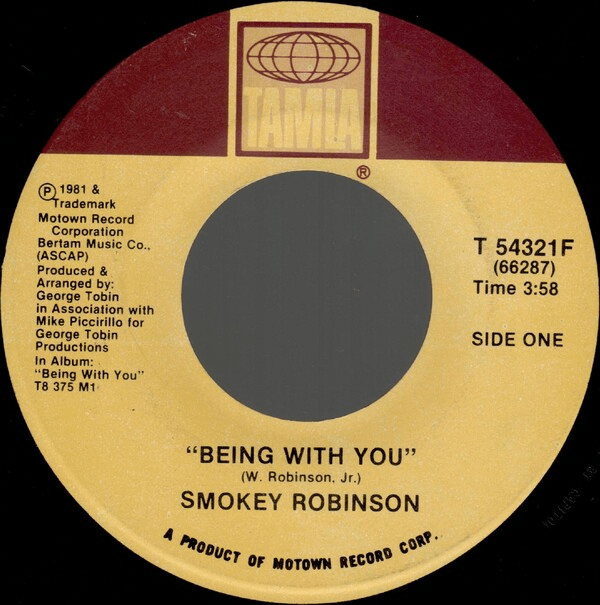
Scott Edwards, who played bass “Being With You,” detailed how the deal went down during an interview with Songfacts:
George Tobin, he went to Smokey Robinson and he told the Motown Machine that if they let him cover all the expenses for the session, play with the musicians, be totally economically responsible, then he wanted some huge percentage of the profit. And Motown, thinking, ‘This cat doesn’t know what he’s doing,’ and ‘How can we lose?’ they agreed to it. So he went in the studio and cut these tracks on Smokey and one of them was ‘Being With You.’ In the session, he would give us basic guidelines on what he felt at different times. We’d throw things at him and he’d say, ‘Yeah, do that.’ So he was not a musical person at all, but he had a helper, a co-producer named Mike Piccirillo who was a guitar player. So between the two of them, they would let you know what they wanted. … Smokey wrote the song, but as far as the interpretation of it, it was totally George Tobin and Piccirillo. That turned out to be one of Smokey’s biggest tunes, and Motown had to fork over part of that big percentage that they just knew was not going to work out.
Again, I can’t knock the player for playing the game and getting a bunch of money out of Motown for betting that a song would become a big hit. The music industry is a business and you can get a nice payday if you know how to play it. Regardless, the song ended up becoming a number two hit and now I have to write about it.
“Being With You” has a good solid roster of west coast players on it. Bill Cuomo (session man for Lynyrd Skynard, Little River Band, and the guy who came up with the synth sounds you hear on “Bette Davis Eyes”) is on keys for this one. George Tobin’s production partner Mike Piccirillo is on guitar. Barry White’s session drummer Ed Greene is here. Greene was one of those west coast guys who was everywhere from the mid-seventies through the early eighties. He’s on the first Captain & Tennille album. He’s the groovemaster on Steely Dan’s “I Got the News.” He’s on most of the Jacksons’ Destiny album (that’s him on “Shake Your Body (Down to the Ground).” He’s on “Maxine” and “New Frontier” from Steely Dan co-leader Donald Fagen’s The Nightfly. Scott Edwards is another cat who’s been everywhere and on a lot of great stuff, from Peaches & Herb’s “Reunited,” to Hall & Oates’ “Sara Smile” and “Rich Girl,” to Donna Summer’s “Bad Girls” and Yvonne Elliman’s “If I Can’t Have You.” Hell of a credit list. Former Miracles member and Smokey’s first wife Claudette Robinson is also here providing backing vocals. They all bring good stuff to this track.
Like “Just The Two Of Us,” this song is a smooth ride the entire time. It doesn’t have the bump and groove of Grover Washington and Bill Withers’ teamup, but it does have the same sophistication, smoothness, and aesthetics of their song. The keyboards have that same atmospheric glitteriness to them that “Just The Two Of Us” has and the saxophone playing at very specific points in the song gives it some added soul and romance. Robinson was close in age to both of those guys and had similar musical sensibilities, so it tracks that the stuff he was putting out at the time was in a similar vein. The song has a groove, but it’s not the kind you really dance to. It’s the kind of song you put on while cruising down the road with your sweetheart. This is the kind of track where you don’t really dance, so much as just sway with someone. It’s easy-listening, but it never crosses into the kind of lame territory that one might think when they hear the term “easy-listening.” It’s a relaxed, makeout session kind of groove and Smokey glides over the whole thing like a bird gently skimming the water’s edge. Robinson’s incredibly smooth, high, wistful, and romantic vocals just fit the song so well and really help give it a mature sophistication. That would absolutely not be the case had Carnes sung this. The backing vocals that come in during the verses are gorgeous and really enhance what he’s delivering. There’s a really great 10cc-ish quality to them that I love. There’s no doubt this is Smokey’s writing, but if Tobin and Piccirillo really did have a big hand in the arrangement, they did a damn good job. This is slick production that still has a warmth to it that got lost during the later half of the decade.
Lyrically, it’s a simple song. Smokey’s friends and relations all have comments and things to say about his relationship, but he doesn’t care about any of that chatter. The only thing that matters is being with the lover he’s crazy about. He’s heard the warnings from friends and he’s been informed about this lover’s reputation as a heartbreaker, but he simply doesn’t care. The chorus is all about Smokey not caring about anything else but this relationship; the verses are reserved for convincing his lover to stay and not give in to all the naysayers. On paper, the lyrics are almost amateurish, with the chorus being built around the repeated line of “I don’t care what they _______,” but they certainly don’t feel that way when someone of Robinson’s caliber delivers them. There’s a breeziness to him that makes those repeated “I don’t care what they ______” lines work instead of having them slide into childish insecurity. Robinson’s whispery voice has a sweetness to it that makes the whole song sound like a man who is going with his gut and going for it, no matter what happens. He’d rather be wrong than give in to his friends and relations trying to sway him.
It really does help that Robinson is one smooth motherfucker. He proves that not only in the song, but also in the song’s music video, which would be more lame if he wasn’t Smokey Robinson. MTV was three months away from launching when this song hit its peak. Like the video for Leo Sayer’s “More Than I Can Say,” it’s a very simple clip. Early music video in a pre-MTV world was very primitive. The clip is just Robinson singing the song while pacing around the inside of a beach house. He looks wistfully out the window, picks a small flower from a basket near a fireplace, readies up a pool cue and hits the eight ball, then walks outside and heads towards the beach as the song fades out. It’s not a classic video by any means, but Robinson has a coolness (“aura,” as the kids would say) to him that just makes it work somehow. This project will eventually cover songs with music videos with budgets that rival Hollywood film productions. Videos like the one for “Being With You” represent the very beginnings of music video starting to creep into the business. That will only increase as we keep going. But we’re not there yet.
The artist that was sitting at the top spot of the Hot 100 was the very same artist Robinson initially wrote “Being With You” for: Kim Carnes. “Bette Davis Eyes” was still a number one hit when Smokey took the silver. I can tell you why that happened. As much as I dislike “Bette Davis Eyes,” I can recognize that Bill Cuomo’s keyboard work is so ahead of its time it’s not even funny. What he played on that song and the sound he worked out for “Bette Davis Eyes” sounds like it came from 1986 or ‘87, not 1981. A lot of songs would end up having keyboards that sound like “Bette Davis Eyes” (especially during the mid-to-late eighties), but it took everyone else time to catch up. Not many songs can claim to be ahead of their time, but that one can. I asked a group of friends to try and guess the year it came out and none of them got it right. I can imagine people heard that song in the spring of 1981 and heard the future in it. I can still hear the future in that song… it’s just a shame that I also have to hear Carnes’ awful rasp croak out that song whenever I hear it. I’m so sorry. I just can’t stand that terrible voice. How on earth Smokey thought she could deliver a song as smooth and delicate as “Being With You” is beyond me, but I digress. “Being With You” lost the top spot because it was competing against a song that was taking pop music further ahead into the new decade. “Being With You,” just like “Just The Two Of Us,” was a hit that was made by an old dog playing with updated and flashier versions of old tricks. The eighties would eventually leave both Robinson and Carnes behind in favor of other things, but at the beginning of the decade, they were both on top.
After “Being With You,” Robinson scored a #3 hit on the R&B Chart (it was also a Top 40 hit on the Hot 100) with 1982’s “Tell Me Tomorrow.” It’s tight and funky as hell and it will be going triple-platinum in my car while cruisin’ down the highway on Friday nights.
He stopped being a presence on the Hot 100 as the eighties went on, but still found a home on the R&B Chart. For example, “I’ve Made Love To You a Thousand Times” was a sensual and romantic hit that peaked at #8 in 1983. In 1984, he teamed up with Superfreak Rick James for the underrated romantic love jam “Ebony Eyes.”
Smokey showed up in the Top 10 two more times in 1987, when the songs “Just to See Her” and “One Heartbeat” went to #8 and #10, respectively. Outside of records and singles, Robinson remained the Vice President of Motown until Berry Gordy sold the label in June 1988. As time rolled on into the nineties, Robinson settled into being an elder statesman. We’ve given him a bunch of honors over time. He’s been inducted into the Rock and Roll Hall of Fame twice (as a solo artist in 1987 and with the Miracles in 2012), he was named a Kennedy Center Honoree, he was given a BET Lifetime Achievement Award in 2015. The character Smokey from Part 2 of JoJo’s Bizarre Adventure is named after Robinson.
In recent years, younger people would know Robinson from his guest appearance on Anderson .Paak’s damn fine 2019 track “Make It Better.” I also remember Robinson courting controversy in 2023 when, at eighty-three years old, he released an album called Gasms, an album full of explicit sex jams. It caught peoples’ attention purely from some of the song titles and the fact that people got weirded out at the idea of songs where grandpa sings about getting it on. Apparently, Robinson’s wife and daughter tried to talk him out of it, but it didn’t work. I remember Twitter and other music publications having a field day with the song “I Fit In There” in particular, because that title truly is wild. I don’t even think Gasms is that crazy of an album to release and hot take: it’s genuinely a solid album. The title track has some of the funniest lyrics of Robinson’s career and the solid and smooth as silk instrumentation only makes it funnier. This comment sums it up perfectly:

I hope you’ve had fun, because this is the part of the story where the fun stops. I mean it. This isn’t gonna be fun anymore. What’s Smokey up to in 2026? Well, not in a great place, currently. A really not great place.
At the time of this writing, Smokey Robinson, now eighty-six, is still under investigation and awaiting trial over allegations from four different former employees (identified only as “Jane Doe 1-4”) who worked under him as housekeepers. They filed a massive $50 million lawsuit in May 2025. A fifth Jane Doe joined that claim later in November. The suit claims repeated sexual assault, harrassment, false imprisonment, negligence and gender violence, as well as a number of labour violations related to wages, breaks, meal times and overtime pay, all committed by Robinson spanning from 2005 to 2024. Robinson’s wife, Frances, is also named in the suit and under investigation for contributing to a hostile work environment and using “ethnically pejorative words and language.” The Robinsons denied the allegations and filed a defamation claim, which has been dismissed as of April 24th of this year. As of now, a trial date for the suit is scheduled for October 2027 and that is all that is known at the current time. It is also worth mentioning that he was also accused of sexual assault in 2015, but was not charged by officials after the court determined there was insufficient evidence. I mention all of this because we can’t in good faith ignore it. This affects how we will ultimately talk about Robinson’s career as a whole in the years ahead. It really sucks, but it’s very possible that he might end up being in the same club as Diddy or R. Kelly, a powerful force in entertainment who abused said power to commit horrible acts on people (it’s not just women, one Jane Doe identifies as a male accuser). It especially sucks because these kinds of stories are too common in the world of entertainment and it becomes a real struggle to figure out how to go about dealing with the legacies of important artists who we later learn were horrible monsters. For example, The Cosby Show played an important role in the history of black television, but how do we talk about what that show did while also being mindful of Cosby’s actions outside of the show? How do you do a detailed history on the Buffalo Bills football team without covering O.J. Simpson’s career? Likewise, if Robinson is found guilty and charged with all the things the suit claims, how the hell do we talk about the history of Motown and black music in the sixties without talking about Smokey? It simply can’t be done.
I don’t know what the outcome will be and I don’t feel confident in offering an answer as to what you should do with all of this info at this moment, because I don’t feel like I have a good one for you. I have to imagine that if five people can build a case against you, then you’re probably guilty of doing something wrong. I don’t doubt that Robinson probably did the things he’s accused of, because what would five accusers really gain from taking an eighty-six year old to court if he didn’t do the things he’s accused of? I don’t know, but I do know that I won’t be able to say anything for sure until that trial happens and more information about this whole mess becomes publicly available. All I can leave you with is this: The old saying is probably true. Where there’s smoke(y), there’s fire. If he’s found guilty of all the things the suit claims, a lot of his music is gonna start sounding more sinister than before, including “Being With You.” We’ll all have to wrestle with that and figure it out when the time comes to confront that.
Luckily for us, Robinson will not return in this project, so we can move on to other, more positive topics for the time being. I wish this story had a better ending, but I don’t get to decide how the stories end. I promise the next entry will be more positive than the way this one ended.
Bonus Silver
There aren’t many covers of this song, nor has it been featured in many things, but thank the lucky stars! Brotherhood of Man is BACK IN THE BONUS SILVER SECTION, BABEY! And their cornball cover of the song did NOT disappoint me. God bless ‘em. Shout out to the poor man’s ABBA. Show ‘em some love here.
 You Got The Silver
Leave a comment