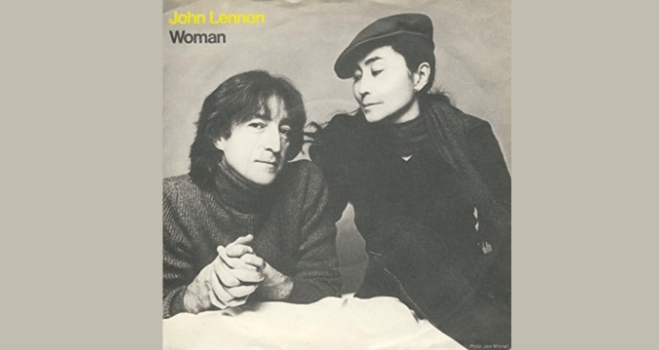
“For the other half of the sky.”
- Reached #2: March 21st, 1981
- Number of Weeks at #2: Three Weeks
- #1 Song At the Time: “Keep On Loving You” – REO Speedwagon (One Week) and “Rapture” – Blondie (Two Weeks)
On the night of December 8th, 1980, the music world suffered a devastating loss. Earlier in the day, Former Beatle John Lennon and his wife, Yoko Ono, were on their way to a recording session in New York City, the place they had called home for close to a decade. Outside, a young twenty-five year old, out-of-work security guard named Mark David Chapman had traveled from Hawaii to NYC to find Lennon. Chapman, a longtime Beatles fan, found Lennon and asked him to sign a copy of Double Fantasy, the long-awaited comeback album that was a collaboration between Lennon and Ono that had been released three weeks prior. Later that night, Lennon and Ono were returning to their apartment at the Dakota on the Upper West Side of Manhattan. Chapman was there, equipped with a gun he had bought three months prior. As Lennon and Ono entered the archway of the Dakota, Chapman fired four shots into Lennon’s back at close range. He collapsed and was rushed to the hospital. He died while en route. Chapman remained at the scene until he was arrested. A silent vigil was held outside the Dakota a week later on December 15th. Around 100,000 people showed up to pay their respects to one of the most important musicians in all of popular music. Lennon’s comeback single, “(Just Like) Starting Over,” had been climbing the charts since its release in late October. It would become a number one hit shortly after his murder, making Lennon the fourth person in Hot 100 history to score a number one hit after death (the three before him were Otis Redding, Janis Joplin, and Jim Croce).
“(Just Like) Starting Over” might have become a number one hit even if Lennon hadn’t been murdered. That was the first single from Lennon after a five year silence, so it probably felt like an event at the time. Public curiosity would have probably taken it far and comparisons to what his old songwriting partner, future You Got the Silver subject Paul McCartney, was doing would have helped with that. If Lennon had lived longer, maybe Lennon/McCartney would have found their way back to each other. We’ll never know. With Lennon’s death in mind, there should be no surprise why the people made “Woman” a number two hit. But even if he hadn’t died, “Woman” is still a damn solid song from a guy who had planned to gracefully enter middle-aged domestic bliss on a clean slate. It didn’t happen.
I imagine John Lennon is someone who probably doesn’t need a ton of introduction, but I’ll provide a highlight reel just so we’re all up to speed. Before catapulting to legendary status, John Lennon was just a lad from Liverpool. He had the roughest childhood of the fab four. His mother was killed in a car accident when he was seventeen. He got in on the skiffle craze that was sweeping Liverpool and formed a band, the Quarrymen, in 1956 as a teenager. A year later, Lennon met his musical soulmate and songwriting partner, Paul McCartney. Along with George Harrison (someone who will appear in this project), the Quarrymen eventually evolved into The Beatles in 1960. You might have heard of them. In August 1962, Ringo Starr joined the band, replacing their drummer Pete Best. The rest is history.
The Beatles achieved monumental superstardom, conquered America, and completely revolutionized and redefined popular music forever. They still hold the record for most number one hits on the Hot 100 (twenty of them) and they did that shit in only six years. Lennon courted controversy several times during the Beatle days. Here are a few greatest hits: Lennon beating up Bob Wooler at Paul’s 21st birthday party. Lennon talking smack on the Hollies. The famous “more popular than Jesus” comment. Lennon often found himself in hot water with the press more times than his other fellow Beatles did. Regardless, Lennon/McCartney became one of the most important songwriting duos of all time, creating some of the most enduring songs in popular music.
During the early Beatle days, Lennon was married to Cynthia Powell, but their marriage eventually became strained due to the skyrocketing fame of the Beatles… that and John wasn’t exactly the greatest husband in the world, more or less abandoning her and his first son, Julian, in 1966 when he met the woman he would spend the rest of his life with: Yoko Ono. They met on November 6th, 1966 in London. Ono was preparing an avant-garde art exhibition (Unfinished Painting and Objects). The two met, connected, and quickly fell for each other. They married in 1969. We’ll talk more about Ono a little later.
Lennon was the first to join the Beatles, the first to record and release solo material (those three really experimental albums he made with Ono in 1968 and ‘69), and the first Beatle to officially (for real, not clickbait) leave the band. The Beatles breakup is a seismic event and you can watch an entire eight hour documentary capturing the days leading up to that breakup to learn more. History has decided that the Beatles breakup was made official on April 10th, 1970 (the legal partnership of the Beatles would be another story, not being dissolved until 1974). After that, the Beatles went their separate ways, only officially reuniting in the mid-nineties to record two new songs John had left behind as part of Anthology.
In 1971, Lennon left England behind for good and moved to New York City, the place he would truly call home for the rest of his life, with Yoko. Like the rest of his fellow Beatles, John started releasing solo material and ended up making what I consider the toughest solo Beatle discography to fully love. I’ve always been a bigger fan of McCartney (Paul’s my favorite Beatle) than Lennon, so take that with a grain of salt. John was the true bohemian of the group and his music tended to reflect those stranger artistic sensibilities. A good number of people consider 1970’s John Lennon/Plastic Ono Band and 1971’s Imagine to be Lennon’s masterpieces. During those early post-Beatles days, Lennon released a lot of his most well-known solo songs: “Instant Karma!”, “Imagine”, “Happy Xmas (War Is Over).”
1972 saw the release of Some Time In New York, probably the most politically-fueled Lennon album. It’s also one of his best. A lot of it has held up really well. “John Sinclair” is pleading for the release of John Sinclair, who had served ten years in prison for giving joints to an undercover cop. “Attica State” laments police brutality. “Sunday Bloody Sunday” and “The Luck of the Irish” are songs about Northern Ireland during the early years of the Troubles. “Angela” is a tribute to famous activist Angela Davis. “New York City” is John writing a Chuck Berry-styled rocker about his and Yoko’s early days in NYC. It unfortunately starts with the very stupid and tragically titled “Woman Is the N****r of the World,” coined after a phrase Yoko said in an interview in December 1968. Tone deaf? OH YEAH. Well-intentioned? Also, yes! They were aiming for the target of “women are just as oppressed as any other minority” and they did hit it, if you can get past the title! It’s just that releasing a song with that title and incorporating that lyric turns a lot of people away, especially now. But that was Lennon! A man who was ultimately well-intentioned, but often made stupid decisions that got him into trouble. His political activism and messaging got powerful eyes on him and landed him in a battle with immigration. It took a few years, but Lennon eventually secured his green card and got to remain an Englishman in America.
From the summer of 1973 until early 1975, Lennon entered a period he would later call his “Lost Weekend” period. He does a lot in a short time, both musically and personally. On the musical side, he releases the albums Mind Games and Walls and Bridges. He made a few guest appearances. He co-wrote, played guitar, and provided backing vocals on David Bowie’s funked up “Fame” and joined him on Bowie’s cover of “Across the Universe.” Made a cover album of his favorite songs (Rock & Roll) with Phil Spector that had a lot of craziness happen during the making of it. Joined Elton John on stage at Madison Square Garden on Thanksgiving 1974 (the last time he would really perform live). Reunited with Paul and buried the hatchet. He finally scored a solo number one hit (the last Beatle to score one) with “Whatever Gets You Thru the Night,” a fun and funky nighttime saxophone driven vamp with Elton John that sounds like it could’ve been the theme song to Saturday Night Live.
On the personal side, Lennon was going off the rails. His marriage to Yoko was on the rocks, so they separated for eighteen months. Lennon ran off with his assistant, May Pang, and spent that time coming and going between New York and Los Angeles. He also spent a lot of time drinking and engaging in a good deal of substance abuse with fellow musician Harry Nilsson. Highlights of their debauchery include getting kicked out of A&M Studios for tossing a bottle at a console and getting tossed out of the Troubadour for heckling the Smothers Brothers. He was a mess, but he eventually pulled himself out of it. The night of his MSG appearance with Elton, he reunited with Yoko and in October 1975 he welcomed the birth of their child, Sean Ono Lennon. After the birth of his son, Lennon stepped away from the music business for five years to be a father. Yoko Ono also put her art career on hold and began managing their business affairs, as well as being a parent with Lennon.
The story goes that Lennon got inspired to return to music shortly after Paul McCartney scored a solo number one hit with “Coming Up.” The songwriting rivalry and desire to one up each other always brought out the best in them, so maybe Lennon believed it could happen again. During a vacation to Bermuda in 1980, Lennon started jotting down ideas. Later, Yoko started contributing ideas as well. As they kept going, they found an album was starting to take shape. That album would become Double Fantasy, the last album to see release during Lennon’s life. Lennon got the name from a sign in the town’s flower garden (“Double Fantasy” is the name of a flower).
Next to Some Time In New York, Double Fantasy is my favorite Lennon album, but I admit it’s a strange one in his discography. The album plays as a dialogue, going back and forth between Lennon’s songs and Ono’s songs. The songs are mostly about domestic bliss, addressing and exploring the time that Lennon and Ono were separated, and their love for their son, Sean. What’s fascinating about the album is how Lennon mostly plays it safe. The ideas all sound like Lennon looking backwards on the music of his youth, evidenced by the Elvis Presley/Roy Orbison pastiche of “(Just Like) Starting Over.” Musically, he doesn’t seem interested in meeting the current moment. But Yoko absolutely is and you can tell she was paying attention to a lot of what the at-the-time modern bands of New York were doing. Hot take: her best material is on this album and is worth your time.
Lennon was killed twenty-one days after Double Fantasy came out, but we know that “Woman” was the song he chose as a follow-up to “(Just Like) Starting Over.” It’s a perfect follow-up that’s similar in sound to the previous single. Had Lennon not been killed, it would’ve just been a sweet-sounding single that gave listeners another taste of what Lennon was doing on his half of the album. But, because of his murder, “Woman” ends up taking on a melancholic note; the last message and thank you to the one person who stood by him, both at his best and his worst.
“Woman” is the most Beatlesque song of Lennon’s solo years, to the point where he called it his eighties update of “Girl” from Rubber Soul. It’s a simple song, but the sincere sentiment is what makes it a good one. It’s Lennon at his absolute sweetest and he sounds lovely on it. The vocal harmony that highlights lines like “For showing me the meaning of success” and “After all, it is written in the stars” is heavenly. The guitar playing is beautiful. The melody is absolutely lovely. It all sounds like the kind of silly love song his old partner used to write and it’s a good example of how even when Lennon made cheeky remarks about Paul’s love songs, it’s clear he took cues from them. Lyrically, “Woman” is written in a way that can be applied to anyone, but “the other half of the sky” (a quote from Mao Zedong) that Lennon refers to is for one woman and one woman only: Yoko Ono. It’s a song that offers both an appreciation and an apology to her, with Lennon referencing their separation in the mid seventies with the lines “Woman, I can hardly express / My mixed emotions at my thoughtlessness” and “Woman, please let me explain / I never meant to cause you sorrow or pain.”
I have never been able to hear this song–or the whole of Double Fantasy, for that matter–without thinking about how Lennon was killed three weeks after its release. It’s difficult to listen to these lines: “Please remember, my life is in your hands / And woman, hold me close to your heart / However distant, don’t keep us apart / After all, it is written in the stars” and not think of his death. It sounds like he’s telling Yoko this from the afterlife. Honestly, the whole song sounds like Lennon’s ghost giving a final message to Ono. That might be one big reason it really stuck with people. It’s the love song that he left behind to the most important person in his life.
There’s a moment in the song’s music video that really stuck with me. The video is mostly a collage of John and Yoko’s life together, interspersed with moments of them walking through the park together during a beautiful autumn day in New York. There’s a long bit about a minute in, where Yoko Ono is just sitting in the park during winter time, dressed in a grey jacket and oversized sunglasses, smoking a cigar. She is completely alone and just staring out while smoking. I hadn’t watched the video for a long time before writing this. Seeing that, I was struck with how at that moment, I no longer saw Yoko Ono, wife of a Beatle. I saw a lonely woman sitting in the park, someone who probably had too many things going on inside her mind in the winter of 1981. She was with her husband when he was gunned down. I thought to myself, how many times did she relive that moment in her mind? Was this song a comfort for her, or was it hard to hear because it’s a beautiful song written by a guy who didn’t deserve to be senselessly killed? At that moment, I saw a woman who was now without the love of her life and had to figure out how to pick up the pieces and keep going, for herself, for her son, and for her late husband. I can’t imagine what she had to live through in the aftermath. I don’t think I want to.
I don’t know if “Woman” would have peaked at number two if Lennon hadn’t been killed and we were all still in mourning. I like to think it would’ve had a good chance even if he hadn’t died. It’s one of Lennon’s most beautiful solo tracks. It’s simple, but like all the most impactful Lennon tracks, I hear the truth in it. What woman wouldn’t want to hear someone thank them for showing them the meaning of success? “I’m successful because I have you.” That’s nothing earthshattering, but it’s beautiful to have someone say it to you all the same. The final part where Lennon says, again and again and again, “I love you, yeah-yeah, now and forever,” is simply divine. In 1980 and 1981, it seems all we wanted were love songs and we sent a lot of them to the number two spot. “Woman” is a great one that was provided by a man who had been in a band that used the word “love” six-hundred and thirteen times across their entire discography.
You hear “Woman”, along with the other tracks on Double Fantasy and you’re left with a certain sadness; a sadness in knowing that Lennon was robbed of the second half of his life and we’ll never know what he would’ve gone on to do. Would he have found his way back to Paul and revive the Lennon/McCartney songwriting partnership? Would he have kept exploring new musical avenues or just made music when he felt like it? Would the Beatles reunite and get back in the studio together? Sean Ono Lennon grew up to be a musician in his own right, would he and his dad have teamed up for something? Would Lennon have led a second act that was less storied and controversial than the first half? We don’t know. We’ll never know… all because some madman wanted fame and glory for shooting a Beatle. It was a senseless killing that nobody gained anything from.
The Lennon you hear on Double Fantasy wasn’t being provocative, wasn’t yelling about injustices, or trying to goad people into organizing and taking out their congressmen. It was an album made by a guy who was finally at peace with himself. He had mellowed out, just turned forty, and learned that being a responsible husband and being a father was pretty damn groovy, which was something he hadn’t known how to do the first time around with Cynthia and Julian. And it sucks that he wasn’t great with them! He certainly hurt them (in more ways than one), but he was getting it right the second time! Doesn’t that count for something?
There was one more single released from Double Fantasy, the really solid track “Watching the Wheels,” which peaked at #10. It’s basically John’s singing about how he enjoys fatherhood and no longer feels the drive to play the music industry game. It’s lovely, cheeky, and a little sarcastic in a way that’s uniquely Lennon.
In 1984, Yoko Ono took the leftovers from Double Fantasy and some other odds and sods lying around and packaged it as Milk and Honey (which has no connection to the very popular Rupi Kaur poetry book). It was released with the lead single “Nobody Told Me,” a song that peaked at #5 on the Hot 100 and something Lennon had initially intended to give for Ringo Starr’s 1981 Stop and Smell the Roses album. It’s probably the best window into what Lennon might have gone on to continue to do had he lived.
Milk and Honey had two other singles released: “Borrowed Time” (which sounds like something Julian Lennon might have released on his first album) and “I’m Stepping Out.” The other stand out track that people love is a piano and vocal demo left behind: “Grow Old With Me.” It’s heartbreaking and another reminder that Lennon was only forty when he was killed. After that, Lennon’s voice wouldn’t be heard until his fellow Beatles reunited in 1995 with Electric Light Orchestra’s Jeff Lynne to finish two songs Lennon left behind on a tape: “Real Love” and the wonderful “Free As A Bird.”
For Lennon’s killer, Mark David Chapman was sentenced to twenty years to life imprisonment. He has been denied parole fourteen times now. His next parole hearing is scheduled for 2027. He’s seventy-one now and odds are pretty good that he’s going to die in prison. Lennon was a flawed and imperfect person who housed contradictions and complexities, the same as any ordinary human. No, Lennon didn’t deserve to get shot, despite what shitheads on the internet might tell you these days.
Some parts of Lennon’s life are a lot uglier than others and those ugly parts tend to be in the spotlight more these days. Have you ever read that famous Onion article about Lennon? It’s the one that goes: “Man Always Gets Little Rush Out Of Telling People John Lennon Beat Wife.” I remember in the mid-2010s when the anti-Lennon bandwagon started really gaining steam. People looked back on all the controversial things he said and did, especially times when he got violent. When his actions and words didn’t match the holy image that boomers spread of Lennon as an advocate for peace, a lot of people, especially younger people, started revolting and only focused on the uglier moments in his life. I know this because I was on that bus for a while in my early twenties and bought into all of that before eventually getting off. My view of him these days is this: he was a very flawed, but ultimately well-intentioned man who wanted to inspire people to be better than him and do better than him through his music. A lot of people saw and heard that. A lot of people still do. So again, no, Lennon didn’t deserve it.
Shooting a Beatle didn’t do anything but bring despair to people who genuinely believed in Lennon’s messages about peace. If Lennon’s death meant anything, it was another reminder that the “peace and love” movement and philosophy of the late sixties was more dead than it had been when Altamont happened. Hell, it’s been forty-five years since Lennon got killed and I had to watch Charlie Kirk get shot in the neck on live video countless times. Nothing has changed. There is still senseless killing that doesn’t bring about revolution, but rather brings more division and more despair than necessary. We all lose.
With that said, John Lennon will obviously not return in this project, though he will serve as the basis for another number two that we will cover soon enough. The world wasn’t done mourning the death of Lennon quite yet.
Bonus Silver
Towards the end of 1981, Brotherhood of Man recorded a cover of the song. These people are like a lame version of ABBA and all their covers sound like corny and sub-par karaoke. I wish they had done a cover for every song we have to cover in this project. Here’s their cover:
Italian saxophonist Gil Ventura once did an instrumental cover of the song. It’s pretty relaxing. Check it out here:
In 2005, Ozzy Osbourne, the Prince of Darkness, covered the song for his 2005 song Under Cover. It’s a strange one, but Ozzy thrived on that. Worth the listen, if nothing else than to satisfy curiosity. Check it out:


Leave a Reply