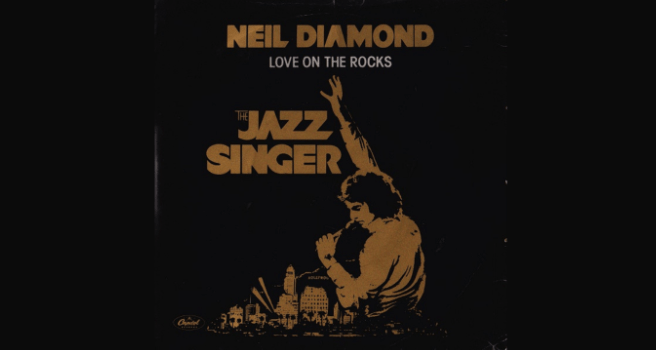
“Maybe blue skies above but it’s cold / When your love’s on the rocks”
- Reached #2: January 10th 1981
- Number of Weeks at #2: Three Weeks
- #1 Song At the Time: “(Just Like) Starting Over” by John Lennon
The Jazz Singer (1980) is a misleading title. There’s not a single lick of jazz to be found in it (it doesn’t even have “The Lick” in it). It almost feels like it has that title in the same way Queen titled their 1978 album Jazz: It’s funny to call it that when they do everything but play jazz. This is the first time this project is covering a hit song from a movie soundtrack. It will not be the last. I wish our first taste of an eighties movie soundtrack song was from a better movie, but I didn’t get to decide these things. Because of that, we have to explore a ballad from a terrible movie that was a commercial disappointment, but had a soundtrack that sold like crazy.
While preparing for this, I went back and watched Neil Diamond Parking Lot, the charming 1996 documentary short from the same guys who did the popular Heavy Metal Parking Lot doc ten years prior. Neil Diamond Parking Lot is basically a pre-internet version of All Gas No Brakes. Two guys are outside a Neil Diamond concert at the Capital Centre in Largo, Maryland. There, they just talk to the attendees to see what’s going on and capture fan excitement before and after the show. It’s wholesome at a lot of points and fascinating as a cultural artifact. It feels like I’m watching footage of an ancient civilization. Most of the people in the documentary are married, middle aged/elderly women who share how many times they’ve seen him, show off their shirts with his face on them, and giggle and tease each other about how Diamond was recently single at the time and imagining what it would be like to be with a man like Neil. I can’t paint a clear picture of a Neil Diamond fan and I don’t know if the doc fully captures what that fandom looks like. I left it with more questions than I had before. Who are these Neil Diamond fans? What fucking power does he wield over these people?
I have had an aversion to the man who is affectionately called “The Jewish Elvis” for most of my life. I am sure he is a fine, upstanding man, but that doesn’t matter when he has made absolutely terrible music that makes me want to eat my own face. I will never have any love in my heart for the man who wrote and unleashed “Sweet Caroline,” one of my most hated songs, onto the masses. I don’t get what that song does to people. I hear it and immediately get annoyed. But there are many people (mostly white) who aren’t me who love screaming “BAH BAH BAH” at the top of their lungs at any event. I don’t think they’re wrong! I’m just simply not wired the way they are.
I remember my dad trying to sell me on the magic of Diamond one time during his life. He told me to listen to the first two tracks of the live album Hot August Night. I don’t even think he was much of a Diamond fan, he just thought that particular sequence was really solid. He told me that I would find “Prologue” really boring at first, but then suddenly “Crunchy Granola Suite” would kick in and it would all click for me, like it had for him when he himself initially wrote it off after having to listen to it with his dad. I inherited a lot of music I love from my dad, but that one never clicked. It never will. Whatever people love about Diamond, I can’t hear it, but I’m gonna make an honest effort for this. I’ve given myself a job to do, after all. And when you got a job to do, you got to do it well. So, let’s get up to speed on the man and the movie before we start getting into the song itself.
Neil Leslie Diamond (his real name, if you can believe it) hails from Brooklyn, New York. Attended the same high school as Barbra Streisand (Erasmus High School in Brooklyn; they were in choir together). Got gifted a guitar at sixteen. Saw legendary folk singer Pete Seeger perform at a summer camp he was working at and thought he could learn to write and perform his own songs too. Diamond quickly applied himself and started on the road to becoming a songwriter.
Diamond’s early career began in the legendary Brill Building songwriting factory in New York. The place was full of top-notch talent, a lot of them working class Jewish Brooklynites. Legendary songwriting teams included Jerry Leiber and Mike Stoller, Carole King and Gerry Goffin, Burt Bacharach and Hal David. On top of that, a lot of now-famous performers got their start writing hits for other people before transitioning and finding success on their own. Carole King, Neil Sedaka, and Diamond were among that list.
Diamond’s first real taste of success was with the song “Sunday and Me,” a Top 20 hit recorded by Jay & The Americans, but the real star-making stuff as a for-hire songwriter came when he supplied the Monkees with a steady stream of songs. “A Little Bit Me, a Little Bit You,” “Look Out (Here Comes Tomorrow),” and “Love to Love” were all Diamond contributions, with the biggest one being “I’m a Believer,” a #1 hit in 1966 and a song that I can never divorce from its appearance at the end of Shrek.
“Solitary Man” was the first true hit of Diamond’s career as a performer in 1966. He started hitting his stride after that and a number of high charting singles followed for the rest of the sixties, the highest charting one being–you guessed it–“Sweet Caroline.” People always ask me if it’s overplayed that’s ruined the song for me. I wish the answer was that simple. But no. The answer is that I have never liked the song and that dislike has only grown stronger with time. I hate every single thing about it.
I’m gonna summarize Diamond in the seventies pretty fast so we can get to the thing we’re here to look at. He pumped out a steady stream of albums during the seventies. He had two songs hit number one: “Cracklin’ Rosie” in 1970 and “Song Sung Blue” in 1972. He shows up in The Last Waltz, the legendary concert film chronicling the final performance of The Band’s prime years, for a performance of the song “Dry Your Eyes.” It will not surprise you that I think it’s the most painful part of the entire film to the point where I just skip it every time I rewatch. He only shows up in that film because Band guitarist/songwriter Robbie Robertson had just recently co-wrote that song and produced Diamond’s 1976 album Beautiful Noise (which is not the title I would’ve given that album.) Diamond scored one more number one hit in 1978, when he recorded “You Don’t Send Me Flowers,” a duet with old high school classmate Barbra Streisand. They do not sound good together and the song would be infinitely better if it was just them accompanied by piano. The overbearing orchestration just destroys anything good about it. It’s seventies music your grandparents would really dig.
In March 1979, Diamond collapsed on stage during a show at the Cow Palace in San Francisco. It was discovered he had a cancerous tumor on his spine. Turns out he had been dealing with back pain for years, but just ignored it. When he collapsed, he couldn’t feel either of his legs. He endured a successful twelve hour surgery to get it removed. The rehabilitation process was lengthy, Diamond had fears that he wouldn’t be able to walk again (he had to relearn it), and was convinced enough that he was going to die that he started writing goodbye letters to friends at one point. By June of ‘79, Diamond had recovered and was ready to make his next big career move: Hollywood.
Film producer Jerry Leider saw Neil Diamond in a 1977 television special (Love at the Greek) and believed Diamond could star in a music movie the same way Elvis Presley (who Diamond got compared to a lot), Barbra Streisand, and Diana Ross had done before. Remakes of old music movies had done well in the seventies. Diana had played Billie Holiday in Lady Sings The Blues in 1972. Barbra made magic happen with Kris Kristofferson in A Star Is Born in 1976. The success of A Star Is Born was what convinced Leider that a remake of The Jazz Singer could also be successful. It would take a while for the film to finally happen in 1980. When it did, the film was a commercial and critical disappointment… but its soundtrack did very good business (it went five times platinum). If you were given a nickel for each time a music movie bombed in 1980 but made up for it by having a soundtrack that sold well, you would be given two nickels (one would be for Xanadu, which came out a few months before.)
The Jazz Singer was originally a 1925 play that became a famous 1927 film starring Al Jolson. It was remade in 1952 with Danny Thomas and Peggy Lee, then again as a television movie in 1959 with Jerry Lewis in the starring role. Finally, the 1980 version happened. All versions basically follow the same basic plot, but we’ll get specific about the 1980 version. Diamond plays Yussel Rabinovitch (who chooses to go by the simplified name “Jess Robin”), the Jewish son of a cantor. Jess sneaks away and plays black music in clubs (jazz in the original, not jazz here) in secret with a black band. I should mention this now: he does this in full blackface (only in one scene, ten minutes into the film). It’s the one thing most people remember about Jolson and the original version of the film. It remains a complex subject which goes far beyond our conversation. I recommend reading this great little piece from the Jim Crow Museum and this 2017 ABC News article to learn more about the historical context of what Jolson was doing. You won’t believe me, but Jolson’s use of blackface did serve narrative/symbolic purpose to the film in 1927. It makes ZERO sense to keep it in 1980. If it makes you feel any better, Diamond doesn’t look back on that choice fondly.
I’m getting off track. You’ve seen movies that have the same basic formula of The Jazz Singer before. A traditionalist father in New York City wants his son to carry on the family’s cultural traditions (“be a cantor like me”). The son says, “I don’t want your life, dad. I have dreams of my own! I have to do this!” The son runs away to L.A. (to make it as a rock singer, not jazz) and somehow hits it big and makes it. The father tries to convince the son that he should come home. It doesn’t work. The son sheds everything from his old life and trades it for the new. The son and the father become estranged. The father eventually disowns the son. The father almost dies and the two eventually find a way to reconcile, culminating in a “I now support you and understand that this is who you are” type of deal. It’s a bad movie that you’ve seen better versions of. It’s melodramatic, Neil Diamond is not a good actor at all and not charming enough to carry an entire film, especially when he’s up against Lawrence Olivier, who is turning in the hammiest performance humanly possible. It’s the greatest underacting versus the greatest overacting you’ve ever seen. The film only stops being bad when Diamond is performing. Other than that, you don’t need to see it in full. The film’s soundtrack (besides traditionals included) was completely written by Diamond and scored three Top 10 hits: “America” (#8), “Hello Again” (#6), and “Love On The Rocks.”
“Love On The Rocks” is the big song of the film’s first act. It’s the first original song we see Jess Robin create and it’s the one that makes him a star. In the film, the band that Jess plays with scores a gig in L.A., doing backing vocals for a new wave/punk star named Keith Lennox (played by the always great British actor Paul Nicholas). He hears “Love On The Rocks” and wants to record it, inviting Jess to fly out to L.A. to be present at the recording. When Jess gets there, he discovers his song, which is a ballad, has been bastardized and turned into a fast-tempo punk song. Jess offers to show Lennox how the song should be done and go over how he thinks the vocal phrasing should be done. He proceeds to perform the song his way, which catches the attention of music agent Molly Bell, who thinks he has real talent and works to turn him into a big star.
Watching the film felt like a chore, but I had to do my due diligence and watch the thing I am tasked with writing about. Nothing impressed me while watching the first forty minutes. I got to the scene where Diamond sits down and plays “Love On The Rocks,” the version that became a real-life single. He got to the chorus of the song and this was my reaction:
Fuck. Okay. You got me. This is great.
A broken clock is right twice a day, after all. I resisted, but after enough time, I couldn’t deny it anymore. I had to admit defeat. Jewish Elvis fucking got me. Everything I usually can’t stand about Diamond disappears somehow with this one song. I don’t know, man. Something about it just works and it hooked me. He pulled it off. I fell for the spell.
When Diamond was recovering from his surgery, there was talk about possibly replacing him with Barry Manilow (who had become a bit of a rival to Diamond) for the lead role in Jazz Singer. That would have made sense, considering Manilow is also a Jewish musician from Brooklyn (and has more connection to jazz than Diamond does). Obviously, that didn’t happen and Diamond kept the role and did the movie. At first, I thought about how Manilow might be able to do a better version of the song, but after enough listens, I don’t think that anymore. Diamond was grand and cheesy, but he had a restraint that Manilow never had. That restraint, even during the song’s big and explosive chorus, is what makes it come alive and prevents it from becoming truly ridiculous. He finds a way to build the song up, have it explode, bring it down, and build it up all over again in a natural way that feels right. Manilow would’ve had the same keep exploding more and more and give it a grand finale that wouldn’t work for this.
I’m a sucker for good synthesizer work in ballads and that’s probably one of the things that got me to concede defeat and give Diamond the applause. Diamond co-wrote the song (as well as four others on the soundtrack) with French singer/composer Gilbert Bécaud and I have no way of knowing which one of them decided to incorporate keyboards as the main parts of the song. Part of me wants to lean towards Bécaud, since Diamond wasn’t really incorporating keyboards into his songs much before this. The synths give the song this haunting and beautiful quality to it that really grab you. They provide a great atmosphere and leave enough space and room for Diamond to come in and work. There’s also enough openness for Diamond to sneak in a bit of acoustic guitar during the verses and easy listening orchestration that had been hallmarks of his work prior to this. That tinkling little run the keys are going on throughout the second verse is lovely. I also love those three notes after the line “How they really need you” in the chorus.
I can tell you the exact moment where Diamond got me. It’s when he sings the lines, “Suddenly you find you’re out there / Walking in a storm” and what immediately comes after hits like the best string parts on an Electric Light Orchestra song. Strings like the ones on this song work well and help enhance the song overall. The ones on songs like “You Don’t Send Me Flowers” make me want to eat drywall. I don’t fully know why it was that part, but that was the bit where I admitted I was hooked. Something about the way he delivered it just hit me in the right way.
Vocally, it’s the only time I’ve really liked Diamond’s voice. He’s usually too raspy and crackly for my taste. Other times, he just sounds pissed off. Here, that grizzly rasp works in his favor. He really sells heartbreak here and the chorus has Diamond sounding more passionate and grand than I’ve ever heard him. He really goes for it on that chorus and the raspy vocals are strangely pleasing in a way I can’t properly articulate. I love the restraint he has and that he doesn’t keep it going and give the song a big, grand, ridiculous finale. He brings the song back down to the quietness of the first verse and ends the song on that melancholic note that just quietly fades. That’s a smart move. That’s how Diamond avoids entering cornball territory and going full Air Supply. Good job.
Bob Gaudio’s production is really solid here. Nothing overpowers anything. Diamond sounds great and remains the focal point of the song, which is important for when it plays in the movie, because it’s Jess Robin’s moment where he gets to prove he’s got what it takes to become a big star. The production on “Love On The Rocks” sounds like the transition point between Diamond’s seventies sound and the sound Diamond entered as the eighties continued. The synths you hear in this song started taking more lead roles in his work, evidenced by songs like “Heartlight” in 1983 and “Turn Around” in 1984.
Diamond was kept off the top spot by the continued reign of John Lennon’s “(Just Like) Starting Over.” In January 1981, nobody was taking Lennon from the top spot. We’ll get into the reason for that very soon, when Lennon appears in this project.
The Jazz Singer managed to double its budget of $13 million at the box office, but was still a commercial and critical disappointment (it needed $35 million to break even). The soundtrack, however, sold like crazy. It’s still the best selling album of Diamond’s career. The rest of the eighties ended up being surprisingly kind to him. “Heartlight” peaked at #5, becoming his final Top 5 hit on the Hot 100. The last time he ever charted on the Hot 100 was with “Headed For the Future,” which peaked at #53 in 1986. The video (which I had never seen before) is the kind of ridiculous time capsule material this project was born to collect and share. Look at this:
After that, he remained a consistent presence on the Adult-Contemporary chart through the rest of the eighties and into the early nineties. Hell, he’s even shown up on that chart a few times in the 21st century. He remained a consistent touring machine until he was diagnosed with Parkinson’s in 2018. He continued to release albums at a healthy rate prior to the diagnosis. He actually just had an album of unreleased tracks, Wild At Heart, come out last month!
Even with Diamond now out of the spotlight, the love for him has never faded. Saving Silverman taught me you can build a long-lasting friendship built around being huge Neil Diamond fans. Will Ferrell once did his best Diamond impression on the Lonely Island’s classic banger “Cool Guys Don’t Look At Explosions.” Diamond’s life story got the Broadway musical treatment with A Beautiful Noise in 2022. Hugh Jackman and Kate Hudson portrayed a real-life husband and wife Neil Diamond cover band (Lightning and Thunder) in Song Sung Blue last year. “Stargazer” showed up in the film version of Project Hail Mary earlier this year. As long as there are guys who want to dress up in glittery jumpsuits and croon songs from the sixties and seventies, Diamond ain’t going anywhere. Diamond is unbreakable, you might say (that one’s for the JoJo’s Bizarre Adventure fans out there).
Neil Diamond will not return in this project. I don’t know if enjoying “Love On The Rocks” will be the key to unlock a reappraisal of Diamond’s music for me, but I’ll happily admit when I’ve met my match. Diamond, you son of a bitch, you did it. You got me to concede and admit to liking something from you. I guess you were right. When they know they have you, then they really have you. Nothing you can do or say to fight it when that happens.
Bonus Silver
In 1981, shortly after the release of Diamond’s original, R&B/soul singer Millie Jackson recorded a version for her album, Just a Lil’ Bit Country. It’s almost more grand and explosive than the original. Check that out here.
Also in 1981, co-writer Gilbert Bécaud recorded a version in French. Listen to that one here.
The always wonderful Gladys Knight (with no Pips) delivers a soaring rendition of the song that honestly makes it sound like a rejected James Bond theme, but is fantastic. Best part is when she changes the chorus and starts singing Harry Nilsson’s “Without You.” Show Gladys some love here.
British theater actor and singer Michael Ball recorded a version of the song in 1998 for an album covering movie soundtrack songs. Here it is:
Korn frontman Jonathan Davis recorded a hilariously bad cover of the song in 2003. I knew the cover was gonna fall apart the second I heard him sing “pour me a drink, bitch.” This is on the level of Limp Bizkit doing “Behind Blue Eyes.” Listen at your own risk here.
 You Got The Silver
Leave a comment