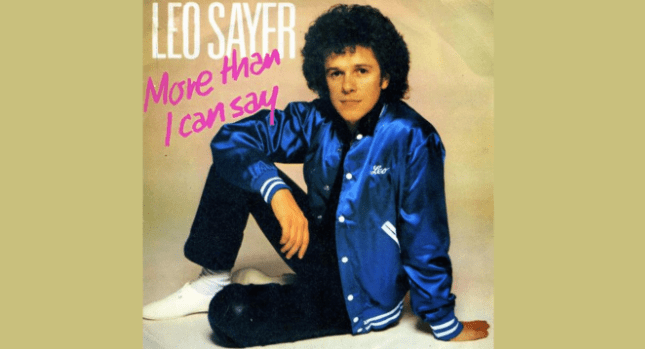
“I miss you every single day / Why must my life be filled with sorrow / Oh love you more than I can say”
- Reached #2: December 6th 1980
- Number of Weeks at #2: Four Weeks
- #1 Song At the Time: “Lady” – Kenny Rogers (three weeks) and “(Just Like) Starting Over” – John Lennon (one week)
Here’s something I didn’t know would happen when I started this project: this is now the third time I have had to cover an early eighties song from an artist who was successful in the seventies covering a song from the sixties. Once is happenstance (Teri DeSario and K.C.’s version of Barbara Mason’s “Yes, I’m Ready.”) Twice is coincidence (the Spinners’ cover of the Four Seasons song “Working My Way Back to You.”) British pop star Leo Sayer, with his cover of the Crickets’ 1960 song “More Than I Can Say,” now makes three times, which is a pattern. For some odd reason, during most of 1980, half of the songs people took to the number two spot were all happily looking backwards and updating slightly obscure songs from a previous generation. In this case, it was a British artist just looking for an oldie to include on his album and somehow he lucked out and scored a hit with it. It really is just a roll of the dice sometimes.
Leo Sayer comes to us from a place called Shoreham-by-Sea, Sussex, which is truly one of the most England-ass names imaginable. He got his start singing in bands with goofy names like “Terraplane Blues” and “Patches” in the late sixties as a college student. Eventually, Sayer’s songwriting partner David Courtney introduced him to British pop star Adam Faith, who had been a big deal in the late fifties and sixties. Faith took on Sayer as a protege and started managing him. Along with Courtney, Sayer and Faith had started a musical partnership that would last a number of years.
Sayer had a rough start to his recording career, with singles that didn’t really go anywhere. But he eventually got a good word-of-mouth from a very powerful ally: The Who’s dynamic vocalist, Roger Daltrey. In 1973, Daltrey had met Sayer and his crew and really liked the songs they were coming up with. He asked if they would be willing to write songs for Daltrey’s first solo album and they agreed. “Giving It All Away” became a U.K. hit and Roger started spreading the good word about Sayer.
Sayer got his first taste of solo success later that year when the kooky, sad clown song “The Show Must Go On” became a U.K. #2 (making him a silver medalist in two countries). “Sad clown” is a very accurate description for the song in more ways than one, because Sayer performed it on television in full pierrot outfit and clown makeup, which isn’t even close to the strangest thing a British dude wore while singing a song in the seventies (nobody could ever go up against every single weird costume Peter Gabriel wore while performing with Genesis.) It wasn’t a hit here in the U.S. when Sayer did it, but Three Dog Night took it to #4 when they did. It makes sense. It’s a very Three Dog Night kind of song, they were more popular here, and Sayer’s original already sounded like he was channeling Chuck Negron vocally. He performed in the clown makeup for a little bit during his earliest days and then eventually ditched that look.
Sayer got his first taste of American success in 1974 when “Long Tall Glasses” became a Top 10 hit and peaked at #9. I really dig this one. It sounds like a really solid and bluesy Rolling Stones deep cut. He sings it like I gave Mick Jagger a mountain of cocaine, had him slam his face into it, and then just let him go fucking nuts in the studio. Sayer really lets himself get animated and goofy with it when performing it on television and it’s a strange delight. Only in the seventies, man.
Sayer’s big moment on American shores happened in 1976 and 1977, when he scored his first of two number one hits. If the name “Leo Sayer” rings any bells, it’s because you know the song “You Make Me Feel Like Dancing.” That’s the one everyone usually recognizes. Whether you love it or hate it is all dependent on how you feel about Sayer’s falsetto. I think he sounds like a dying cat (Barry Gibb is the only white man who’s ever truly figured out how to do a good one), but the song is fun and catchy enough that I can’t fully hate it.
That song, along with his second and final number one hit, the Albert Hammond/Carole Bayer Sager-penned ballad “When I Need You,” launched his album 1976 Endless Flight to platinum status. “When I Need You” is fine and Endless Flight, produced by Harry Nilsson and Carly Simon producer Richard Perry, is a solid album. But if you prefer Sayer’s uniqueness and him being a quirky weirdo like his earlier stuff, Endless Flight is when he sheds that and becomes a more conventional pop artist.
After Endless Flight, Sayer spent the rest of the seventies in a slump. Nothing was really hitting and eventually Sayer sought out a new producer for his 1980 album, Living In a Fantasy. The guy he found was a man named Alan Tarney, who mostly made his name through writing and producing a number of Cliff Richard hits and albums as well as producing all of A-ha’s well known stuff (yes, he’s the guy who produced “Take On Me” and “The Sun Always Shines On TV.”) With Tarney’s help, Sayer was able to make one more splash on American shores by covering an old American song that was never really a hit here.
When Sayer heard “More Than I Can Say,” the oldie he was looking for as a cover song for Living In a Fantasy, it was not the original Crickets version he heard. Despite being a fan of Buddy Holly and his backing band, he heard the song via Bobby Vee’s 1961 cover of it. He heard it during a television commercial for a greatest hits album by Vee. To hear Sayer tell it via The Billboard Book of #1 Adult Contemporary Hits, “We went into a record store that afternoon, bought the record and had the song recorded that night.”
The Crickets original is… fine. It’s fine. Listening to the Crickets without Buddy Holly is like listening to the Pips without Gladys Knight. It’s good, but something is definitely missing. Jerry Allison and Sonny Curtis still had Holly when this was being written, but it wasn’t completed and recorded until shortly after Holly’s death in 1959 and wasn’t released until 1960. It was more successful as a Bobby Vee song (and I think his cover is better), but it didn’t become a big hit on the Hot 100 (it peaked at #61). It’s a different story in the U.K. though, where Vee’s version soared higher and hit #4. If Sayer was going to learn about the song’s existence, it was going to be through Vee. Out of every version of this song that exists, Sayer’s is the one that usually comes up first when you search for it. And for good reason! His cover is easily the best version of it.
Sayer’s version turns this song into a perfect three and a half minute pop song that was designed to be heard on radio over and over again. Every choice regarding the arrangement and production works to enhance the versions that came before it. Sayer’s cover leans into the territory of the breezy soft rock that was hanging around for most of 1980. Like “Yes, I’m Ready” and “Working My Way Back to You,” this cover keeps everything that works about the original song, but gives it modern tweaks and improvements that make for a much more enjoyable experience. Tarney’s production gives the whole song this feeling of longing without falling too hard into melancholy. The atmospheric backing vocals throughout the song are gorgeous. The added electric guitar parts along with keeping the acoustic elements from the Vee version are great. Sayer himself sounds great on it too. If they really recorded this in one night, it doesn’t sound like it! The whole song is just a really solid pop song cover and catchy in all the right ways. Of the three covers we’ve encountered so far, this one is probably my favorite.
The only thing Sayer and Tarney got rid of entirely from Vee’s version was the plucky orchestration, which is perfectly fine. I think the song works better without that and it helps the song sound way less dated. Sayer’s take mostly sounds like something you’d hear in a bar while nursing a beer, thinking about the one that just got away. That low, twangy, country-tinged guitar part you hear at the start of the song really sells that vision and I love it. Honestly, if Sayer leaned into it more, his cover of this song could’ve easily been a country track (you can hear two examples of this in the Bonus Silver section).
There isn’t much to this song lyrically. Leo Sayer loves you more than he can say. He’ll love you twice as much tomorrow. He misses you every single day. He needs to know if you mean to make him cry, if he’s just another guy to you. The whole song is a basic plea for love. It’s not a very deep song with a lot of meaning. The beautiful thing about pop songs is that they usually don’t need a lot of meaning to work. Sometimes there just isn’t that much to it and it’s best to not overthink it.
This song had a music video made for it. This is notable because this is the first song we’ve covered for this project where there was an actual music video made for it and not some television performance I found (or an official video made forty-five years later, like the entry for “Ride Like the Wind” had). The video aired often during the earliest days of a little channel called MTV, which scrounged for any kind of video they could get their grubby little hands on. MTV will loom heavy over this project and we’ll be talking about the channel in greater detail in due time. At this point, we’re still about eight months away from MTV’s launch on August 1st, 1981, but Sayer and this song was there when MTV first arrived, so we might as well talk a little about it now.
There’s a charm to these early MTV videos. They’re cheap, most of the effects work looks like ass, and nobody had a single clue what they were doing or what they should be making. Artists and labels wouldn’t know until the channel had been operating for a few years (and Michael Jackson makes an entire short film for “Thriller”). I don’t think the video for this song is great, but I think it’s fun. The clip features Sayer singing the song while cutting pictures from magazines. He eventually kicks a can of paint over (that is poorly green-screened) and eventually uses a paint brush (which is also poorly green-screened) to paint the Living In a Fantasy album cover. There’s a lot of silly and hilariously bad videos that aired during MTV’s earliest days. I don’t think this is one of them. There were guys from the seventies who were much worse at video making than Sayer was. This video still holds up just fine.
I don’t know what it was about the early eighties, but between Sayer, Russell Hitchcock, Steve Lukather from Toto, Kevin Cronin from R.E.O. Speedwagon, and MTV VJ Mark Goodman, white boys just seemed to love rocking the curly afro. White Boy Summer just looked different back then, I guess.
“More Than I Can Say” was prevented from winning the gold by two different songs: “Lady” by Kenny Rogers and “(Just Like) Starting Over” by future You Got the Silver subject John Lennon. I don’t have a great answer as to why Sayer lost to Rogers. I can tell you that “Lady” fucking sucks and that this song is a lot better, but that’s not exactly an intelligent observation. If I had to try and give you one, I would say that Sayer lost because Rogers had teamed up with Lionel Richie and those two just knew how to grab an adult-contemporary audience by the throat. Country music and country artists were also enjoying some success on the Hot 100 during 1980, so that’s also a factor. Kenny Rogers was just having a great moment and sliding between the country and pop worlds like a chameleon. Sayer lost to Lennon for a much more important reason, which is something we will talk about when Lennon appears in this project, which will be soon. The reason why “(Just Like) Starting Over” became a number one hit is more than I can say (for now).
After “More Than I Can Say,” Sayer had one more song chart on the Hot 100. It was the title track to Living In a Fantasy, which hit #23. After that, we Yankees shipped him back to the U.K. and never wanted anything to do with him again. His native U.K. was kinder to him for a little longer. In 1982, Sayer released World Radio, his follow-up to Fantasy. It’s lead single, “Have You Ever Been In Love” was a #10 hit. Sayer got another Top 40 hit with the solid “Heart (Stop Beating In Time),” which peaked at #22 and showed that Barry, Maurice, and Robin Gibb (the Bee Gees) still had the sauce as songwriters even after their disco supremacy was over. I really like that one.
The third single, “Paris Dies In the Morning,” didn’t chart and that blows because that one fucking rules. Living In a Fantasy and World Radio are solid albums if you like a lot of early eighties soft rock and pop. Sayer had one more major hit in 1983 with “Orchard Road,” a song that he wrote with Tarney in the midst of his first marriage falling apart. I don’t like it very much, but the “About” page on Sayer’s website tells me it’s one of his most enduring singles. I don’t know anybody in Britain who can confirm that for me (if you’re British and reading this, please leave a comment and tell me if “Orchard Road” is a certified heater where you live).
After that, he spent the rest of the eighties releasing one-off singles, oldies covers for British movie soundtracks I’ve never heard of, and having an acrimonious breakup with his manager, Adam Faith, in 1985. When Sayer was getting divorced, he decided to properly look over his finances for the first time and found that Faith was woefully mismanaging him and robbing him blind. He also discovered that Faith was turning down a lot of opportunities for work without Sayer knowing about it. Naturally, he was quite livid and eventually sued him for said mismanagement, winning £650,000 (roughly $874,412.45) in 1992. He finally made another album in 1990 (Cool Touch) but spent most of the decade wrapped up in court cases and legal disputes, most of them about publishing and finances.
Sayer had one major comeback in 2006, when British DJ Meck made a dance remix of Sayer’s 1977 song “Thunder In My Heart” and took it to #1 in the U.K. The Groove Generation had done a dance remix of Sayer’s “You Make Me Feel Like Dancing” in 1998 (but that one only got to #32).
That brief return to the spotlight was enough to land Sayer a spot on the fifth series of Celebrity Big Brother in 2007. It’s not one of his prouder moments. He comes off like a ginormous asshole in it. In his defense, he was miserable while doing it and doesn’t look back on it too fondly today. I don’t fully blame him. The business troubles kicked his ass for a while and I imagine being in the Big Brother house just does something evil to you. Watching an interview with Sayer from August 2024, he seems like a much nicer and happier bloke these days.
He’s still active at the time of this writing. He’s been an Australian citizen since 2009 and has released five more albums since 2008. The most important offering you need to know is his 2022 cover of “Eleanor Rigby” that mashes it up with–and I swear to God I’m not kidding–“Billie Jean.” Delightfully strange and worth a listen if you’re curious.
Beyond that, he still tours pretty regularly in the U.K., with shows coming up in October and November. America might not have wanted him past early 1981, but the U.K. still seems to have a decent amount of affection for him (though maybe Celebrity Big Brother fans don’t…) He seems like a fine bloke who’s done alright for himself.
Leo Sayer will not appear in this project again, but I will remember him fondly. I only really knew him for “You Make Me Feel Like Dancing” and “When I Need You” before writing this. Along the way, I discovered a lot more that I like and admire from the guy, which was more than I could say before. So thanks, Leo. I’ll love you twice as much tomorrow.
Bonus Silver
A really great duet performance of “More Than I Can Say” between Sayer and country icon Glen Campbell. Campbell’s guitar playing adds even more country flavor to Sayer’s version. It’s a good one. Check it out here.
British-Jamaican singer June Lodge recorded a reggae version of the song that got big in Belgium, Germany, and the Netherlands in 1982. It strangely works well as a reggae tune. Give it a listen here.
Norwegian pop duo and Eurovision 1985 winners Bobbysocks (which sounds like a name I made up for a television show to avoid using a copyrighted name) recorded a cool mid-eighties version of the song. It’s probably the silliest version of the song I found (the backing vocal choices are a real trip), but that only makes it more worth sharing. Check it out here.
Country singer Sammy Kershaw recorded a version in 1999 that reaffirms my thoughts of Sayer’s cover version being country-tinged. It’s pretty solid. Listen to that here.
I have no information on who this is or who originally posted it, but I feel it’s important to share this video of a Chinese man doing a beautifully wholesome rendition of the song, broken English and all. I don’t know why he posted this, but I hope someone heard it and felt genuine love. Check it out.


Leave a Reply