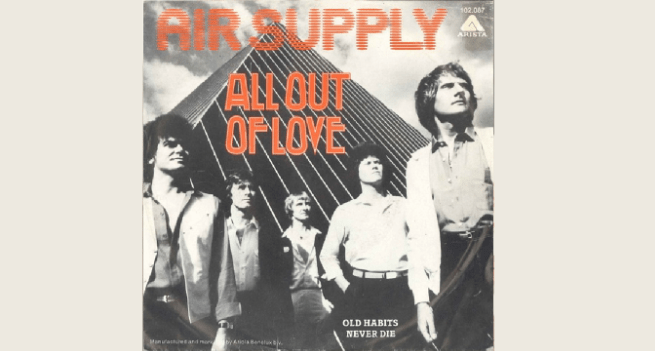
“I’m all out of love, I’m so lost without you / I know you were right believing for so longI’m all out of love, what am I without you?”
- Reached #2: September 13th 1980
- Number of Weeks at #2: Four Weeks
- #1 Song At the Time: “Upside Down” by Diana Ross
I was born in 1995, fifteen years after Graham Russell and Russell Hitchcock, the Australian duo known as Air Supply, had their moments of massive American success. For my entire life, their existence has left me bewildered. For my entire life, their music–especially “All Out Of Love”–has been the punchline to a joke about either lame men with bad music taste or music that plays in the background after a sad, wet dog of a man just got dumped. Maybe I owe Dan Fogelberg an apology. “Longer” is boring, but it serves an important purpose as a romantic wedding song for couples looking for a good slow song. Air Supply commits a bigger musical sin: “All Out Of Love” is fucking lame.
It baffles the mind to think about Air Supply in terms of commercial success. The question isn’t how were these guys so successful, it’s a question of why these two were so successful. Consider: between 1980 and 1983, these guys had eight Top 5 hits in America. Four of those have the word “love” in the title and their first five singles in America were consecutive Top 5 hits. That’s a rare feat (and they like comparing themselves to the Beatles, who have also done that). By 1983, they had racked up enough hits to put out a greatest hits album… and that shit went five times platinum! AND they had only been a presence in America for THREE (3) years! Do you know how insane that is!? That’s a crazy impressive run to have in such a short amount of time. Not since the Bee Gees had there been such assured money in the bank. But when you seek out and listen to that greatest hits album, you’re left asking, these guys? This?? Why was this so successful?
I can understand “Lost in Love” being a hit. I like that one. I don’t mind “Even the Nights Are Better” either. I like that one too. Both songs are soft, sweet, and romantic. Those are the easiest examples to point to in order to hear all of Air Supply’s calling cards. They pumped out a steady stream of romantic, adult-contemporary balladry using the Barry Manilow playbook: a combination of gentle acoustic guitars, pianos, and sweeping orchestration. Sweet melodies with close harmony vocals that led to earworm choruses and big showstopping finishes. Every major Air Supply hit plays with this bag of tricks, especially “All Out of Love.” Listening through Air Supply’s 1983 greatest hits album to prepare for this, I can understand why their songs saw success.
All throughout 1980, we’ve seen adult contemporary balladry claim the second highest spot on the Billboard Hot 100. After disco’s supremacy, the charts were in a state of flux. As we’ve covered previously, whenever there’s nothing major happening on the charts, that’s when adult contemporary schlock can step in with a bouquet of flowers and slip right back in like it never left.
With all that said, “All Out of Love” still makes no sense to me. How the fuck was this so successful? Who would turn this on willingly? Who in the name of Heaven and Earth would be comforted by this bunch of nothing? That’s the part that remains confusing to me. I get every other major Air Supply hit, even if I don’t love them. But this one? No.
We should get acquainted with the two men who call themselves Air Supply. Graham Russell and Russell Hitchcock come from the land down under known as Melbourne, Australia. For the sake of convenience, I will strictly use their first names, otherwise it’s gonna get confusing. It’s either that, or I go with “the one that looks like Jeff Daniels” and “the little guy who looks like Larry from Three’s Company.”
Anyway, they initially met in 1975 when they were both involved in an Australian production of Jesus Christ Superstar. After the production wrapped, the two found they had a musical connection and decided to form a duo. They pooled their money together and started going around playing any place that would have them. Pizza places, night clubs, coffee shops. The usual story. Graham was the guy with the guitar, Russell was the singer. At this stage, I imagine they were basically the Australian Simon & Garfunkel. Graham eventually started writing original songs and the two built a solid reputation. They recorded a demo tape of two songs and shopped it around to every record company in Sydney. Nobody wanted it except for one: CBS Records. They heard something unique and took a chance on it. Their first big break was with the song “Love and Other Bruises,” which shot up the Australian charts and peaked at #6.
I like a good deal of music that came from Australia in the seventies. Bee Gees, Olivia Newton-John, AC/DC, Little River Band. Basically everything except these guys. In fact, the best way to describe Air Supply’s seventies material is “if Little River Band was soft, corny, and lame as hell.” But Aussies bought it! After that, they were on their way. The next year, Rod Stewart scooped the guys up and took them on tour with him through Australia, the U.S., and Canada. Getting to tour with a big star is a good thing, but it didn’t bring Air Supply the massive success they thought it would bring them. By 1979, they were in trouble, to the point where they called their fourth album Life Support. Things weren’t looking so hot. To hear Russell tell it via Air Supply’s official website:
We were broke, dead in the water with no gigs in sight because there had been no PR in Australia about these young guys with a hit song touring the U.S. with a legendary rocker. One of my musician friends saved my life by giving me the opportunity to record jingles. And then Graham wrote the song that changed everything for us.
Life Support had a song on it called “Lost In Love,” which is important to their story for a number of reasons. For starters, it was a Top 20 hit in Australia (and a #3 hit in New Zealand). More importantly, it caught the ear of one of the most important and powerful record executive titans to ever walk the earth: Clive Davis.
Davis heard “Lost in Love” and thought it was money in the bank. He had a feeling it could be a big deal, so he signed them to Arista Records and played a hand in a remixed version of that single as well as their debut album (Lost in Love) in America. Back in the seventies and eighties, Clive Davis had an unbelievable track record when it came to taking big swings and having his bets on artists and singles end up hitting. “Lost in Love” was one of those. It became a #3 hit on the Hot 100, but their next single would get them one spot higher. That single was “All Out of Love.”
Every time I have heard “All Out of Love” somewhere, it was because I was watching something that had it play as a joke. The Bonus Silver section is going to be long, because that’s where I will catalog the various places it’s been used as a joke. Ryan Reynolds has found himself playing at least two cornball characters who find kinship with this song after getting heartbroken (Van Wilder and Deadpool 2). It plays when Stan Marsh is depressed in bed after being dumped by Wendy in the “Raisins” episode of South Park. Charlie Kelmekis writes while listening to this in the film version of The Perks of Being a Wallflower. Those are all examples of losers finding some kind of comfort in this song. I have never been able to take this song seriously because of those instances. Whatever comfort or emotion I’m supposed to get from the song just doesn’t exist. It’s become a now-ancient meme to have this song be the soundtrack to a loser character being depressed after a breakup. That’s all this is and that’s all it will probably ever be to most.
Did you know this song has verses in it? It’s fine if you don’t. This is one of those songs where the chorus holds the entire thing up. That’s the hit. Everything else is disposable and only a means to get to that part. Both verses are really easy to sum up: “We broke up, I’m very sad about it, and I wish you would come back.” There’s no point in doing a deep dive into Air Supply lyrics because they’re not saying anything profound or poignant that you haven’t heard in a million other places. They made their name producing consumable love songs for yuppies and sad, wishy-washy breakup songs for dorks. Despite my hatred for the term, this is probably the early eighties equivalent to “coworker music.” It’s a bunch of nothing made for the most milquetoast person you share an office cubicle with who wants to listen to something, but it can’t be anything exciting that distracts from the job.
Graham Russell is a very capable singer and sounds completely fine during the verses, but there’s an emptiness to his entire performance that I simply can’t shake. Nothing about it sounds convincing. Contrast him with John Edwards on “Working My Way Back to You,” a breakup song with some grit behind it. Edwards is heartbroken, but also has to sell himself as a man groveling, apologizing, and promising to be better after his girl leaves him for being a cheating snake. There’s a desperation in that song that’s uniquely compelling. He probably won’t succeed in winning her back, but you at least appreciate how grand he is with his plea. With this, there’s a desperation that’s more embarrassing than sincere. “I wish I could carry your smile in my heart / For times when my life seems so low” is some shit weird guys with no profile picture and zero game leave as a comment on their favorite Instagram model’s posts. “I want you to come back and carry me home / Away from these long, lonely nights” is a drunk 2 AM text you send that she immediately shows her group chat and new boyfriend. They will laugh and then she blocks your number for good.
The chorus is what the song really wants to sell. The verses all lead to the big moment when Russell Hitchcock comes in and fully delivers. The chorus is where all the emotion is laid bare and the song takes off like a rocket. It’s the kind of chorus where Hitchcock can really go for it and keep escalating until it has its big finale. If this song has ever meant a real thing to anybody, it’s the chorus that did it.
The line everybody knows from the chorus is “I’m all out of love / I’m so lost without you.” That was not the original line when Graham wrote it. The original line was this: “I’m all out of love / I want to arrest you.” Supposedly, it made sense to Australians and was supposed to mean something along the lines of “I want your attention,” but I also found out that Aussies don’t say that, so that’s just a really weird line that Graham didn’t think hard about. Clive Davis was the one who told them that line needed to be changed. He’s credited along with Graham as a songwriter on the song, presumably because without the change to “I’m so lost without you,” the song wouldn’t have been a hit. Graham talks about it in a Songfacts interview:
Historically, Clive usually was right and he’s especially right in this case. “I’m all out of love / I’m so lost without you” fits way better and also keeps the patheticness of the song’s narrator running through the whole thing. It’s a good example of how one line can completely change a song. “I’m so lost without you” is the most important line in the entire song because that’s the line most people latch onto and that’s the line that makes a depressed, heartbroken loser listening to it all the more funny.
This song, more than most Air Supply songs, really shows that Graham and Russell were theatre guys prior to pop stardom. The last minute of the song is basically a showcase for Russell Hitchcock’s vocal talent. I’ll give him this: he absolutely goes for it, which you kinda need to do when you’re making easy listening schmaltz like this. Love it or hate it, he gives it all he’s got and he does pull off quite an impressive feat. He holds the final note of this song for a whopping 16.2 seconds (the longest held note by a male singer on a pop record until Sherriff’s “When I’m With You” in 1983, when Freddy Curci went even longer at 19.4). Also, give Russell this: he’s done it for just as long in concert. That trick of having a soft breakup song escalate and explode in this big finale full of vocal fireworks worked for the easy-listening god Barry Manilow for years on a dozen hits (he did it a lot, take your pick). That same trick can and did work for these guys. Considering Clive Davis had signed both Manilow and Air Supply to Arista, I’m certain he knew that (it wouldn’t shock me if Manilow learned it from Davis). The big finish is the one time I would argue the song does anything impressive, but also, who’s going out of their way to listen to this of their own volition? There are better sad breakup songs. I have never met a person who loves this song, nor have I ever met an Air Supply fan. I don’t think they really exist, but considering how successful they were in such a short time and how much of a concert draw they still are for people who were around in their moment, such people must exist. There are creatures living lives we cannot imagine.
“All Out of Love” was kept off the top spot by “Upside Down,” the Diana Ross surprise comeback hit that proved she was still supreme. These two limp-dick yuppies weren’t going up against the monster that is that song. The groove to “Upside Down” is simply unstoppable. It could shake mountains. That song still gets dance floors going. In the first days of the eighties, the number one spot was home to a lot of interesting post-disco. Queen’s “Another One Bites the Dust,” Pink Floyd’s “Another Brick in the Wall (Part 2),” and “Upside Down” were all proving that disco wasn’t fully gone, it just had to disguise itself, whether it be by pivoting more to its funk roots, giving a beat to a rock song about Roger Waters’ views on the British education system, or adapting into a more elastic and twisting dance. Meanwhile, a lot of songs we’ve covered in the number two spot have all been easy-listening darlings. Those other three songs are fantastic, but it’s songs like “All Out of Love” and “Longer” and “Yes, I’m Ready” that are more indicative of what the early days of the decade were really like.
This is where I would tell you how the rest of Air Supply’s career played out, but I can’t. Not quite yet, because we’re not done with them yet. If you can believe it, Air Supply will be our first subject who returns with a second song that got the silver. We will see them in this project again.
Bonus Silver
I warned you this would be long. This song has lived the longest life out of every song we have covered thus far. There are so many goddamn versions of this and I am not even scratching the surface of what’s out there. These were just some of the most interesting ones. Prepare yourselves.
This song has been covered as early as 1981, when German singer Ingrid Peters recorded a fully German version of it. I don’t know if singing the entire song in German makes it better or not, but it’s definitely not as lame and it does add a nice flavor to it. You be the judge. Check it out here.
In 1997, Irish boy band OTT recorded a very late nineties version of the song. It honestly kinda works as a wind-blowing, shirt-ripping, weepy boy band song. Check it out here.
In 1999, Jamaican singer Andru Donalds recorded a well known cover version. I don’t know what it was with dudes in the late nineties wanting to do smooth R&B versions of this song, but they’re out there. Check it out here.
Future You Got the Silver subject and Johnny Bravo guest star Donny Osmond covered this song in 2002 for his cover album Somewhere in Time. Doing Michael Bublé before Michael Bublé was popular. Check it out here.
I don’t know what the fuck the Irish love about this song, but Irish singing group Celtic Thunder has a video of a live performance from 2011. Here it is.
We’re done with covers. Now I’ll share the song as it exists in pop culture (as promised). Up first, a really solid Saturday Night Live skit where Will Ferrell and Chris Kattan, as Air Supply, change the words to “All Out of Love” to be about Thanksgiving time (and absolutely nothing else). Watch it here.
Van Wilder wallows in sorrow while this song plays. When Sally asks him what it’s called, he gives it a better title than the original: “Gwen Used Me For Her Story, Then Married An Asswipe Who Ran Over My Heart With A Big Metaphorical Truck (Originally Performed By Air Supply).”
Supernatural’s Dean Winchester gives a passionate performance of the song in the episode “Slash Fiction.” Bravo. It’s fun to see Jared Padalecki try to maintain a straight face. Watch it here.
Charlie Kelmekis gets into it and writes while listening to the song in the film version of The Perks of Being a Wallflower.
One more. Either Ryan Reynolds thinks this song makes for really great comedy and chose this, or he just had the luck of starring in two movies where two different characters find comfort in the song. Either way, this song is heard at the start of Deadpool 2, where a heartbroken Wade Wilson wallows and blows up his house after inadvertently killing his girlfriend, Vanessa. Watch the display here.


Leave a Reply