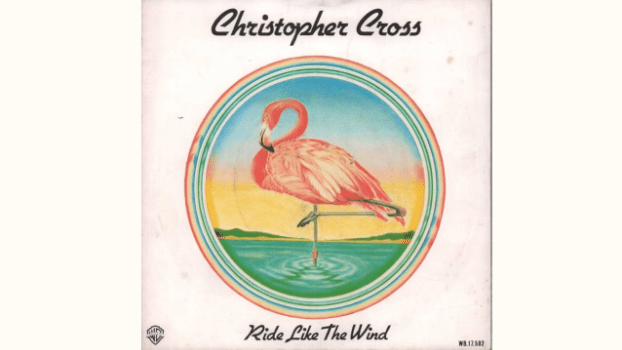
“And I’ve got such a long way to go / To make it to the border of Mexico /
So, I’ll ride like the wind, ride like the wind”
- Reached #2: April 26th 1980
- Number of Weeks at #2: Four Weeks
- #1 Song At the Time: “Call Me” – Blondie
The third season of the hit HBO series, Euphoria, begins with a Jeep riding like the wind through the desert. In the opening scene, some helpful Mexicans push a Jeep out of a ditch and we see series protagonist Rue Bennett, played by Zendaya, sticking her head out of the car and happily saying, “Gracias! Mi Amigos!” before riding off to complete a drug run at the U.S./Mexico border. As Rue rides off and puts the pedal to the metal, the needle drop that accompanies this is Christopher Cross’ 1980 debut single and first hit, “Ride Like the Wind.” Rue is seen singing along and enjoying the song as she rides across the bumpy desert terrain. It was admittedly strange to hear that song soundtrack the first sight of Rue’s new life as a drug runner. She doesn’t strike me as the kind of young woman that would get down with Christopher Cross, but Rue Bennett contains multitudes. My only complaint is that I didn’t get to hear her do a Michael McDonald impression. That scene matches what “Ride Like the Wind” was attempting to achieve: a badass outlaw fantasy of being on the run, raising hell, and riding off into the distance without ever looking back. But this project is all about looking back. In hindsight, Cross was a lightning-in-a-bottle phenomenon and this song could have only achieved the success it did at the dawn of the eighties, when the pop charts were an absolute free-for-all. After his moment, the rise of MTV made image and branding the new thing in popular music, effectively ending the chance for guys like him to pull off what he did during 1980. This project will eventually reckon with the beast that was MTV, although not for some time. But in his moment, Cross was the crown prince at the height of a movement that wouldn’t get its name until decades later. That coronation began with “Ride Like the Wind,” a song I honestly wish I liked more than I do.
First, we should become acquainted with the man. Christopher Geppert was born the son of an army physician in San Antonio, Texas, who, like a lot of famous musicians, found an interest in music at a young age. He did all the typical things young musical men do when building up to a career: formed bands in high school and played at local events like school dances and church functions. He started out as a drummer but eventually shifted gears to being a guitar player.
When Geppert was still in his teens in the late sixties, he met two guys that he would form a band with: bassist Andy Salmon and keyboardist Rob Meurer. Together, they moved to Austin, where they would eventually recruit drummer Tommy Taylor. The name of the band they formed… was Christopher Cross. Yeah. “Christopher Cross” didn’t start as a stage name for Geppert, though it eventually morphed into one, because naming a band “Christopher Cross” is headscratchingly odd. That was the most headscratching discovery for me while researching Geppert, later Christopher Cross. The four guys initially considered “Christopher Cross” to be the name of their band, rather than being the stage name of their frontman (whose first name is Christopher).
Anyway, when they formed in Austin, they spent the entire seventies in the club circuit, playing in all kinds of places in the Austin area, such as the Paradise, the Old Pecan St. Cafe, and the Steamboat. They weren’t playing original material at the time. Cross would often do Beatles and Beach Boys covers. They also played at a lot of college events. As the seventies went on, Geppert began writing original material that would eventually become his self-titled debut album.
In 1974, Geppert submitted a demo tape to Warner Bros. Records. It didn’t catch on, but he was told to try again at some point. Four years later, he scrounged up enough money to produce a second tape and tried again. This time, he found a guy willing to go to bat for him: Warner Bros. executive Michael Osten, who loved what he heard. He took it to producer Michael Omartian, who then convinced the higher ups at Warner to give Geppert a deal. Omartian would go on to produce his first four albums.
When Geppert signed with Warner Bros. Records, they signed him as a solo artist and treated “Christopher Cross” as a stage name, rather than the name of a band. I would have loved to have been a fly on the wall watching Warner executives look at each other in confusion and ask, “Wait… it’s the name of a band? It’s not a stage name? What?” I don’t know why, but I’m just fascinated by that little fact. Regardless, from here on out, I will also be treating “Christopher Cross” as Geppert’s stage name and refer to him as that.
Christopher Cross’s first album was made within a special and unique scene that had enjoyed great success at the end of the seventies and the early eighties. Along with Cross, this scene included the likes of Kenny Loggins, the Doobie Brothers, Steely Dan, Toto (who will eventually appear in this project), and an interconnected web of other, more obscure artists. Loggins and Doobie Brother/Steely Dan alum Michael McDonald were the two undisputed kings of this scene (for examples, see Loggins’ “This Is It” and the Doobies’ “What a Fool Believes”). Cross came in right after those guys achieved massive success and he followed suit. This scene was defined by several characteristics: the music was breezy soft rock that utilized a lot of jazz and R&B chords in the songwriting. It was music made pretty much exclusively in California. Electric piano was featured a lot. The lyrics were usually about either dreams of fantastical escape or heartbroken and foolish men. The production was slick and smooth as a sea lion’s skin. Songs usually included a personnel list made up of some of the greatest studio musicians the state could offer. This scene didn’t have a specific name until two decades later, when two guys–J.D. Ryznar and Hunter Stair–created a web series poking fun at the scene and gave it a name: yacht rock. (Note: Yacht not required.)
It got the name “yacht rock” from its two creators noticing that nautical themes tended to appear a lot within the music and album artwork. Cross contributed to that trend with his song “Sailing.” Steely Dan’s “Home at Last” is another example. “Yacht rock” as a term wasn’t meant to be treated that seriously, but it was a term that really caught on and it’s one of those things where it isn’t really a genre the way that “rock” or “jazz” or “rap” is, but it’s a goofy term you can use and music nerds will immediately know what you’re talking about. The web series is still funny as hell (and available on Youtube) even if I think the term has traveled way too far and gotten out of hand. But that’s neither here nor there. I like that it’s a term that makes guys like Rick Beato and Daryl Hall angry.
I have heard Boz Scaggs’ 1976 album Silk Degrees be referred to as “yacht rock Voltron” more than once, with the joke being that a lot of people that made up the yacht rock scene contributed to that album in some form. I disagree with that album having that distinction. The album that best fits the description “yacht rock Voltron” is Cross’ debut. A lot of major players in that yacht rock scene played a role in shaping that album. Consider: it’s produced by Michael Omartian. It has Michael McDonald doing backing vocals on several tracks (especially on “Ride Like the Wind”). Steely Dan alumni are present (guitarists Jay Graydon and Larry Carlton). Don Henley, J.D. Souther, Nicolette Larson, and Valerie Carter all provide vocal work for the album. The only thing it’s missing is at least one Toto member being present (we’ll talk about that when we eventually get to Toto. Those dudes were everywhere.) Cross’ debut album is still one of the best ways to easily explain to someone what Rynzar and Stair were pointing to when they coined their now ubiquitous term.
“Ride Like the Wind” was the first single from the album. Warner wanted “Say You’ll Be Mine,” a smooth and bouncy Beach Boys-inspired tune to be the first one, but Omartian convinced them that “Ride” was the right choice. I also think Omartian was right in the end, even if I think “Ride Like the Wind” is one of the weaker songs on Cross’ debut.
My biggest issue with “Ride Like the Wind” is that for every good thing it has going, there is something about it that just turns me off and doesn’t work. The good things are that the production is slick and very smooth, it has a very good bounce to it. That Fender Rhodes piano is banging out a very catchy main riff that gives the song a great drive. The congas running through the song give it a unique and almost Latin flair. That “ba-da-da-da, ba, ba, ba, BA!” part that runs after the chorus is straight out of the biggest America hits, like the end of “Sister Golden Hair.” All of that stuff works!
So what doesn’t work? Well, Omartian’s production might be too smooth for this song to achieve what it wants. For a song all about being a badass outlaw escaping and riding free and fast on the open road, it has no real bite to it like the best highway driving songs do. It’s breezy like a highway song, but this doesn’t make me want to put the pedal to the metal and really ride. I tried blasting this song while driving down the highway whenever I knew I was going to be doing ten (or twenty) over the speed limit. It didn’t give me the same feeling I get when I blast “Rockin’ Down the Highway” or “Highway Star.” Now those are songs that make a guy want to evade the law and keep hitting the gas.
The biggest issue on the production side of things is in the mixing. Did you know there’s a really killer guitar solo in this that Cross plays? You would never really know that unless you’ve heard Cross play this song live, where he suddenly hulks out and becomes a bonafide guitar hero. It’s a great moment! There’s a solo in the studio version towards the end of the song, but it’s completely drowned out by that incessant “ba-da-da-da, ba, ba, ba, BA!” refrain and buried in the mix of everything else going on. It’s a shame, because I think the song would benefit from having that be front-and-center and the vocals going away while Cross, for lack of a better word, rides. The song lives up to its name when Cross gets to capture that moment through his guitar playing that captures that sense of wild freedom on the open road. When played live, it’s a great takeoff moment. It just soars after that and he gets to just go crazy with it until the song ends. None of his major hits feature him playing like that, so audiences get their minds blown right at the end of the show when you get to see what he can really do. You can hear glimpses of that in the studio cut, but you have to block out everything and focus on that, which I shouldn’t have to do. It should be the main attraction at the close of the song, because trust me, you will start getting sick of that “ba-da-da-da, ba, ba, ba, BA!” repetition at some point. You don’t bury a solid guitar solo with that kind of noise and that’s exactly what happened and a lot of people missed it because of that. Look up any live performance of this song on Youtube and you will inevitably find some variation of comment about being underrated as a guitar player and not knowing he could do that. He’s like the original “I’m sorry sir, I was unfamiliar with your game.”
Another major issue: It’s way too slow to be a good highway song. That’s really what kills the whole thing for me. It needs to be played at a faster tempo. Highway jams and songs about badasses commanding the open road need to hit hard and fast. This song does neither of those things. If you play this at 1.15x speed, this problem is immediately eliminated.
Christopher Cross was always good at sounding like a wise friend, with introspective songs that are about relationships and being in-touch with his own emotions. His style is that of the sensitive singer/songwriter: relaxed, calming, warm. You can hear a lot of Carl Wilson from the Beach Boys in his vocal style. What Cross is not good at is sounding like a badass outlaw. He looks like a defensive tackle for Texas A&M, but he doesn’t sound like that. His voice is too high, too breezy, too sensitive. He’s not terribly masculine, which isn’t a bad thing! However, that makes lines like “I was born the son of a lawless man / Always spoke my mind with a gun in my hand / Lived nine lives / Gunned down ten” sound silly coming from him. He’s more of a Hank Hill kind of Texan rather than a Pecos Bill, if you know what I mean. I like Michael McDonald’s backing vocals (🎶Such a long way to goooooooo🎶) and they sound great, but they are also very very silly when trying to sell this story of a badass outlaw on the run (see Bonus Silver for a legendary SCTV skit poking fun at that).
Cross’ style of singing and songwriting just doesn’t fit a topic like this. Supposedly, Cross wrote the lyrics to this song after he took acid while on a road trip from Houston to Austin. I don’t know if I fully believe that, but I’ll give it to him as a “print the legend” type of deal. Regardless, in a Songfacts interview, Cross talked about the lyrics being inspired by a love for old cowboy media he grew up watching.
This all makes perfect sense. “Ride Like the Wind” is a daydream. It’s a song selling a fantasy where you imagine yourself as a hardened criminal evading the cops and escaping to Mexico… but it’s not selling a cool version of that fantasy. It’s selling an attractive touristy version of it to the kind of woefully middle-aged guy who watched Easy Rider or Smokey and the Bandit too many times and wants a taste of that wild outlaw fantasy, but wouldn’t actually want to live the real danger of that life in any way. I can’t shake that feeling and coupled with its other issues, prevents me from really falling in love with this song the way I enjoy other Cross hits.
“Ride Like the Wind” got the silver, but he would hit the top after this with the next single: “Sailing.” That’s the one. That’s a better display of all of Cross’ strengths, both as songwriter and performer. It’s hypnotic, enthralling, calming, beautiful. There’s no other song quite like it. That went to the top in August 1980. “Never Be the Same” and “Say You’ll Be Mine” were also Top 20 hits. I don’t love “Ride Like the Wind,” but the rest of that album is incredibly solid. It’s worth your time. That first album ended up doing damn good business, eventually going six times platinum and sweeping the 1981 Grammy awards. That’s going to factor into a future You Got the Silver subject, so we’ll talk more about that when we eventually get there.
That wouldn’t happen again, but Cross wasn’t unsuccessful after that first outing. Cross shot up to the number one spot a second time in October 1981, when he sang the Burt Bacharach/Carole Bayer Sager-penned “Arthur’s Theme (Best That You Can Do),” the theme for the 1981 Dudley Moore/Liza Minelli rom-com Arthur. I have never seen it, but I’ve heard that song plenty of times. It is absolutely gorgeous. Cross has never sounded better vocally than on that track.
The follow-up to that debut album didn’t happen until January 1983, when Cross finally released his second album, Another Page. It’s not as good as the first one, but there’s still a number of songs I enjoy from it. A few of those songs ended up being hits too, especially on the Adult Contemporary charts (which is where a lot of the yacht rock survivors ended up after the scene got shipwrecked by the mid-eighties). The biggest one of those was “Think of Laura,” which might be one of Cross’ best songs. There’s a non-zero chance that song got popular because people were super invested in the Luke and Laura relationship on General Hospital around that time. He did not write it for the show (he wrote it about someone he knew who died in a shooting), but that didn’t stop the show from using it.
The other major hit from that album was “All Right,” a breezy motivational song that sees Cross teaming up with McDonald again on backing vocals and half of the members of Toto. Solid song. It makes me smile and say, “You know what? I think we are gonna make it, Chris.”
Cross more or less disappeared after that, but he showed up in a few odd places providing backing vocals on some songs. For example, I knew Carl Wilson was on it, but I didn’t know Cross was also on David Lee Roth’s version of “California Girls.” Wilson and Cross also teamed up again on Olivia Newton-John’s 1985 track “You Were Great, How Was I?” These yacht rock guys are always around and show up when you least expect it. They’re like the Spanish Inquisition of musicians.
Anyway, he did show up in popular media one more time after his big moment. In 1988, Cross’ track “Swept Away” was featured in the Season 3 opener to Growing Pains, during a montage when Kirk Cameron’s Mike Seaver falls in love with the first Hawaiian girl he lays eyes on. In that same episode, he also tells the audience that seeing this girl was a sign from God that she should “be his first Hawaiian experience.” Weird.
Cross kept trucking and putting out music through the nineties and oughts, but has mostly remained a reliable touring machine, playing the hits that have endured. He’s on tour right now at the time of this writing.
“Ride Like the Wind” missed the top spot because Blondie (who will not appear in this project) were riding an absolute high at the time and just batting a thousand over and over. “Call Me” is still a barn stormer. If you really want to know why “Ride” didn’t make it to the top, that’s easy. Blondie were making way more exciting music. Plus, their frontwoman was Debbie Harry, a supernova brimming with attitude and a magnetic personality. It also helped that she was and still is a galactically beautiful woman, so pack it up. It’s game over.
Christopher Cross will not appear in this project again, but don’t feel too bad for him. If anything, him and his whole damn scene have gotten a great reappraisal as time has marched on. The Yacht Rock web series and the way new generations have latched onto the memes and turned it into genuine love have helped greatly. In every interview I’ve watched with Cross and everything I’ve read about him, he seems like a fine, upstanding guy who is perfectly content with how his career has played out in the long run. If he’s bitter about anything, he’s never really shown it. His songs have stuck around and keep appearing, even after forty-five years. The daydream fantasy he conjured in “Ride Like the Wind” and that sense of excitement and escape still exists as Rue Bennett sings along to the radio, riding across the bumpy desert terrain as fast as she can to get to the border of Mexico. Her life during the rest of Euphoria’s third season was a hellish nightmare (that ended in death), but in that moment, she looked more free than she had ever been. Ride like the wind, Rue.
Bonus Silver
Second City Television (SCTV) had a legendary skit imagining Michael McDonald in the booth recording his parts for “Ride Like the Wind.” The real Michael McDonald was stoned in a hotel room with fellow Doobie Brother Pat Simmons and saw this skit when it aired. He thought he was losing his mind at first, but thought it was hilarious. I can’t hear the song without thinking of this clip. View it here.
At a 1981 show at The Ritz in New York, the always musically adventurous Frank Zappa surprised the audience by covering the song. Along with Zappa’s band, famed jazz-fusion guitarist Al Di Meola joins in on the fun and Brian Peters, one of the roadies, steps up and takes lead vocals. It’s a real trip. Di Meola goes fucking crazy on this. Cross was an admirer of Zappa’s guitar playing, so he’s probably heard this and loved it. Check it out.
Legendary jazz trumpeter Freddie Hubbard put his own spin on the song in 1982. It’s a stunning cover. It grooves, it glides, it rides. I prefer this version to the Cross original. Listen to it here.
Last year, R&B/soul singer Allen Stone recorded his own take on the song. It’s a solid and soulful take. The energy is really good on this one and I love how it rises towards the end. Shout out to the keyboardists who are going full McDonald with the backing vocals. That’s the only way to do it. Check it out.


Leave a Reply