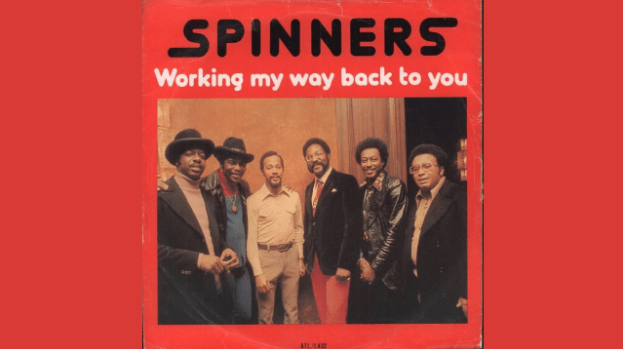
“When you were so in love with me / I played around like I was free / Thought I could have my cake and eat it, too / But how I cried over losing you”
- Reached #2: March 29th 1980
- Number of Weeks At #2: Two Weeks
- #1 Song At the Time: “Another Brick in the Wall (Part 2)” by Pink Floyd
So, who the fuck was gonna tell me that the Spinners’ “Working My Way Back to You” was a cover? I’ve gone my entire life thinking this was a Spinners original! You’re meaning to tell me the Four Seasons first did this in 1966? That doesn’t sit right with my spirit. It feels wrong. I had never heard the Four Seasons original prior to sitting down to write this. But that’s just what can happen sometimes in the wake of a successful cover. Sometimes, a cover becomes so successful and beloved that it overtakes the original, to the point where the original doesn’t sound right. In the case of the Spinners, they did that with “Working My Way Back to You” in more ways than one. They took their version to a higher spot on the Hot 100 than the original did (the Four Seasons original only made it to #9) and now if you search the song, it assumes you’re looking for the Spinners. This is the correct assumption because the Four Seasons original is… not great. If I’m caught in a bad mood, I might even say it’s bad. I don’t like being burdened with the knowledge that the Spinners version is a cover, but that’s just the way it’s gotta be.
So, for the second time on You Got the Silver, we have an act that scored a number two hit by giving an old mid-sixties song a modern facelift. It’s an odd little thing that somehow happened twice in the same year. No, crazier than that. It happened within the same month.
It isn’t the strangest thing when you step back and look at the eighties in full. Boomer nostalgia for the sixties would end up running wild during the second half of the decade. Every act that was big in the sixties and still kicking seemed to get a second wind and score major comeback hits. But I find it fascinating that the massive amount of nostalgia the eighties had for the sixties began at the very start of the decade, instead of being a later development, where it’s a lot more obvious. The Spinners were active in the sixties and so far, they’re the oldest act we’re covering. But they weren’t relics yet. They would be after this, which was one of their last big hits on the Hot 100. “Working My Way Back to You” is a last big hurrah for a group that would keep on working, even after the party was over. Let’s get into it.
[Note: Like a lot of vocal groups from the Spinners’ time, there are a few lineup changes between their inception and the Spinners that spun their silver hit. For the sake of easy understanding, the Spinners that appear on “Working My Way Back to You” will be written in bold.]
The story of the Spinners begins in the Detroit suburb of Ferndale in 1954 as a doo-wop group named the Domingoes. The original Spinners Domingoes were: Henry Famborough, Pervis Jackson, Billy Henderson, C.P. Spencer, and James Edwards. James Edwards was only involved for a few weeks before getting replaced by Bobby Smith. Spencer left shortly after and George Dixon eventually joined. They changed their name to the Spinners (which is a cooler name) in 1961 and never looked back.
Their first single in 1961 was “That’s What Girls Are Made For” and they went on to join Motown’s roster in 1963, when Motown bought Tri-Phi, the local label the Spinners were on. Despite being part of the Motown machine, the Spinners couldn’t crack a single Top 10 hit for the entire decade. During the sixties, George Dixon left and Edgar “Chico” Edwards took his place.
The Spinners came close to having a Top 10 hit in 1970 when they recorded the Stevie Wonder/Lee Garrett/Syreeta Wright-penned “It’s A Shame.” It’s a shame the way you’re messing ‘round with your man, and it’s a shame that it only got to #14. That song is a certified heater. That’s lead vocalist G. C. Cameron you hear, who only appeared with them on their 2nd Time Around album in 1970. He would leave and be replaced with their most well known lead vocalist, Philippé Wynne.
The Spinners were consistently in the shadows of other Motown titans, so they eventually jumped ship and found themselves over at Atlantic Records. It was there that the Spinners got paired up with the man who would lead them to greatness: Thom Bell.
Thom Bell, along with Kenny Gamble and Leon Huff, is one of the architects of the Philadelphia Soul sound. Barbara Mason’s original version of “Yes, I’m Ready” has early elements of it, but Bell’s songwriting and production work throughout the seventies is what truly turned it into an easily identifiable style. Several groups owe a lot to him: The Delphonics (“Didn’t I (Blow Your Mind That Time),” “You Are Everything”), The Stylistics (“Betcha By Golly Wow”, “You Make Me Feel Brand New”) and the Spinners. Once the Spinners linked up with Bell as their songwriter/producer, the hits started coming. A highlight of those hits include: “I’ll Be Around,” “Could It Be I’m Falling In Love,” “Games People Play,” and “The Rubberband Man,” which is not to be confused with the other popular rubberband man that was created by famous manga writer Eiichiro Oda. Bell’s hits were in a similar line with what Gamble and Huff had built the Philly soul sound on: songs with a lot of lush, orchestral strings piled on and sweet sounding voices delivering hooks and melodies for days. Unlike Gamble and Huff, Bell incorporated a lot of strange little flourishes, instruments, and touches within the space that hooked you in and kept you coming back. It’s odd, but just odd enough that it attracts rather than repels. Gamble and Huff wrote and produced more number ones than Bell, but Bell’s catalog of heaters will keep you and your family warm through the coldest winter. It shouldn’t be ignored. That partnership between the Spinners and Bell lasted for five years and produced a lot of worthwhile stuff. It’s a good run worth exploring if any of those hits mentioned spark interest.
In 1977 and 1978, two things happened that shook up the Spinners: the first was that Philippé Wynne left the group to embark on a solo career. John Edwards would replace him and the Spinners lineup would remain unchanged until 2000. The other thing that happened which really hurt them was Thom Bell stopped writing and producing for them after the 1978 album From Here to Eternally. The Spinners shifted gears and moved towards disco, enlisting another producer, Michael Zager (more on him later). The group also took more of an active role in production starting in the post-Bell era.
1979’s Dancin’ and Lovin’, which is where “Working My Way Back to You / Forgive Me Girl” comes from, is as disco as it gets. From Here to Eternally was already gesturing in that direction, but Dancin’ and Lovin’ went all in on it. I imagine it probably seemed like a good move at the time, even if this album saw release a few months after Disco Demolition Night happened in Chicago. Disco obviously didn’t die overnight, but I would also tell you that the Spinners probably pivoted to disco just a tad too late. Dancin’ and Lovin’ has some fun songs on it, but it’s nothing particularly mindblowing. It absolutely helps that “Working My Way Back to You” is not a disco song.
I can understand people arguing that the Spinners version of “Working My Way Back to You” is a disco song. It has everything that would support that argument. The beat is incredibly disco, the strings are more aligned with disco than the Philly soul sound the group got big with, it has an earworm chorus it repeats several times and then refuses to leave your head after. And yet… I think one of the reasons this was able to peak at number two at the end of March 1980 is because it incorporates disco elements without being explicit about it. To my ears, it leans more towards soul and R&B than straight up disco, which is probably why people latched onto it the way they did. Pink Floyd’s “Another Brick in the Wall (Part 2)” pulled off the same trick. It has elements of disco (Nick Mason’s drum beat, David Gilmour’s guitar strumming that sounds like something Chic would play) but they’re also Pink Floyd, so people don’t notice it as much because they’re paying attention to Roger Waters’ lyrics criticizing the British education system and hearing Gilmour rip one hell of a solo. The listening public had rejected disco by late 1979, but you could still play with disco in parts if you knew how to disguise it or distract from it.
That’s what I find the Spinners are doing here. Their cover of “Working My Way Back to You” flirts with disco while remaining in the lane of being a soul song. The string arrangements are done in a way that calls back to what you would have heard during the Bell-era Spinners work, the vocal arrangements are more informed by soul and R&B than disco vocals (John Edwards is straight up singing soul and the baritone vocals don’t fit most disco), the lyrics are an apology and plea rather than being a bunch of unimportant nonsense about dancing, and it’s an update of a song from 1966 rather than trying to specifically be something new within the current moment. You can make the case that this is a disco song, but I think there’s too much working against it to call it that. Gun to my head, I’d be confident in my stance that this is a soul song and not a disco track.
And boy, does that soul shine! The soul of the song is really what makes it the definitive version. I don’t know who the hell would want to hear Frankie Valli’s nasally goose honk of a voice singing this song. I can only handle Frankie in short doses. The Four Seasons original as a whole sounds stilted and awkward. That disco beat fixes it by giving the song more of a groove. It lets the vocal melody flow smoother. It makes a world of difference that John Edwards just goes for it and delivers the entire song as a bleeding heart with genuine regret and an almost desperate plea to his girl to take him back after messing around and cheating on her. The baritone vocals also add a lot of memorable little hooks throughout. There’s just something about that deep voiced delivery of “been paying every day” that’s just pleasing to the ear. That’s Pervis Jackson you hear doing those parts and he’s great. The other Spinners providing backing vocals are on fire and I think little flourishes like Jackson’s deep vocals help give the song a personality that the original is lacking. The whole song has this exuberant and confident energy that fits the concept of a cheater who seems pretty sure he will be able to convince his girl to forgive him and take him back (even after cheating).
That’s what “Working My Way Back to You” is all about. The narrator and his girl have broken up due to him running around and cheating on her. The kind of man who thinks he can get away with it and then gets heartbroken when she finds out and leaves. He also voices enjoyment over making her cry, which won’t help with endearing you to this guy. It’s an apology song centered around a vow to pay for all the pain he’s caused and work his way back into her good graces. Your mileage may vary on how well this strategy works, if it even works at all.
I get the feeling the Spinners–and producer Michael Zager–knew that this apology song wasn’t the most sound and decided the song needed something extra in order to really sell the feelings of remorse and the desire to change. That’s where the “Forgive Me Girl” part of the song comes in.
When the Spinners made the shift towards disco, Michael Zager had developed a profile in the R&B and disco scene during the mid-to-late seventies, mostly producing a bunch of disco I’ve never heard of and I doubt anyone else has heard unless you’re a huge disco nerd and have elite ball knowledge on the deepest of deep cuts. He’s most well known for the 1977 hit “Let’s All Chant” (credited to the Michael Zager Band), a truly maddening yet hypnotic disco jam that is as late seventies as it gets. He ended up working with the Spinners on Dancin’ and Lovin’, as well as the two albums that came after that in the early eighties (1980’s Love Trippin’ and 1981’s Labor of Love).
He was the one that wrote and provided “Forgive Me Girl,” a new bridge for the Spinners’ version of “Working My Way Back To You.” He would do this same thing for two other covers that the Spinners did after this. He fused Sam Cooke’s “Cupid” with a new piece called “I Have Loved You For a Long Time” in 1980 for Love Trippin’ and fused the Carpenters’ “Yesterday Once More” with a new piece called “Nothing Remains the Same” in for Labor of Love in 1981. It doesn’t make the song a mindblowing masterpiece or anything, but it does give John Edwards the chance to sell himself as the remorseful, heartbroken man and make it sound like he really means it. The additional lyrics go like this:
My road is kinda long
(You, you, babe) I just gotta get back home
Whoa, I’m really sorry for actin’ that way
I’m really sorry, ooh, little girl
I’m really sorry for telling you lies for so long
Oh, please, forgive me, girl, come on (Give me a chance)
Won’t you forgive me, girl, hey (Let’s have romance)
Ooh, forgive me, girl (Let’s start again)
Come on, forgive me, girl
I want you over and over and over and over again
It’s a nice little addition that gives the song something new and it feeds back into the chorus really well. It’s a nice trick. I don’t think it worked nearly as well when Zager tried it the other two times and the Spinners really only hit the silver with it once. Their cover of “Cupid” went to #4, but “Yesterday Once More,” while good, wasn’t a hit in the slightest.
Overall, this is a really solid cover and a great example of what you want a cover to do. It takes a song that was fine, but rough around the edges. It transforms it into something new and exciting, to the point where everyone has accepted it as the definitive version. The Four Seasons original is fine, but the Spinners version sounds like a party and a man’s desperate attempt to win his lady back. We never know if he ends up working his way back to his lady, but we do know that the party didn’t last for the Spinners. In fact, it super didn’t last for them. Their silver moment comes right at the very end of their commercial relevance.
The Spinners’ commercial decline was steep and fast. Their last song to show up on the Hot 100 was with a pretty damn solid cover of “Funny How Time Slips Away.” After that, they more or less disappeared. They fared better on the R&B Chart, but were gone by the second half of the decade. For what it’s worth, I kinda really dig their Crossfire album from 1984. That one’s worth a listen and has some pretty good songs. I didn’t know this when sitting down to write this, but they provided the vocals for the theme song to Mel Brooks’ 1987 comedy classic Spaceballs. I’ve seen the movie a good number of times, but had no idea that it was the Spinners doing the vocals. Good shit.
I don’t quite know why the Spinners didn’t have better luck in the eighties. Maybe they pivoted to disco too late and it screwed them? Or maybe they just didn’t have the same flair as their contemporaries. It’s strange, because black R&B vocal groups thrived during the decade. The Temptations had a good comeback era. The Gap Band had a good run. New Edition were a hot commodity. Ready For the World and DeBarge had brief glimmers of greatness. Hell, even the Whispers had a pretty good track record. Then again, maybe the reason the Spinners didn’t pop off in the eighties was because they didn’t make “Rock Steady” (an eighties funk banger that has gone multi-platinum in my home).
The Spinners’ version of “Working My Way Back To You” represents the final time we will see anything resembling disco in this project. It’s fully over after this. We are also reaching the end of the seventies backwash. Very soon, the late seventies will be a distant memory and we’ll only be covering songs that were released in the eighties.
The Spinners will not return in this project, but we’ll keep working our way through the decade with them in our hearts.
Bonus Silver
In 1980, Brotherhood of Man recorded their own version of the Spinners cover. It’s fine, but it sounds too much like a bunch of yuppies doing karaoke, so I don’t know why you would need this over the Spinners’ version. Regardless, listen to it here:
In 1980, British pop group Brotherhood of Man recorded their own version of the Spinners cover. It’s fine, but it sounds too much like a bunch of yuppies doing karaoke at their local bar, so I don’t know why you would need this over the Spinners’ version. Regardless, listen to it here:
In 1990, Jamaican dancehall artists Sanchez & Flourgon recorded their own version of “Working My Way Back to You.” It works surprisingly well. I dig it. Check it out here:


Leave a Reply