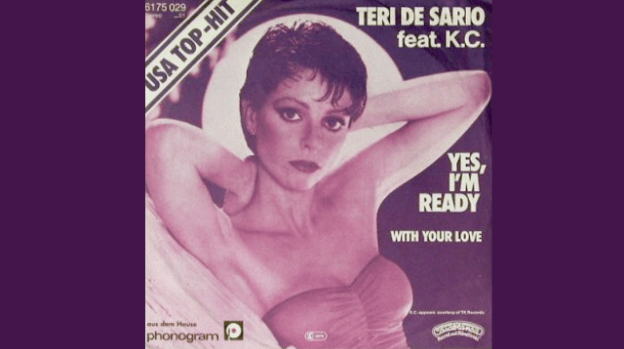
“Are you ready? Yes, I’m ready”
- Reached #2: March 1st 1980
- Number of Weeks at #2: One Week
- #1 Song At the Time: “Crazy Little Thing Called Love” – Queen
The 1980s as it exists in the popular consciousness only really exists from the years 1983 to 1987. Most of the really beloved music from the decade came out during that time. Movies and television that people build their entire personality around came out during those four years. When you see Instagram accounts that are built around “living like it’s the eighties,” it is always the romanticized and imagined version of it: The neon, the big hair, the fashion, the technology, and the pop culture of the decade (as it appears to people who were not actually there but desperately wish they were).
This is all to say that the beginning of the 1980s is far away from what people tend to picture in their minds when they think of the decade, especially when it comes to music. The identity was developing by the end of the seventies, but it wouldn’t take over for a few more years. With that in mind, the first few installments of You Got the Silver will be dedicated purely to seventies backwash, the last gasps of dying movements clinging to life before a new generation steps in and shapes the future in their own mold. “Yes, I’m Ready” is a song released in 1979, but it gives us a good starting point for this project, as it perfectly represents that weird spot in between two specific times. One decade is over, but a new one is still in infancy, still working out what it’s gonna be.
The popular music of the early eighties is like exploring a destroyed city after a war. There’s nothing but rubble and debris, but something can still be built and recovered from what’s still around if it can be found. During the final years of the seventies, the public had gone all in on the disco craze. The eventual backlash to that popularity eventually caused it to crash and burn hard, etching itself into pop music mythology. That death led to the weird lack of identity you find at the dawn of the eighties. The new and exciting things that would come to shape the decade hadn’t arrived yet and the previous big thing that drove the previous years was killed and tossed away. When something like that happens on the pop charts, something has to come in and take its place. Luckily, the world of adult-contemporary ballads is always there and ready (heh heh) to keep the Hot 100 warm until the next thing arrives. Historically, whenever there’s been a boring lull in the pop charts where nothing is happening, adult-contemporary ballads swoop right in. So if Teri DeSario and K.C., our first silver medalists of the decade, were going to score a hit with a milquetoast nothing burger of a ballad, it could have only been in the early days of 1980, when no major moment was happening and songs of this nature suddenly thrived again.
Teri DeSario is a special kind of one hit wonder: the one hit wonder who’s one hit is a cover song. She’s in that club with the likes of Alien Ant Farm (“Smooth Criminal”), The Lemonheads (“Mrs. Robinson”), and Pseudo Echo (a truly baffling cover of “Funkytown” that needs to be heard to be believed). There are worse places to end up.
DeSario hails from Miami, Florida, getting her first tastes of musical experience studying classical voice at Barry University when she was thirteen. She began her professional career at eighteen as a singer/songwriter in Miami and Ft. Lauderdale. Two years later, she joined up with the Early Music Consort, a British music ensemble that mostly dealt in delivering historically accurate Medieval and Renaissance period music. She would remain with them as a soloist and member for six years. She briefly studied jazz voice at the University of Miami, but dropped out in favor of continuing the singer/songwriter route. Interesting resume for a woman who would end up singing music light years away from any of that.
Things changed for her in 1977. While performing with a jazz fusion outfit in Coconut Grove, frequent Bee Gees collaborator and producer Albhy Galuten heard her and was impressed with her voice. He took a demo tape to Barry Gibb, who decided to take her on and work with her, writing and producing a song that would become her debut single and end up on her first album, Pleasure Train (1978). Considering Gibb and the Bee Gees were right on the cusp of releasing the soundtrack for Saturday Night Fever (which would be the best selling album of 1978) and going on the greatest chart run since the Beatles, DeSario couldn’t have fallen into better hands if she tried. She hit the musical lottery.
That collaboration with Gibb spawned “Ain’t Nothing Gonna Keep Me From You,” a song that would go on to become a cult classic disco hit. All the same musicians who played on the Andy Gibb classic “Shadow Dancing” played on this. “Ain’t Nothing Gonna Keep Me From You” peaked at #43, which certainly isn’t terrible for a debut single!
Barry Gibb couldn’t take her to the top, but luckily for DeSario, she happened to know of another white disco king that might be able to do something with her that would really make a splash.
That white disco king was Harry Wayne Casey, better known as “K.C.” of K.C. & the Sunshine Band.
For a time in the mid-seventies, right before the Bee Gees usurped him and became the undisputed kings of the late seventies, K.C. & the Sunshine Band reigned supreme as the biggest band in disco. Formed in 1973 by K.C. and bassist Richard Finch, the Sunshine Band made a name for themselves on dance floors by pumping out a steady stream of unstoppable disco and funk classics. Four of them were number one hits between 1975 and 1977: “Get Down Tonight,” “That’s the Way (I Like It),” “(Shake, Shake, Shake) Shake Your Booty,” “I’m Your Boogie Man.”
By 1980, the original version of the Sunshine Band was falling apart. Nobody was getting along and after 1979’s Do You Wanna Go Party, Finch and K.C. had a bitter split. What made matters worse was that for the three years after that 75-77 run, the Sunshine Band couldn’t break the Top 10, even during disco’s supremacy in 1978. Besides a few songs cracking the Top 40, they couldn’t catch that same spark.
But K.C. wasn’t out of the water just yet. For the first week of the eighties, he had the number one song in the U.S. with the not-disco ballad “Please Don’t Go.” Listening to it in hindsight, it plays like K.C. knew that disco’s backlash was serious and that a reinvention and pivot away from that world was necessary in order to keep the good times going. It was a smart move and for a brief moment, that worked! “Yes, I’m Ready” is also a not-disco ballad and while it didn’t become a number one, it at least proved that K.C. still had some gas left in the tank.
Teri DeSario and K.C. joined forces because she knew him back when he was just Harry Wayne Casey. Desario and K.C. went to the same high school and were old friends. She was searching for a producer for her second album, 1979’s Moonlight Madness, and he ended up taking the job. He produced the whole album and appears as a guest on two songs, both of them covers: “Dancin’ in the Streets” and “Yes, I’m Ready.” DeSario cites “Yes, I’m Ready” as one of her favorite songs from her teenage years on her website.
The original “Yes, I’m Ready” began life in 1965 as a hit for Philadelphia soul singer/songwriter Barbara Mason. Many of the musicians that played on it went on to form the nucleus of MFSB (Mother Father Sister Brother), the house band of Philadelphia’s Sigma Sound Studios. Because of those musicians, the sweet and sweeping strings, and possibly because Mason is a Philly native, this song is often considered the first record that has “the Philadelphia Sound” of soul. I live about an hour and some change away from Philly and I’ve spent a good deal of time exploring the city, but was unfamiliar with this song in any form until sitting down to write this.
The original is… fine. It’s fine. I don’t love it. I can hear the Philadelphia sound (it’s the strings, mostly) and how it laid down the foundation for what came later with songs like “If You Don’t Know Me By Now” and “You Make Me Feel Brand New,” but the song doesn’t leave me knocked out and wanting more. DeSario is a better singer than Mason is and I think her voice captures what Mason was shooting for with her original. Mason wrote the song about being a young and innocent person falling in love for the first time and taking the plunge, even if there’s nervousness and trepidation about that. Mason’s voice doesn’t really capture that, but DeSario’s does. DeSario’s voice has this softness to it that evolves into something bold by the end of the song. She sounds like someone innocent and really falling in love with someone for the first time and finally being brave and going for it. There’s a genuine romance I feel with DeSario’s version that I don’t really get with Mason’s original. The late seventies glittery keyboards driving the song over strings helps with that too. DeSario’s version sounds like a good slow song that would have played at a school dance or during a moment in the club where they slow things down a bit (do they do that in clubs? I’ve never actually been in one.)
The biggest change to this song is DeSario and K.C. turning it into a duet. It’s a really good change and I think it fits. DeSario and K.C. are a pretty good match vocally and they compliment each other nicely. DeSario is mousy and soft and nervous at the start, while K.C.’s vocals have a warmth and tenderness to them that helps sell the romance of the song. You hear the both of them getting more comfortable with each other as the song goes on and makes the big finish all the sweeter. Mason’s original doesn’t have this, but DeSario and K.C’s cover has the final minute start to escalate more and more to give it that cheesy late-seventies big finish during the fade out. Both vocalists get louder, DeSario sounds braver, K.C. sounds more excited. They have good chemistry together and having a prior history of knowing each other helps with that. Every video I could find of these two performing the song together has them looking comfortable with one another and having fun. They look like two friends doing karaoke together and I came away liking this song more than I initially thought I was going to. It’s a cute song. There are certainly worse songs that could have kicked off this project.
DeSario struck silver with this song (it surpassed Mason’s original, which peaked at #5) but never managed to do it again. In true one hit wonder fashion, she got lucky one time and then never again. The first piece of unluckiness was being signed to Casablanca Records, Neil Bogart’s flashy disco-fuelled record label that was a home for KISS, Village People, Donna Summer, Lipps, Inc., and Parliament. The downfall of Casablanca’s golden age is pop music’s fall of Babylon. A mismanaged label built on the disco craze that immediately crashed and burned when that craze was effectively over. DeSario got caught up in all that (to the point where she named her third album Caught in reference to how she felt about the label) and was never able to make herself into a big name. She converted to Catholicism in the mid-eighties and pivoted into making Christian music. She helped co-write Philip Bailey’s (of Earth, Wind & Fire and also someone who will eventually appear in this project) 1984 solo track “The Wonders of His Love.” She had a song called “Overnight Success” in 1984 that was released exclusively in Japan, went certified gold, and sounds like a rejected Sheena Easton track. If you like really cheesy mid-eighties motivational songs that make perfect soundtracks for movie montages, then that one’s for you. In 1996, she appeared as a vocalist on two tracks (“Facetus Malem” and “Kyrie”) for the X-Files soundtrack The Truth and the Light: Music from the X-Files. I do not have information on what she is up to these days. She has an Instagram account that appears to be dedicated to sharing knitting projects, but has not posted since 2024 (what gives, Teri? I need updates!) Based on everything I have been able to read about her, she seems like a nice woman.
K.C. on the other hand, is still out there. In January 1981, he survived a bad car crash that left him partially paralyzed for half a year. He had to relearn how to walk and play piano. In 1983, he had a brief comeback when the song “Give It Up” became a UK number one, his last Top 40 hit on the Hot 100, and a song that soundtracks Eggsy fighting Gazelle in the first Kingsmen film. He entered retirement in 1984 and then unretired in the 1990s, reforming the Sunshine Band (mostly with new members) and has been performing on the nostalgia circuit ever since. In fact, you can go see them on tour right now at the time of this writing. Meghan Trainor and Post Malone might be cancelling their tours, but K.C. would never do that to you!
“Yes, I’m Ready” had enough juice to hit number one on Billboard’s Adult Contemporary Chart, but not enough to climb the summit of the Hot 100. Queen’s “Crazy Little Thing Called Love” topped the chart when this song had its moment and I think it couldn’t climb to number one because Queen just had something unbeatable in that song. Freddie Mercury and the band were much more exciting and “Crazy Little Thing” is full-on camp in ways that this song could never compete with. Despite that, they both still share something in common: nostalgia. Queen were doing a full on Hollywood Elvis pastiche and nodding to his mid-sixties career, while DeSario and K.C. were reintroducing a mid-sixties love song to the masses. The first days of the eighties were interested in looking backwards instead of forwards.
We will see another mid-sixties song reintroduced to the masses soon in a future installment. We will sadly not see Teri DeSario again, nor will we see K.C. again during this project.
Bonus Silver
In December 1986, La Toya Jackson sang a very 1986 sounding version of DeSario’s cover with some fool named Jed on Japanese television. It is perfectly okay, but does not have the charm of DeSario and K.C.’s version. The thing that truly makes it stand out is that nothing will truly prepare you to see a man who looks like the poor man’s Daryl Hall and La Toya Jackson, of all people, start singing lyrics in full Japanese. When I first saw this I did not expect them to suddenly start doing that. And they said La Toya had no talent! What do you call this!? (Note: I asked my friend Brian, who can speak and sing in Japanese, to tell me if she actually sings in Japanese well. His only reaction was that he told me her pronunciation is terrible).
In 1997, Taiwanese musician Harlem Yu recruited teen singing sensation Kimberly Scott for a nineties R&B version of “Yes, I’m Ready” for Yu’s English language album Harlem Music Channel. The video is full of that beautifully strange nineties goodness. The song itself is also a vibe. View that here.


Leave a Reply